Does Your Noncustodial Crypto Startup Need a License?
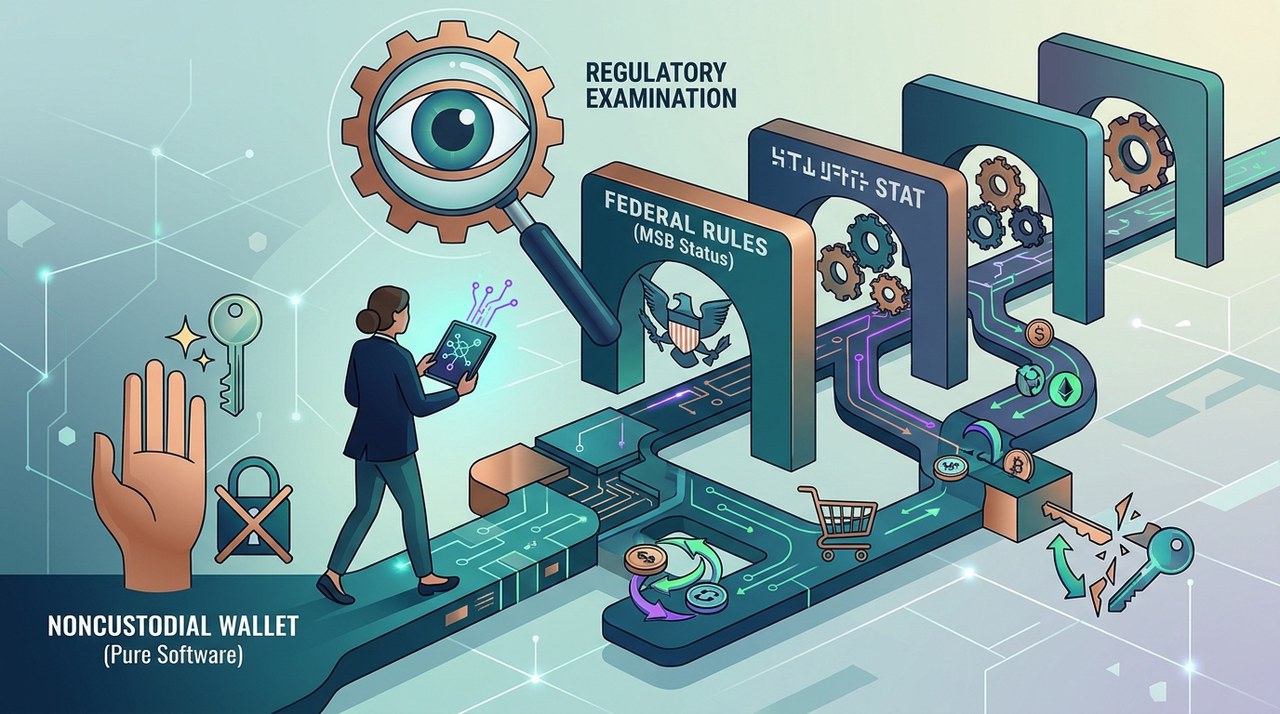
The Noncustodial Label: Why Marketing Terms Are Not Enough
Imagine your startup builds a new crypto wallet app. Your users sign every transaction on their own devices, and your servers never hold their private keys.
Naturally, your team describes the wallet as a noncustodial product. You assume this label exempts your company from money transmitter licensing rules.
Later, your developers add new features. You launch wallet recovery tools, integrated token swaps, and a checkout feature for merchants.
Does your business still count as a pure software project? Or have you started operating a regulated financial service?
Simply calling your business noncustodial does not settle the issue. Regulators look past marketing labels to examine your actual transaction flows, authority over funds, and operational controls.
Federal vs. State Rules: Two Separate Regulatory Hurdles
To determine whether your crypto application needs a license in the United States, you must address two separate regulatory frameworks.
At the federal level, the key issue is whether your business is a Money Services Business (MSB) under the Bank Secrecy Act.
Under federal regulations (31 C.F.R. § 1010.100(ff)(5)), money transmission generally means accepting currency or substitute value from one person and sending it to another location or recipient.
FinCEN classifies businesses based on specific facts and circumstances. If your company qualifies as an MSB, you must register federally and establish a written anti-money laundering (AML) program under 31 C.F.R. § 1022.210.
State authorization is a completely separate question. Federal registration does not fulfill state requirements.
For example, the New York Department of Financial Services explicitly states that registering with FinCEN does not determine whether your business needs a BitLicense.
Software Development vs. Financial Operations
Regulators draw a clear legal distinction between developing code and offering financial services.
In Administrative Ruling FIN-2014-R002, FinCEN clarified that creating and distributing software does not constitute accepting and transmitting value.
This distinction protects pure software developers whose applications help users handle their own digital assets.
Consider a wallet application that generates keys locally on a user's phone, lets the user approve transfers, and cannot move funds on its own. Its legal analysis focuses on software functions.
Now change the scenario. Suppose your company receives funds into a central wallet address, credits a customer balance, and forwards those assets to an address chosen by the customer.
Even if you label that app a noncustodial wallet, accepting and transferring assets requires a full money transmission analysis.
Evaluating Asset Authority and Emergency Controls
Stating that your company does not hold private keys is only a starting point for legal analysis.
Attorneys must examine recovery tools, smart-contract permissions, and partner arrangements. Essential questions include:
- Can your company authorize a transaction alone or through instructions to third parties?
- Can an administrator replace signers or alter withdrawal permissions?
- Do account recovery procedures give your team temporary access to customer assets?
- Can customers withdraw their crypto without needing your company's active cooperation?
- Could a smart-contract upgrade redirect customer funds or shift control over them?
- Does the customer hold assets directly on-chain, or do they hold a recorded balance with a service provider?
FinCEN's 2019 guidance on convertible virtual currencies demonstrates these subtle distinctions.
In Section 4.2.2, FinCEN explains that a limited multi-signature validation service does not transmit value and is not an MSB.
However, combining multi-sig validation with hosted wallet features alters the legal outcome. Regulators focus on ownership, payment system interaction, and independent control rather than brand labels.
Analyzing Swaps, Payments, and DeFi Services
A single wallet interface can host several legally distinct features. Basic asset storage carries different legal risks than built-in token swaps, payments, or settlements.
For integrated swaps, you must map out who receives each asset, who supplies liquidity, who contracts with the user, and who settles the transaction.
For merchant payment products, determine whether your app only provides checkout software or actively receives and forwards customer payments.
Do not assume you qualify for a payment processor exception. Federal rules require meeting specific criteria, such as operating through a clearing and settlement system under contract with the seller.
Decentralized finance (DeFi) tools require similar careful analysis.
In Sections 4.4 and 5.2.2 of its 2019 guidance, FinCEN distinguishes between creating an application and actively deploying it to conduct money transmission. Owners and operators can face regulatory obligations if a decentralized application performs money transmission.
How State Laws Differ: New York vs. California
State laws often define regulated activities differently than federal regulations.
New York's BitLicense framework acknowledges that distributing pure self-custody wallet software does not require a license. However, New York regulates exchange services and transmission activities beyond custody.
California's Digital Financial Assets Law (DFAL) uses unique definitions. Under California Financial Code § 3102(c)(1), transaction control includes the power to execute a transaction unilaterally OR block it indefinitely.
Therefore, even if your business cannot move user assets alone, having the technical ability to block transactions indefinitely can trigger regulatory oversight in California.
California provides specific exemptions under Financial Code § 3103(b)(7) for software connectivity, computing power, data storage, or security services. But if you combine technical infrastructure with regulated financial features, both components must be evaluated.
Best Practices: Audit Before Launch and Review Product Updates
A thorough legal review starts with verified technical documentation: transaction flow diagrams, signing permission structures, recovery protocols, admin controls, user agreements, vendor contracts, and target jurisdictions.
Always document failed transactions and emergency procedures. Standard operational diagrams often miss the exact moments when a business gains temporary control over user assets.
It is also vital to keep track of regulatory updates. For instance, on October 6, 2026, FinCEN officially withdrew its proposed transaction reporting rule for unhosted wallets.
While that withdrawal eliminated a specific regulatory proposal, it did not create a general licensing exemption for self-custodial crypto platforms.
Any future product updates—such as adding fiat settlement, changing recovery mechanisms, or introducing new exchange mechanisms—should trigger a fresh legal evaluation.
About Law and Ledger
This article was written by Guest Author Michael Handelsman for Kelman.Law and published on November 1, 2026. Law and Ledger is a news segment focusing on digital asset commerce and legal developments.
Kelman PLLC provides legal assistance to crypto businesses navigating MSB registration, Bank Secrecy Act compliance, and state money transmitter licensing.
Attorney Advertising: This article provides general information and does not constitute formal legal advice. Legal requirements depend on your specific business model and facts. Contacting Kelman PLLC does not create an attorney-client relationship.
Latest blog posts

Can Playing GTA 6 Really Save You $5,000?
Millionaire investor Mark Tilbury claims buying GTA 6 could save players $5,000 by swapping expensive nights out for gaming at home.

Family Sells $3 Yard Sale Bowl for $2.2 Million at Auction
An upstate New York family bought a small ceramic bowl for $3 at a tag sale and used it as living room decor for years before discovering it was a 1,000-year-old Chinese masterpiece worth millions.


1.8 Billion XRP Moved? What On-Chain Data Really Tells Us
Reports show 1.8 billion XRP moved in 24 hours. Here is what the data actually says about XRP Ledger health and network activity.
|