DeFi 201: How Connected Protocols Work Together
What Is DeFi 201 and Why Does It Matter?
Have you ever wondered how decentralized financial applications interact behind the scenes? Basic crypto guides usually show you how to set up a digital wallet or make a simple token swap. However, understanding the true power of decentralized finance requires looking under the hood.
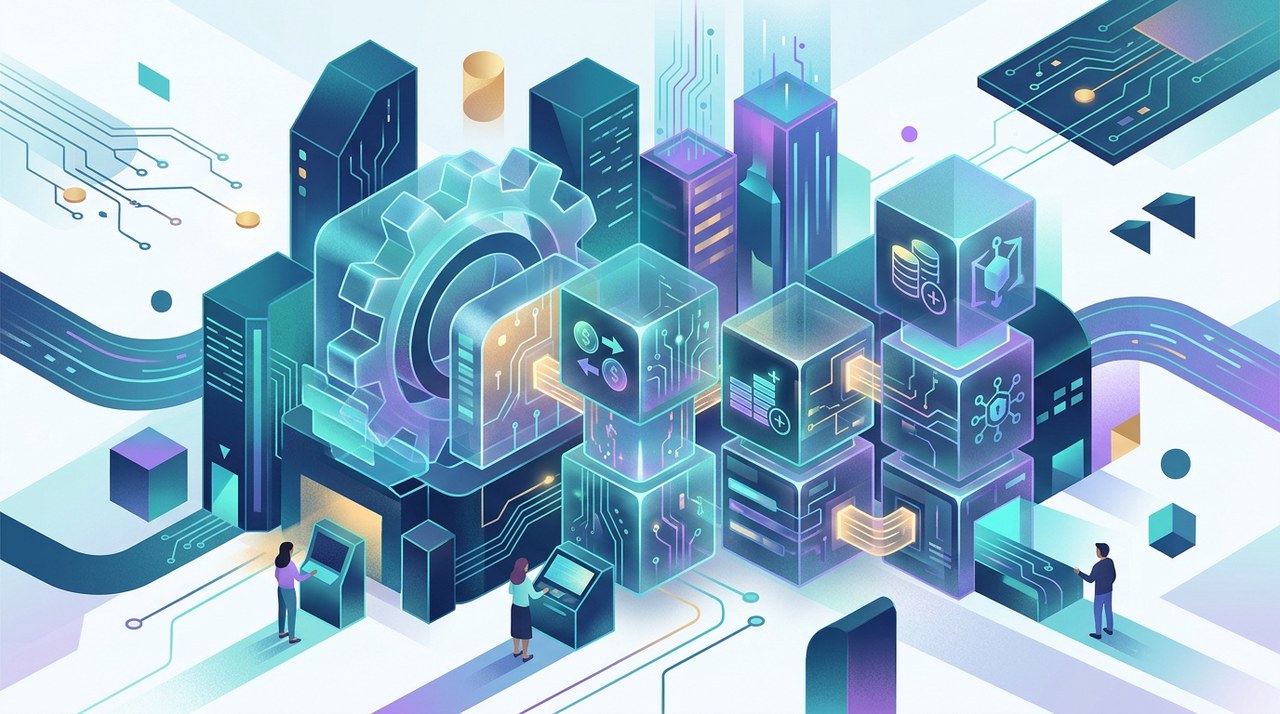
DeFi 201 shifts the focus from individual applications to the entire financial ecosystem. It explains how independent smart contracts connect like gears in a clock. By combining trading engines, lending pools, and automated tools, developers create a permissionless financial system.
The Magic of Composability: DeFi's Money Legos
The foundation of advanced DeFi is a concept known as composability. Industry experts often describe composability using the analogy of digital Money Legos.
In traditional banking, financial institutions operate in isolated siloes. A loan application at one bank cannot easily interact with an investment portfolio at another bank without complex manual processing.
In contrast, open-source smart contracts on blockchains communicate seamlessly. Developers can snap existing protocols together to build entirely new financial services without needing approval from a central authority.
Decentralized Exchanges (DEXs) and Automated Market Makers
At the heart of decentralized trading are Decentralized Exchanges, commonly known as DEXs. Traditional platforms rely on centralized order books that match individual buyers with individual sellers.
DEXs eliminate order books by utilizing Automated Market Makers (AMMs). AMMs rely on smart contracts and mathematical formulas to determine asset prices dynamically based on market demand.
- Peer-to-Contract Swaps: Users trade directly against smart contracts instead of waiting for a counterparty.
- Deterministic Pricing: Prices adjust automatically using supply ratios within asset pools.
- Non-Custodial Control: Traders retain full custody of their private keys throughout the swap process.
Liquidity Pools: Fueling Decentralized Commerce
Automated Market Makers cannot function without digital liquidity. This liquidity is provided by network participants known as Liquidity Providers (LPs).
LPs deposit equal values of two or more tokens into a shared smart contract called a liquidity pool. These pools enable instant token exchanges for traders on the platform.
In exchange for supplying capital, LPs receive trading fees generated by the market. However, liquidity providers face potential risks like impermanent loss when asset prices fluctuate heavily during periods of market volatility.
Decentralized Lending and Borrowing Markets
Decentralized lending protocols replicate standard banking loans without requiring credit checks or identity verification. Anyone with an internet connection can access these credit markets.
Lenders supply tokens into interest-bearing pools, making capital available to borrowers. Borrowers can then draw funds from these pools by providing crypto assets as collateral.
To protect lenders against defaults, loans must be over-collateralized. If a borrower's collateral value drops below a pre-set threshold, the protocol automatically liquidates the collateral to cover the debt.
Yield Aggregators: Putting Strategies on Autopilot
Managing funds across DEXs, liquidity pools, and lending applications manually can be time-consuming and expensive due to network gas fees.
Yield aggregators address this challenge by automating investment movements through programmed smart contract vaults. These vaults continuously shift user funds toward protocols offering higher optimized yield efficiency.
While yield aggregators streamline portfolio optimization, they also combine the risks of every underlying platform interacted with in the strategy.
Blockchain Oracles: Connecting Off-Chain Data
Blockchains are isolated, self-contained networks. By default, smart contracts cannot look outside their native environment to check real-world information like current market prices.
Oracles serve as secure digital bridges that deliver real-time external data onto the blockchain. Lending platforms rely heavily on price oracles to calculate collateral values accurately.
If an oracle feeds incorrect or delayed pricing data, smart contracts may trigger unintended liquidations or expose protocols to arbitrage exploits.
Crypto Derivatives: Advanced Financial Products
Decentralized finance extends beyond spot swapping and basic lending to include financial derivatives such as perpetual futures, synthetic assets, and decentralized options.
These instruments allow market participants to hedge exposure or speculate on price movements with leverage.
Because on-chain derivatives rely on continuous oracle feeds and deep liquidity, high market volatility can lead to fast liquidations for leveraged traders.
DAO Governance: Community Protocol Management
Who controls the parameters of these connected financial systems? Most protocols are managed by Decentralized Autonomous Organizations, or DAOs.
Governance token holders submit proposals and vote on crucial protocol decisions, such as adjusting collateral ratios, changing fee structures, or deploying smart contract upgrades.
DAO governance ensures that protocol changes remain transparent, open, and driven by community consensus.
The Dark Side of Composability: Systemic Risk
While composability fosters rapid innovation, it creates a tightly coupled system where a single point of failure can destabilize multiple applications.
When protocols rely on each other, a flaw in one base protocol can trigger a domino effect across the connected network.
- Oracle Exploits: Manipulated price feeds can cause unfair liquidations across multiple lending platforms.
- Smart Contract Bugs: A vulnerability in an underlying vault can impact yield aggregators relying on it.
- Cascade Liquidations: Rapid price drops can trigger automated liquidations that push prices down further across DEXs.
Evaluating DeFi Protocols Responsibly
Understanding how protocol layers fit together empowers participants to make better-informed decisions while navigating decentralized finance.
When assessing DeFi protocols, it is essential to look beyond advertised features and evaluate smart contract security audits, oracle reliability, and system dependencies.
Past performance of digital assets or past operational results do not guarantee future returns or operational results.
Latest blog posts


Judge Orders Bitcoin Wallet Returned to Convict's Family
A Canadian court has ordered a Bitcoin wallet returned to a family, as crypto prediction markets evaluate potential price targets.
|
Can We Mine Bitcoin in Space? Elon Musk's Big Idea
Elon Musk suggested placing data centers in space. While mining Bitcoin in orbit is technically possible, high launch costs make it impractical today.
|

Solana Co-Founder Names Top Threat to Crypto Security
Solana co-founder Anatoly Yakovenko warns that phishing and social engineering pose far greater risks to crypto holders than advanced math-breaking AI or quantum computers.
|