
Can We Mine Bitcoin in Space? Elon Musk's Big Idea
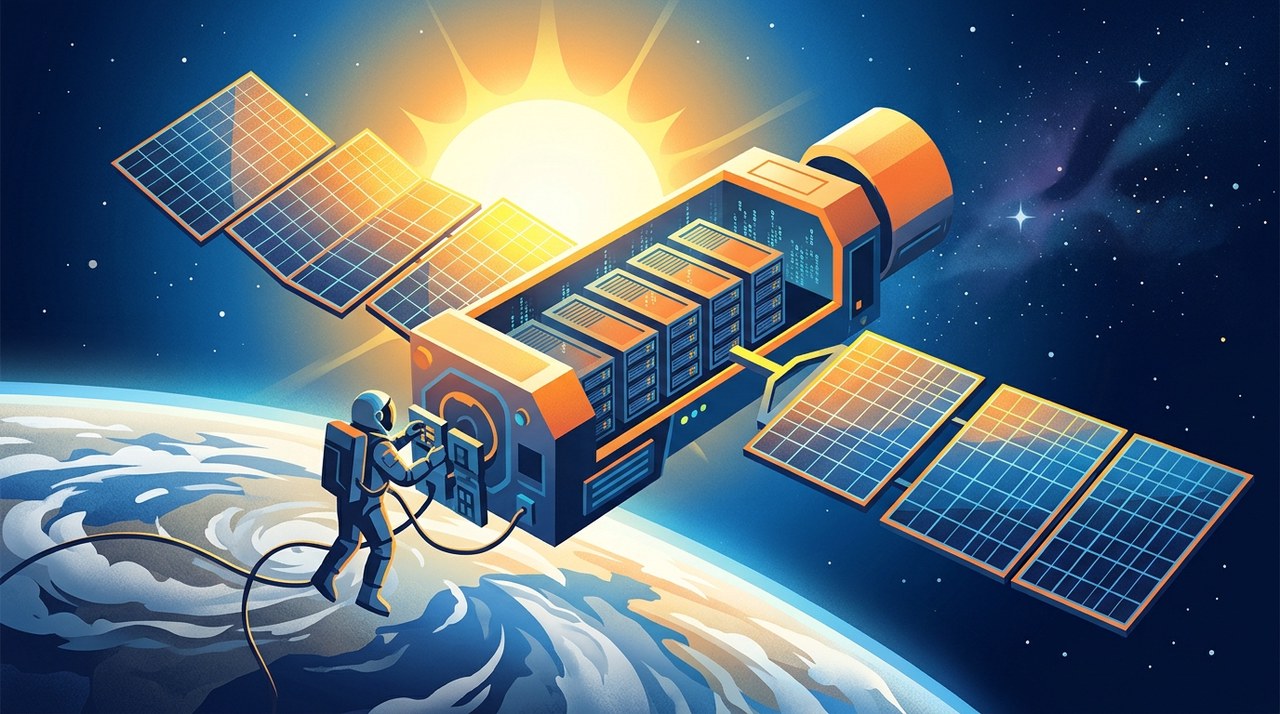
Elon Musk Sparks a Cosmic Idea for Data Centers
Imagine sending supercomputers into space to mine crypto powered entirely by the Sun. It sounds like science fiction, doesn't it? But tech billionaire Elon Musk recently got people talking about this exact concept.
On November 4, 2026, Musk shared a brief post on X (formerly Twitter) stating: "Data centers in space look pretty appealing right now."
While Musk was speaking broadly about data centers, the crypto community quickly wondered whether Bitcoin (BTCBTC+1.80%) Application-Specific Integrated Circuit (ASIC) mining rigs could also operate in orbit. Let's break down how this idea works, why it sounds amazing, and why it is much tougher than it looks.
The Major Advantage: Unlimited Solar Energy in Orbit
Mining Bitcoin requires significant electrical energy because hardware works around the clock solving complex mathematical puzzles. On Earth, mining farms rely heavily on local electrical grids or dedicated renewable energy installations.
Space presents a unique advantage: uninterrupted access to solar power.
- Constant Sunlight: Satellites in orbit can draw continuous power from sunlight, reducing the need for heavy battery storage systems.
- No Grid Dependency: Space-based setups do not rely on local energy utilities or fluctuating regional electricity prices.
- 24/7 Mining Potential: In theory, ASIC miners could run continuously powered purely by the Sun with zero ongoing power bills once operational.
The Cooling Challenge: Heat Management in Space
You might assume space is ideal for keeping computers cold because cosmic background temperatures are freezing. However, cooling hardware in space is actually far more difficult than doing so on Earth.
On Earth, mining facilities dissipate heat using fans, air conditioning, or liquid immersion tanks that transfer heat into the surrounding air. In space, there is a vacuum with no air at all to carry heat away.
The only way to release heat in a vacuum is through thermal radiation. That requires massive radiator panels that emit excess heat as infrared radiation.
According to estimates by the Boston Consulting Group (BCG), a 100-kilowatt orbital data center would need roughly 400 square meters of radiator panels just to keep the mining rigs from overheating.
High Rocket Launch Costs and Maintenance Hurdles
Even if heat management issues are solved, the financial math presents a major roadblock. Launching physical equipment from Earth into orbit remains extremely expensive.
Data from the Boston Consulting Group indicates that launching payloads into orbit currently costs around $1,500 per kilogram.
Here is how those costs break down for a space-based mining facility:
- Launch Expenses: Sending a modest 1-ton (1,000 kg) mining setup into space would cost about $1.5 million in launch fees alone.
- Hardware Costs: That $1.5 million figure excludes the purchase price of ASIC miners, solar arrays, cooling panels, and power management equipment.
- Maintenance Limits: If a machine breaks down on Earth, a technician can swap parts in minutes. In space, broken components cannot easily be repaired or replaced.
- Radiation Exposure: Harsh cosmic radiation can degrade microchips over time, shortening hardware operational lifespans.
The Data Advantage: Low Bandwidth Needs
While transferring large files from space can be challenging, Bitcoin mining has a unique structural advantage in terms of network communication.
Bitcoin miners do not need heavy internet bandwidth. They only need to receive new block templates and transmit small, solved block hashes back to the network.
Because the data footprint for mining is minimal, existing satellite internet connections can handle the required communication without creating major bottlenecks.
Could Space Mining Become Economically Feasible Later?
Physically, operating Bitcoin mining equipment in orbit is possible today. Economically, however, ground-based mining in traditional data centers remains far more practical and cost-effective.
For orbital mining to become financially practical in the future, several technical advancements need to occur:
- Lower Launch Costs: Continued developments in reusable rockets could significantly reduce the cost per kilogram to launch payloads.
- Lighter Radiator Technology: Next-generation cooling materials could reduce the weight and size of thermal management systems.
- More Efficient ASIC Chips: Advanced mining chips that deliver higher hash rates per watt would increase output relative to hardware weight.
Final Thoughts on Orbital Mining
Elon Musk's comment highlights an exciting concept for the future of infrastructure. However, for Bitcoin mining, high rocket launch fees and thermal cooling challenges keep orbital rigs firmly in the theoretical phase for now.
As with all crypto developments, market participants should evaluate technical trends and market conditions carefully. Past performance of digital assets is not a guarantee of future returns. You can view current market information on Bitkub Market BTC.
Latest blog posts

Judge Orders Bitcoin Wallet Returned to Convict's Family
A Canadian court has ordered a Bitcoin wallet returned to a family, as crypto prediction markets evaluate potential price targets.
|

Solana Co-Founder Names Top Threat to Crypto Security
Solana co-founder Anatoly Yakovenko warns that phishing and social engineering pose far greater risks to crypto holders than advanced math-breaking AI or quantum computers.
|
Justin Sun Seeks $264K Sanctions in World Liberty Dispute
Justin Sun plans to refile his token-freeze lawsuit in California state court after resolving a $264K sanctions motion against World Liberty.