

Bitcoin's $19B Flash Crash: Has Crypto Learned Its Lesson?
A Sudden Shock to the System
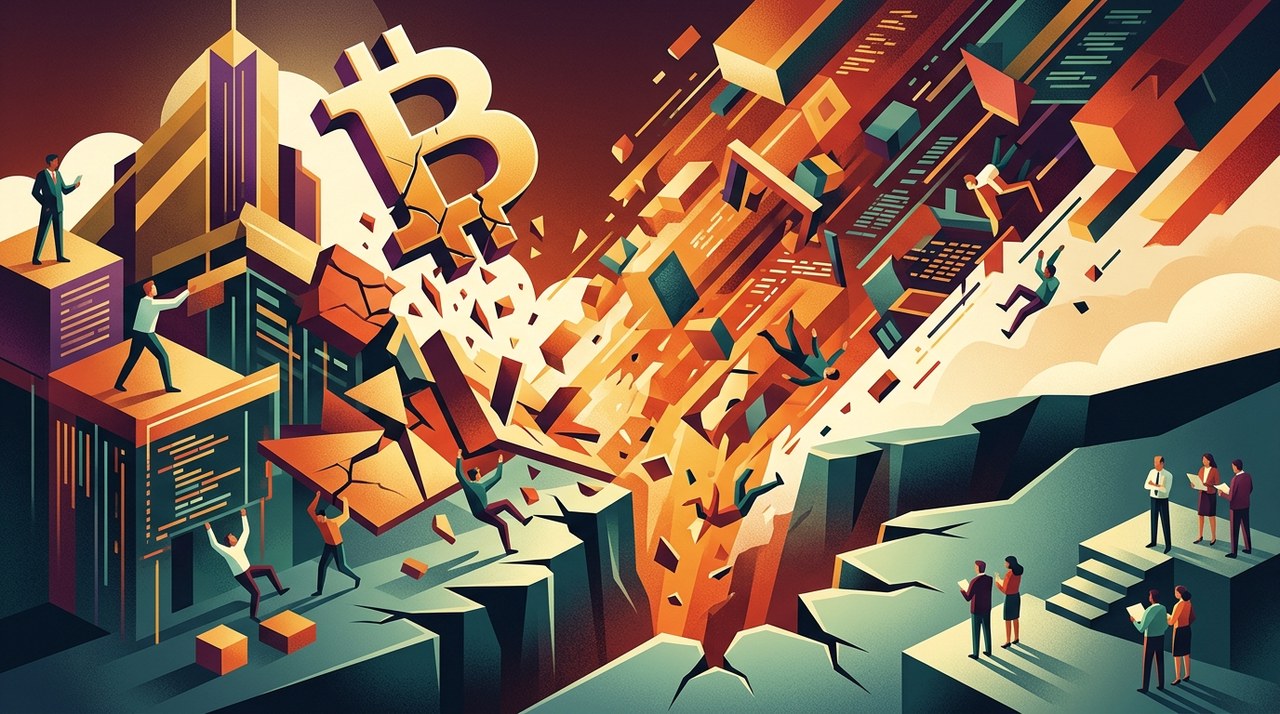
On October 10, 2025, the cryptocurrency market experienced one of its sharpest selloffs in recent history. Just days after BitcoinBTC-0.66% reached a new record high above $126,000, its price suddenly dropped from around $122,000 to $105,000.
Much of this dramatic fall took place within minutes. The sharp plunge triggered roughly $19 billion in forced liquidations across trading platforms, catching thousands of optimistic traders completely off guard.
Past performance of digital assets or past performance does not guarantee future returns or performance. You can review historical market price data anytime on bitkub.com/th/market/BTC.
One year after that dramatic market shakeout, analysts are reflecting on a key question: Have crypto traders adopted better risk management, or do the same market forces remain?
What Driven the $19 Billion Liquidation Cascade?
To understand why the selloff was so intense, it helps to examine trader positioning right before the event. For months leading up to October 2025, market sentiment had been overwhelmingly bullish.
Many traders had taken on high amounts of leverage, borrowing funds to amplify potential returns. They operated on the assumption that Bitcoin would follow historical post-halving patterns to set higher records.
It just was a very quick and violent market top that we did not expect. Positioning was important then, and it's important today.
That observation comes from Mark Connors of Risk Dimensions, who previously managed hedge fund products at Credit Suisse. He pointed out that open interest—the total value of outstanding derivative contracts—was sitting near historic highs prior to the move.
When prices dipped slightly, automated exchange risk mechanisms began liquidating under-collateralized positions. This created a chain reaction, where forced selling pushed prices lower and triggered additional liquidations.
Paper Bitcoin vs. On-Chain Reality
A key takeaway from the event is that short-term price movements are often dictated by derivatives markets rather than on-chain transaction activity.
Connors highlighted that the selloff was not caused by changes in fundamental on-chain data. Instead, it was driven by paper contracts like perpetual futures, which allow traders to speculate on price moves without holding the underlying Bitcoin.
The movement was obviously not onchain data. I mean, it was all derivatives. So paper bitcoin again is alive and well and governs the near term.
Using high leverage can multiply prospective gains during upward moves, but it also increases the risk of rapid liquidations during market declines.
Are Market Risk Factors Still Present Today?
One year later, the trading mechanics behind the crash remain active. Perpetual futures continue to account for a significant share of total crypto trading volume.
Trading venues also have financial incentives to maintain leveraged offerings, as transaction volume generates fee revenue. Because these products remain widely used, sharp price fluctuations driven by leverage remain possible.
Connors noted that similar liquidation events could occur again in the future because leveraged trading options remain central to overall market activity.
Better Visibility into Market Structure
While leverage risks persist, market participants now have access to improved analytical tools to track systemic leverage in real time.
Data platforms provide clearer visibility into exchange order books, open interest levels, and funding rates, allowing traders to observe when positioning becomes overly skewed.
Connors noted that enhanced data visibility helps clarify overall market structure, giving traders better tools to evaluate risk during volatile periods.
Steps Recommended by Market Analysts
Chris Sullivan, co-founder of Hyperion Decimus, outlined practical risk-management principles for navigating leveraged markets:
- Limit Leverage: Reducing or avoiding borrowed capital significantly lowers the probability of forced liquidation.
- Track Open Interest: Monitoring the volume of open derivative positions helps identify when the market carries elevated debt levels.
- Observe Funding Rates: Extreme positive or negative funding rates indicate heavily one-sided sentiment in perpetual futures.
- Exercise Patience: Waiting out periods of extreme sentiment can help investors avoid reactive decisions.
For long-term spot investors, Sullivan suggested utilizing self-custody by moving assets off trading platforms into personal wallets.
Holding assets directly removes platform dependency and protects spot positions from the liquidation dynamics seen on derivatives exchanges.
Evaluating the Four-Year Halving Cycle
The 2025 selloff also prompted a re-evaluation of Bitcoin's historical four-year halving cycle model.
Historically, traders expected predictable post-halving price cycles. Before the crash, some analysts discussed optimistic targets ranging between $250,000 and $400,000 based on past data.
However, those projections relied on favorable macroeconomic assumptions and uninterrupted market liquidity. When leverage rapidly unwound, prices corrected downwards instead.
Any price projections carry significant downside risks and depend on external economic conditions, including central bank policies, global liquidity, and geopolitical developments.
The four-year cycle is not dead; it has changed, and we can't rely on it for as much signal as we have in the past.
Connors emphasized that broader macroeconomic forces now play a substantial role alongside internal supply dynamics like the halving.
Wider Ecosystem Trends and Developments
Beyond derivatives markets, several notable developments are shaping the digital asset landscape:
- Changing Volatility Dynamics: While Bitcoin's multi-year volatility has trended lower overall, short-term price spikes occur with higher frequency than in 2018.
- Real-World Asset (RWA) Yields: Yields on real-world asset stablecoins maintain around 5% to 7% from credit markets, compared to compressed crypto funding yields around 4%.
- Layer-2 Activity Changes: Networks like Robinhood Chain have seen transaction and trading volumes decline by over 40% amid changing user activity.
- Institutional and Consumer Adoption: A Visa study indicated that nearly half of consumers in the Asia-Pacific region are open to using stablecoins by 2031.
- Regulatory Oversight: Regulatory bodies like the U.S. CFTC are moving to classify event contracts under swap regulations, while former Celsius CEO Alex Mashinsky reached a $35 million legal settlement including a lifetime industry ban.
- Security Inspections: Hardware wallet producer Ledger investigated reports of device tampering following reports of an $86 million security incident.
- Legal Disputes: DWF Labs subsidiaries filed a $141 million lawsuit against BitGo concerning an alleged token lock-up disagreement.
- Protocol Upgrades: The XRPXRP+0.38% Ledger successfully patched a long-standing protocol bug, while Zcash developers set a target for quantum-resistant updates.
Conclusion
One year after the $19 billion liquidation event, the crypto market exhibits both improved analytical awareness and persistent structural risks.
While traders now possess better tools to analyze leverage and derivatives positioning, the underlying financial products that drove the selloff remain active.
Understanding market structure and managing risk exposure remain central principles for navigating digital asset markets responsibly.
Latest blog posts

Critical XRP Ledger Bug Fixed Before Tokens Were Minted
Developers patched a severe XRP Ledger bug that could have allowed bad actors to generate unlimited XRP tokens out of thin air.
|

Ripple Prime Wins Major Honor at 2026 Hedgeweek US Awards
Ripple's institutional division, Ripple Prime, has been named Prime Broker of the Year: EMEA at the 2026 Hedgeweek US Awards.
|

Strive Follows Strategy Playbook to Raise Cash for Bitcoin
Strive raised an estimated $55 million through its preferred stock in a single week, generating enough capital to purchase approximately 638 Bitcoin.
|