


Bitcoin Loans Now Funding Tuition, Businesses, and Everyday Life
Beyond Trading: Bitcoin Loans Go Mainstream
Imagine owning a valuable property like a home or a rare painting. If you suddenly needed cash to cover a family medical emergency or fund your child's university education, you probably wouldn't sell the house immediately. Instead, you would likely look into taking out a loan against it. That exact financial strategy is now taking off in the world of digital assets.
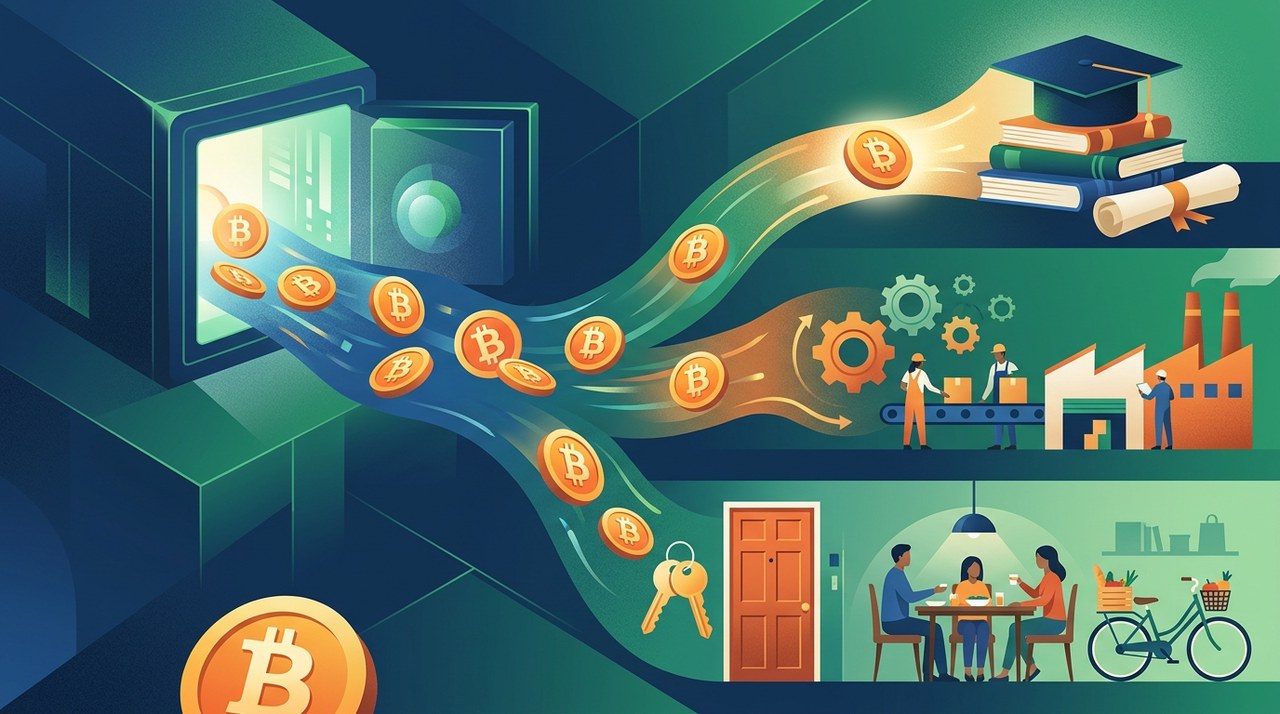
On October 8, 2026, major cryptocurrency lenders revealed that borrowing habits among digital asset holders are undergoing a massive transformation. Rather than using borrowed funds to make fast, high-risk market trades, an increasing number of individuals are using Bitcoin (BTCBTC-0.74%) as collateral to cover real-world expenses. These range from college tuition fees and business working capital to slow operational months and major personal purchases.
At the time of reporting, Bitcoin traded around $83,207.05. While borrowing allows holders to unlock cash without giving up their crypto, digital assets remain volatile. If the underlying asset price drops significantly during the loan term, borrowers face distinct risks, including margin calls or liquidations.
Real-World Expenses: Tuition, Cash Flow, and Big Life Events
Hunter Albright, the Chief Revenue Officer at SALT Lending, explained that recent customer conversations and internal transaction data both point to the same trend: everyday people are increasingly using crypto credit to manage their actual living costs.
"What I am seeing, both in the conversations I'm having and in the data, is that more people are starting to borrow against their Bitcoin for real-world needs. That includes emergency expenses and larger life decisions, such as funding college tuition or a once-in-a-lifetime trip. We also see people using it to supplement their cash flow," said Hunter Albright, Chief Revenue Officer of SALT Lending.
This shift represents an important milestone for alternative finance. In the early days of crypto, borrowing was almost exclusively used by active traders seeking leverage. Today, Bitcoin is serving a role far more similar to traditional bank credit, making digital assets significantly more functional for mainstream users.
Who Is Borrowing and Why?
SALT Lending first began offering Bitcoin-backed loans back in 2016. In its early days, the platform's core clientele consisted primarily of Bitcoin miners—the network operators who run specialized computer hardware to secure the blockchain in exchange for BTC rewards. Over time, that demographic expanded dramatically.
Today, SALT works with a mix of institutional borrowers as well as retail users, including Gen Xers and BabyBABY+0.00% Boomers who hold Bitcoin and want clear guidance on how to navigate the loan process.
Another prominent lender, Ledn, has observed similar adoption trends since launching in 2018. To date, Ledn has facilitated over $11 billion in loans. The platform projects its cumulative lending volume could eventually scale toward $1 trillion as borrowing for non-trading purposes becomes routine.
Past performance disclaimer: Past returns of digital assets or operational records of lending platforms do not guarantee future performance or results. Investors can check live market data directly at bitkub.com/th/market/BTC.
Institutional Players vs. Everyday Borrowers
Adam Reeds, co-founder and CEO of Ledn, highlighted how diverse the borrower community has become across different client segments.
"Our borrowers range from traditional investors seeking to get more from their bitcoin position, to entrepreneurs who want to access working capital, to institutional players," noted Adam Reeds, co-founder and CEO of Ledn.
Reeds pointed out that Ledn's private wealth clients typically borrow larger amounts to fund significant financial moves—such as commercial real estate transactions, business expansions, or higher education for their children. On the other hand, retail borrowers tend to pull smaller amounts to manage short-term liquidity needs, like covering expenses during a slow month when primary income temporarily falls short.
The Strategy: Hold Bitcoin While Accessing Cash
Why choose to borrow against Bitcoin rather than simply selling a portion of it? The core motivation comes down to maintaining long-term market exposure while accessing liquidity.
When investors sell their Bitcoin to raise cash, they give up their holdings completely and may trigger taxable capital gains. By locking up BTC as collateral instead, borrowers get cash in hand while keeping ownership of their underlying digital assets.
Albright noted that SALT's primary philosophy has remained unchanged since its inception: "We don't believe people should have to sell their most valuable assets to get the value out of it."
Reeds echoed this sentiment when describing why clients routinely renew their loans rather than paying them off by selling their collateral.
"People borrow against their bitcoin because they believe it will be worth more in the future, and they also want to be certain they'll get it back. Most clients renew their loans, because the whole premise of this type of lending is not selling bitcoin and continuing to hold the position," Reeds explained.
However, borrowing against volatile assets carries important scenario-based risks. If Bitcoin's market price drops during the loan period, the value of the collateral backing the loan decreases. If it falls below required loan-to-value thresholds, borrowers must post additional collateral or repay part of the balance to prevent their assets from being liquidated.
Albright added that taking credit against major assets is a financial strategy that ultra-wealthy individuals and large corporations have used for centuries. Cryptocurrency-backed loans are now democratizing this strategy, making it available to a far broader audience based on the assets they hold.
Moving Toward Fixed Rates and Predictable Terms
For crypto lending to truly align with mainstream financial habits, predictability is essential. Traditionally, crypto loans relied heavily on variable interest rates that adjusted frequently based on market conditions, making long-term planning tricky for everyday borrowers.
To solve this, lenders are actively developing fixed-rate financial products. SALT aims to make crypto credit operate more like traditional mortgages, offering predictable repayment structures over longer periods.
"Our ultimate goal is to have loan products behave much more like a mortgage, where someone can take out a loan, at a fixed rate over a longer term and have greater predictability around the cost of borrowing, even while Bitcoin remains volatile," Albright said.
Major industry platforms are already adopting this approach. On September 22, 2026, Coinbase integrated fixed-rate Bitcoin-backed loans into its retail application using MorphoMORPHO+5.54%'s Midnight protocol. Through this feature, users can lock up BTC to borrow USD Coin (USDCUSDC+0.03%) with fixed interest rates and set repayment dates agreed upon from the start.
This new fixed-rate offering complements Coinbase's existing variable-rate options on Morpho, which manage over $1.4 billion in active loans backed by roughly $3 billion in collateral. While Coinbase's current fixed-rate terms are relatively short-dated, SALT is focusing on developing options designed for much longer durations.
Expanding Beyond Bitcoin to Gold and Hard Assets
Looking ahead, credit providers expect this collateral model to expand beyond digital currencies to include physical hard assets—most notably gold.
Reeds pointed out that while gold represents a $20 trillion asset class globally, everyday gold owners historically had few options to borrow against their holdings without selling them.
"The next stage is lending against hard assets more broadly. Gold is the obvious next example. It's a twenty-trillion-dollar asset, yet borrowing against it has largely been an institutional privilege. For most everyday holders, the way to get cash from gold has been to sell it," Reeds noted.
As modern financial tools bridge physical and digital markets, investor mindsets are changing. "Our clients increasingly think in terms of hard assets they want to hold for the long term, and borrow against rather than sell," Reeds added.
Key Highlights Across the Crypto Market
Alongside developments in crypto-backed credit, several important events are shaping the broader cryptocurrency ecosystem:
- Bitcoin Price Moves: Bitcoin temporarily dipped below $83,000 as oil prices surged following reports surrounding potential military strike plans involving Iran.
- EthereumETH-1.47% Network Upgrade Testing: Ethereum's 'Glamsterdam' test runs achieved throughput near 200 million gas per block following platform upgrades, marking progress in blockchain scalability.
- Banking Liquidity Discussions: Banking giant Wells Fargo is in talks with Payward, the parent firm of exchange platform Kraken, regarding crypto trading liquidity.
- Stablecoin Integration: Polygon connected with TRON's $94 billion stablecoin liquidity pool to enable smoother cross-border monetary transfers.
- Central Bank Collaboration: The Central Bank of Kazakhstan engaged Tether to evaluate stablecoin deployment and asset tokenization frameworks.
- Cybersecurity Guidance: Europol issued a technical warning clarifying that quantum computing advances primarily threaten exposed private keys rather than underlying blockchain ledger security.
- Institutional Portfolio Shifts: Research reports indicate Ether may see changing institutional flows after Tom Lee stated that Bitmine plans to pause token purchases.
- Media Industry News: Media outlet Cointelegraph is searching for a buyer following a significant reduction in web traffic.
- APAC Regulatory Focus: A CoinDesk Research study commissioned by Ripple showed that the Asia-Pacific (APAC) region is fast becoming a key testing ground for regulated stablecoins such as RLUSD.
Summary for Prospective Borrowers
Borrowing against Bitcoin offers clear utility, but it requires thoughtful risk management. Here is a quick summary of factors to consider:
- Cash Liquidity: Borrowers can fund personal or business expenses while maintaining ownership of their digital assets.
- Tax Considerations: Borrowing against assets typically avoids triggering immediate capital gains tax obligations compared to outright sales.
- Market Risk: Crypto price drops can reduce collateral value, potentially triggering margin calls or asset liquidations.
- Loan Terms: Emerging fixed-rate loan options provide clear repayment expectations compared to variable-rate alternatives.
Latest blog posts


 +2
XRP Hits Lowest Weekly Close Since 2024: Key Levels to Watch
XRP recorded its lowest weekly close in two years at $0.97 as broader altcoin weakness continues to impact digital asset markets.
|
World Bank Taps Circle and Citi to Test Stablecoin Payments
The World Bank Group is partnering with Circle and Citi to test stablecoin technology for faster, transparent global fund disbursements.
|
Crypto Startup Valuations: Why 2021 Unicorns Face 70% Discounts
Private market data shows 2021 crypto unicorns trading at 50% to 70% discounts, while select industry leaders surge to new record highs.