


AI May Crack Crypto Encryption Soon, Warns Ethereum Researcher

A New Threat to Crypto Security
For years, digital asset experts have warned that quantum computers might one day crack the math behind cryptocurrency. But now, a leading researcher thinks artificial intelligence could beat quantum computers to the punch.
Justin Drake, a researcher at the EthereumETH-1.62% Foundation, published a startling warning on X on Wednesday, October 7, 2026. He urged the entire blockchain community to begin preparing for what he calls bunker mode.
The threat targets ECDSA (Elliptic Curve Digital Signature Algorithm). This is the underlying cryptographic system that both Bitcoin and Ethereum use to verify that a transaction was signed by the rightful owner of a wallet.
What Is 'Bunker Mode' and How Does It Work?
Drake is not telling anyone to sell their crypto or make wild moves. Instead, he recommends a calm, controlled migration of assets into brand-new addresses.
"Today I call upon the blockchain industry to calmly begin planning for 'bunker mode'. My personal recommendation is to set in motion a controlled mass migration of assets to fresh addresses, i.e. addresses whose pubkeys remain hidden behind a hash."
To understand why this helps, think of your wallet like a physical mailbox:
- Unused Fresh Address: Your public key stays hidden behind a cryptographic hash. Anyone can send funds there, but no one can see the raw public key.
- Used Address: The moment you sign an outgoing transaction, your raw public key becomes visible on the public blockchain network.
If an attacker can see your raw public key, advanced AI algorithms might eventually work backward to figure out your private key. Once they have your private key, they can drain your wallet.
Why AI Math Advances Are Accelerating the Timeline
Until recently, most experts believed breaking ECDSA would require powerful quantum computers—an event often called Q-Day. Drake previously thought Q-Day was years away.
However, rapid breakthroughs in artificial intelligence have changed his calculus. Drake noted that in the worst-case scenario, ECDSA could be broken in "months not years."
By "broken," Drake means an attacker using standard, available hardware—such as a large cluster of Graphics Processing Units (GPUs)—could recover a wallet's private key in about one week.
Drake pointed to recent breakthroughs in automated mathematics. On Tuesday, OpenAI published a cluster of 722 research results, demonstrating that long-standing assumptions about mathematical difficulty are falling rapidly.
"Elliptic curves feel especially vulnerable to superintelligence," Drake noted, pointing out that complex mathematical curves have structural shortcuts that advanced AI could exploit, unlike hash functions which are built to withstand those attacks.
Don't Panic: Recommendations for Users and Major Exchanges
Despite the dramatic warning, Drake emphasized that everyday users should remain calm. Protecting your assets does not require downloading complicated new wallets or adopting unproven tools right now.
He specifically urged major crypto platforms and custodians—including Binance, Bitbank, Robinhood, Bitfinex, and TetherUSDT-0.36%—to harden their cold storage setups by transferring funds to unexposed addresses.
What Is 'Satoshi's Shield'?
For individual investors holding smaller amounts, Drake highlighted a unique buffer he calls Satoshi's shield.
Bitcoin's creator, Satoshi Nakamoto, has roughly 20,000 exposed addresses created in the early days of Bitcoin, each holding 50 BTCBTC+0.78%. Because these addresses have visible public keys and massive value, any attacker who figures out how to break ECDSA would almost certainly target Satoshi's coins first.
This means wallets holding smaller amounts (under 50 BTC) would likely get an early warning signal if an exploit begins in the wild.
Quantum Risks and Ethereum's Long-Term Upgrades
Concerns over crypto encryption have been building throughout the year. Back in March, a paper published by Google researchers suggested quantum computers might overcome standard encryption faster than expected.
At that time, Drake estimated there was at least a 10% chance that Q-Day would arrive by the year 2032.
In response, the Ethereum Foundation established a dedicated post-quantum research team earlier this year. Ethereum co-founder Vitalik Buterin has also outlined clear roadmaps to transition the blockchain toward quantum-resistant signature systems.
Now, Drake wants to speed up that timeline dramatically, advocating for "maximum defensive acceleration" to transition Ethereum toward hash-based cryptography as fast as possible.
Key Takeaways for Crypto Holders
While security warnings can sound alarming, the crypto developer community is actively building solutions well before these threats become active exploits.
Here is a quick summary of what you need to know about this development:
- The Risk: AI and superintelligence could potentially find shortcuts in ECDSA math, making revealed public keys vulnerable to private key recovery.
- The Immediate Fix: Keep assets in fresh addresses that have never sent an outgoing transaction, hiding the raw public key behind a hash.
- The Long-Term Solution: Major networks like Ethereum are working to upgrade their foundational protocols to quantum- and AI-resistant cryptography.
- No Need to Panic: Everyday users do not need to rush or make sudden transactions; the advice is to plan carefully and maintain good security habits.
Latest blog posts

 +2
+2Trump's Iran Pledge Eases Markets as Bitcoin Holds $82K
Bitcoin stabilized near $82,600 after political statements reduced immediate military concerns, easing pressure across crypto and traditional stock markets.
|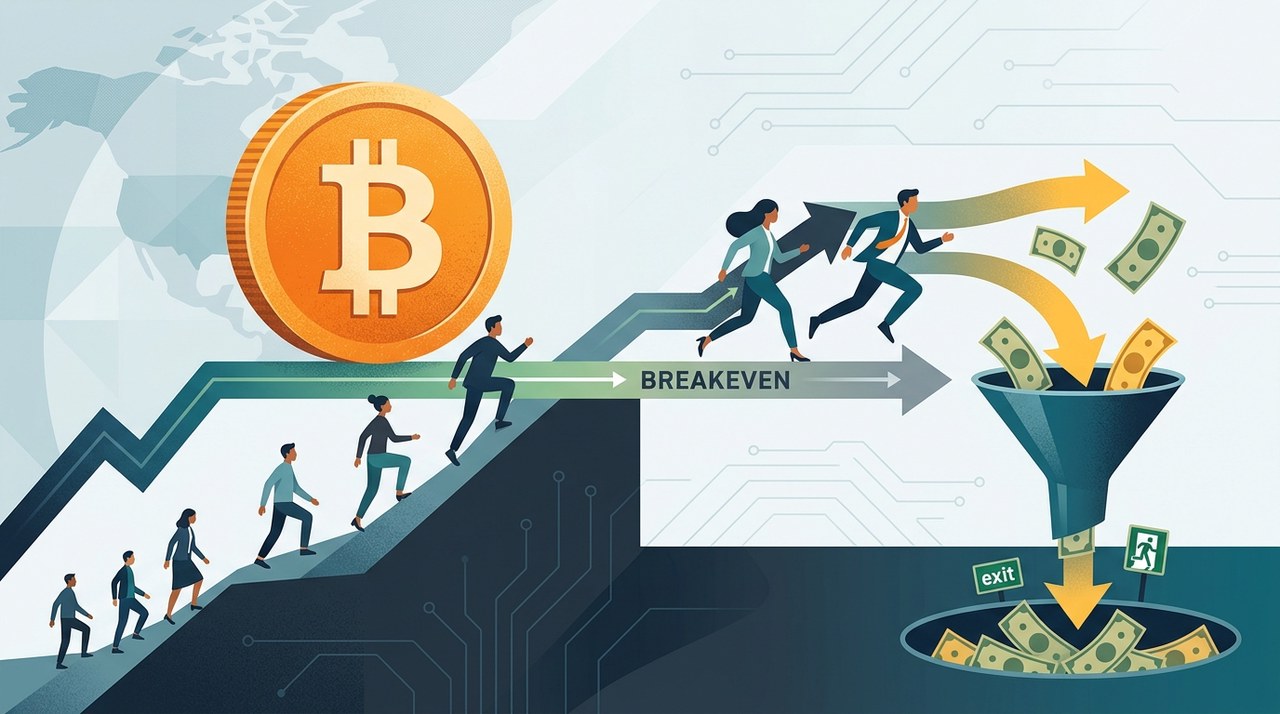
Bitcoin ETF Holders Cash Out $729M Near Breakeven
US spot Bitcoin ETFs saw $729 million in outflows over two sessions as prices touched the estimated average cost basis of $81,722.
|

Crypto Liquidations Top $1B: What It Means for Bitcoin
Over $1 billion in crypto trades were liquidated in 24 hours. Here is what caused the massive flush and what to watch next for Bitcoin.
|