
18 Years of Bitcoin: Can Satoshi's Creation Survive What Comes Next?
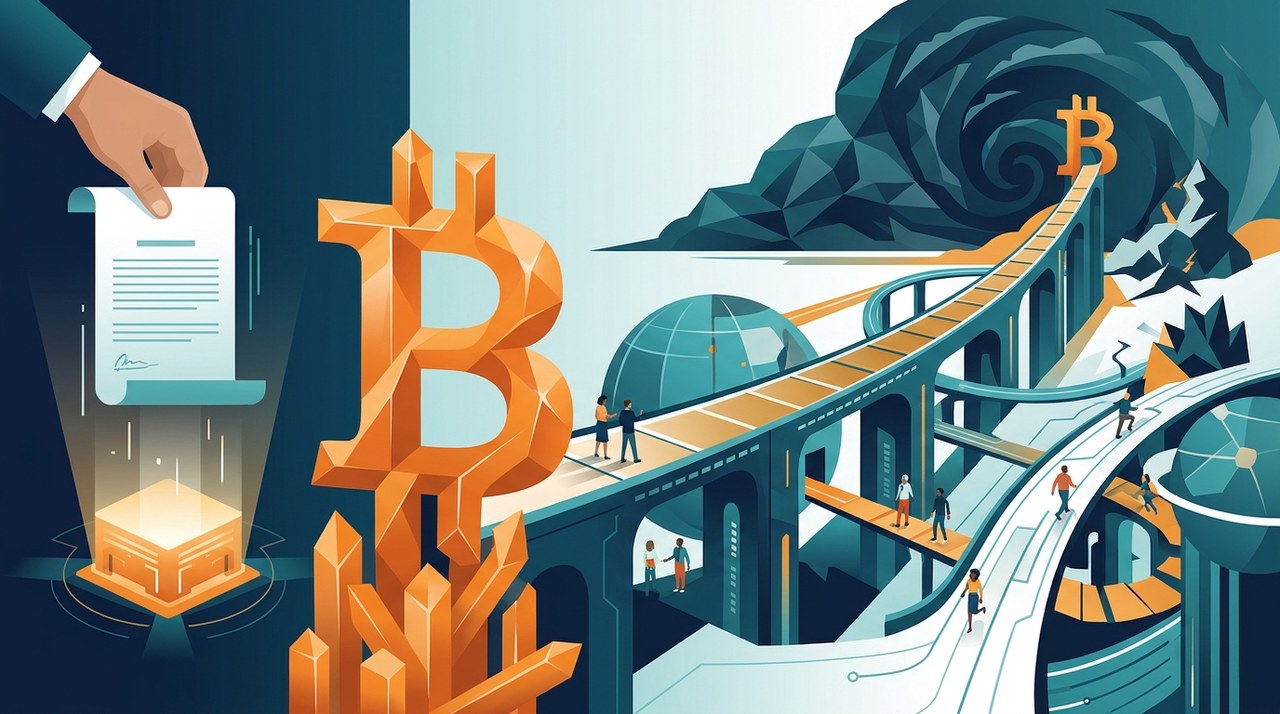
18 Years Since the Whitepaper: How Bitcoin Got Here
Imagine launching a project, walking away from it forever two years later, and watching it grow into a global financial network worth well over a trillion dollars. That is the exact story of Bitcoin. On October 31, 2008, an anonymous developer or group using the pseudonym Satoshi Nakamoto published a simple nine-page document titled Bitcoin: A Peer-to-Peer Electronic Cash System. Today marks the 18th anniversary of that historic whitepaper release.
Over these eighteen years, Bitcoin has matured from an obscure computer science experiment into a major asset class. At recent market levels, Bitcoin has traded near $77,330, giving the network an overall market capitalization of roughly $1.55 trillion. However, as with any digital asset, market prices experience significant short-term volatility, and past performance of digital assets is not a guarantee of future results. You can inspect live market trends on platforms like Bitkub Market.
Solving the Peer-to-Peer Puzzle Without Banks
To understand why Bitcoin was such a massive breakthrough, it helps to look at how digital information worked before 2008. If you send a digital photograph to a friend over email, you keep a copy on your phone while your friend gets an identical copy. That works great for pictures, but it creates a massive problem for money. If you could copy digital cash, you could spend the exact same dollar twice.
I've been working on a new electronic cash system that's fully peer-to-peer, with no trusted third party.
Before Bitcoin, the only way to prevent this double-spending problem was to rely on a central authority, like a bank or payment processor. Satoshi Nakamoto proposed a radical alternative where computers across an open network verify every transaction independently. By linking transaction records into an unalterable chain of data blocks, the network prevented double-spending without needing a central middleman. By late 2010, Satoshi stopped posting publicly, leaving the network to run completely on its own.
The $85 Billion Shadow: Satoshi's Untouched Fortune
One of the most intriguing mysteries in financial history is the sheer volume of coins attributed to Bitcoin's creator. Blockchain researchers estimate that an early miner, widely believed to be Satoshi, accumulated roughly 1.1 million BTCBTC+0.08% during the network's earliest days.
At current market valuations, this untouched treasure chest is worth around $85 billion. Yet, remarkably, almost every single one of those coins has remained dormant for over a decade and a half. Nobody knows who controls the private cryptographic keys to those wallets today, or whether those keys still exist at all.
This setup creates what analysts call the Satoshi Paradox. On one hand, these inactive coins showcase Bitcoin's commitment to decentralization, as no single creator steps in to alter supply or governance. On the other hand, the massive reserve creates a psychological shadow over the market. If those 1.1 million coins were to suddenly move between wallet addresses, traders might fear that Satoshi has returned or that someone gained unauthorized access to the keys. Even though moving coins does not equal selling them, market uncertainty alone could trigger short-term price fluctuations.
AI as a Crypto Archaeologist: Uncovering Early Code
While Satoshi remains silent, modern technology is shedding new light on how Bitcoin was built. Recently, developers have begun using advanced Artificial Intelligence models to dig into the earliest artifacts of the network.
In a recent experiment, a developer known as T4T5 utilized Anthropic's Claude AI model to reconstruct preserved Bitcoin software dating back to 2009. Because the exact binary compiled on launch day is missing from public archives, researchers used Claude to analyze historical code snippets. Remarkably, the AI helped match the original 2009 compiled program binary byte-for-byte, confirming the precise structure of Bitcoin's earliest software release.
In a separate exploration, researchers used Claude to analyze mysterious numbers embedded within NSA-supplied cryptographic standards used in early security protocols. For years, some skeptics harbored long-standing suspicions that government intelligence agencies might have placed secret backdoors inside these mathematical constants. However, the AI analysis helped trace those specific numbers back to a standard timestamp-based random number generator, reducing long-held paranoia regarding hidden structural weaknesses in early security primitives.
Could AI Hack Bitcoin? Examining the Arguments
As artificial intelligence grows more powerful, some market figures have raised questions about whether advanced computing could threaten Bitcoin's fundamental security. Billionaire investor Chamath Palihapitiya sparked discussion recently by suggesting that AI could eventually hack Satoshi's wallet and send Bitcoin's price to zero.
To evaluate this claim objectively, it is essential to look at how Bitcoin's cryptography functions under normal conditions and what assumptions would be required for such a breach to happen. Bitcoin relies on public-key cryptography (specifically the secp256k1 elliptic curve). Under current mathematical understanding, deriving a private key from an unexposed public address would take conventional computers—and existing AI models—trillions of years of computation.
For an AI system to successfully compromise Satoshi's coins, several extreme theoretical conditions would need to occur:
- The AI would need to discover an unknown mathematical shortcut in elliptic curve cryptography that bypasses public-key encryption.
- Satoshi's public key would need to be fully exposed, which only happens when an address broadcasts an outgoing transaction.
- The global network of users would have to remain entirely passive without implementing defensive security upgrades.
Currently, no practical attack of this nature exists. While future advances in quantum computing or advanced AI math solvers could theoretically alter security calculations decades from now, the open-source developer community actively monitors these developments to prepare cryptographic upgrades well in advance. Investors evaluating market commentary should recognize that while technological risks require ongoing monitoring, dramatic predictions often rely on hypothetical scenarios far removed from present reality.
The Ultimate Test: Upgrading a Decentralized System
Eighteen years after Satoshi published the whitepaper, Bitcoin has proved its resilience against numerous obstacles. It survived its creator's sudden exit, exchange failures, software bugs, and regulatory scrutiny across multiple global markets.
However, the network's next major test will likely be governance. Because Bitcoin is decentralized, no CEO or central board can simply mandate a code update. If a future technological threat requires upgrading Bitcoin's core cryptography, the global community of miners, node operators, and developers must reach consensus on how and when to implement changes.
Summary of Key Takeaways
- Historic Milestone: The Bitcoin whitepaper was published on October 31, 2008, introducing peer-to-peer electronic money without traditional financial intermediaries.
- The Satoshi Paradox: An estimated 1.1 million BTC (~$85 billion) remain untouched in wallets linked to Satoshi Nakamoto, posing psychological market uncertainty if moved.
- AI Discovery: Researchers recently used Claude AI to recreate 2009 Bitcoin software byte-for-byte and debunk old theories regarding NSA cryptographic backdoors.
- Security & Risk: Claims of AI hacking Bitcoin remain theoretical, as breaking public-key encryption requires mathematical capabilities that do not exist today.
- Future Governance: Upgrading Bitcoin's defenses against future computing threats will test the decentralized community's ability to reach consensus on security proposals.
As Bitcoin enters its adult years, understanding both its technical foundation and potential security challenges is vital for anyone following digital asset markets. Always perform thorough research and keep risk management in mind when observing market developments.
Latest blog posts



Cardano Warns of Critical Linux Flaw: Is Your ADA at Risk?
Intersect has alerted Cardano stake pool operators about a critical Linux flaw, but delegator funds remain safe in user wallets.
|
Wall Street Poll Details How US Election Could Impact Bitcoin
A Bloomberg survey of 301 financial pros explores how the upcoming US election could shape Bitcoin, stocks, and crypto regulation.
|
Crypto and the 2026 US Midterms: What You Need to Know
A practical guide to how the 2026 U.S. midterm elections could shape digital asset regulation and policy over the coming years.