XT Exchange and the Foundations of Trust in Digital Finance
Why Trust Is Essential for Digital Asset Exchanges
When you trade cryptocurrencies, you rely on an exchange to handle your orders quickly.
However, centralized crypto exchanges do much more than execute trading pairs. They also act as custodians for the digital funds you deposit.
This means the exchange holds assets on behalf of every person participating on the platform. Because of this arrangement, how funds are handled remains a central concern for users.
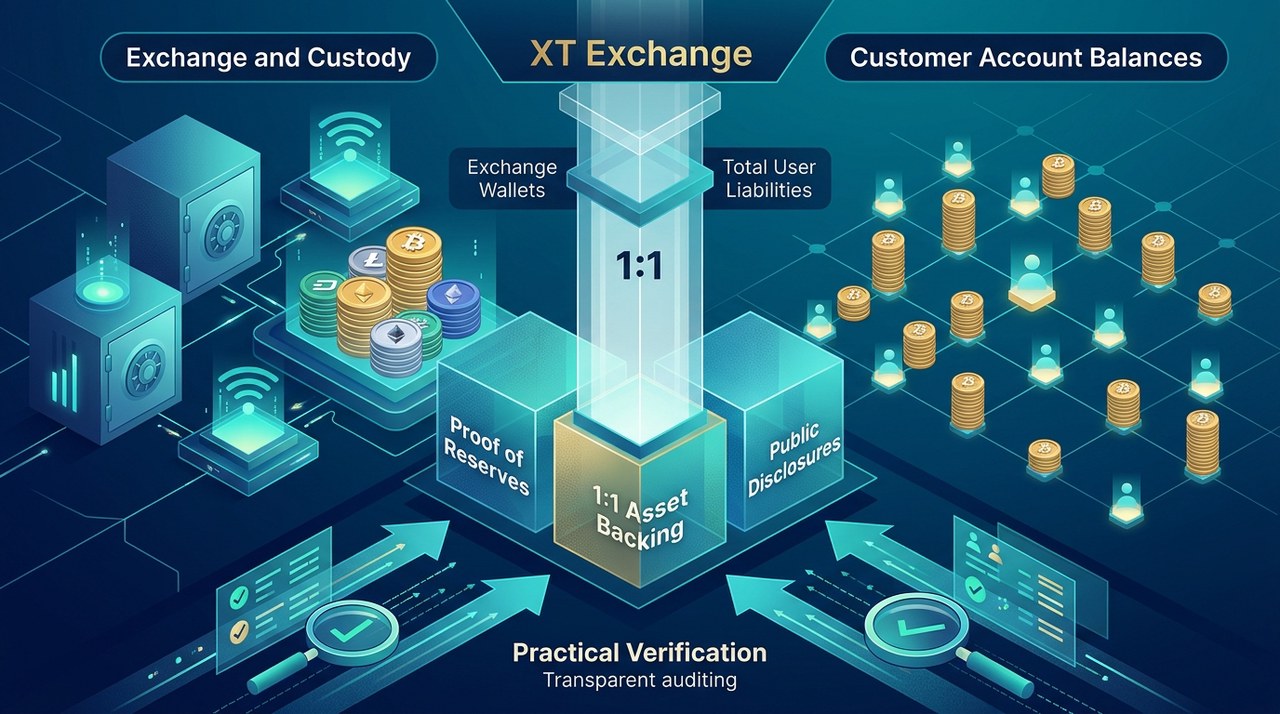
For XT Exchange, founded in 2018, maintaining confidence requires practical verification rather than simple promises. The exchange uses public disclosures to make its custodial role clear.
Understanding Proof of Reserves and 1:1 Asset Backing
Proof of Reserves (PoR) gives cryptocurrency users a way to examine part of an exchange's backing for themselves.
XT states that it maintains covered user assets on a 1:1 basis against customer account balances. This statement applies to mainstream digital assets included in its standard reporting scope.
To evaluate this, the platform publishes reserve ratios for covered assets. Here is how that math works in simple terms:
- Calculating the ratio: The reserve ratio compares reported XT wallet balances against total customer holdings recorded at a specific snapshot time.
- What 100% means: A reserve ratio of at least 100 percent indicates that reported wallet holdings equal or exceed the total included customer balances for that asset.
- Financial reference: A user sees their account balance, while the reserve report shows the total backing pool supporting those balances.
Bringing these figures together provides a public point of reference. Readers can review the published figures and underlying methodology to understand how the exchange calculates asset coverage.
How Merkle-Tree Verification Protects User Privacy
Publishing exchange-wide totals is only the first step. Account holders also need a way to check if their personal account balance was included in the report.
XT uses a cryptographic structure called a Merkle tree to solve this problem. This technology connects high-level company reports to individual account records.
The Merkle-tree balance verification process offers two important features:
- Individual verification: Eligible users can independently verify that their account balance was included in the relevant snapshot.
- Data privacy: The verification process works without publicly revealing any customer's personal identity or private balance details.
This setup allows individual users to confirm their status in the report without sacrificing privacy across the broader community.
Security Measures: Cold Storage and Bug Bounties
Reserve reporting is just one piece of a broader security architecture. Exchanges must also explain how custodial assets are physically protected from operational risks.
In its public security disclosures, XT highlights specific custody safeguards:
Offline Cold Storage
The exchange stores the majority of user digital assets in offline cold wallets. Keeping assets disconnected from the internet limits exposure to online security threats.
Multi-Signature Approvals
XT enforces multi-signature (multi-sig) access controls for designated wallet transactions. This structure prevents any single individual from moving funds unilaterally.
External Security Scrutiny
To maintain code integrity, XT hosts a public bug bounty program on the security platform HackenProof.
Independent security researchers can report qualifying software vulnerabilities within a defined scope. This vulnerability testing acts as an additional layer of technical scrutiny, distinct from Proof of Reserves verification.
Understanding the Scope and Boundaries of Proof of Reserves
Precision is crucial when reading exchange disclosures. While Proof of Reserves provides valuable data, users should understand what these reports do and do not cover.
Clear boundaries define the conclusions that can reasonably be drawn from a reserve snapshot:
- Point-in-time snapshot: A PoR report captures specified assets and included balances at one exact moment in time.
- Not a full financial audit: PoR verification focuses on reported wallet reserves versus included customer deposits. It is not a complete corporate financial statement audit.
- Does not capture unstated liabilities: An individual balance check verifies inclusion in a snapshot, but it does not prove that all off-chain corporate liabilities have been accounted for.
- No future guarantee: A reserve snapshot demonstrates asset coverage at the reporting date, but PoR alone cannot guarantee future withdrawal availability or prevent future operational issues.
Recognizing these limits helps customers interpret published figures accurately against the same dated reference points.
Maintaining Long-Term Transparency
For XT Exchange, reserve transparency gives practical expression to its core principle of 'Trade with Trust.'
By combining public reserve figures with individual Merkle-tree verification, the exchange allows users to check asset backing claims for themselves.
However, the ongoing value of reserve disclosures relies on consistency over time. As future reports are published, presentation consistency helps readers track changes and confirm that figures remain comparable.
Keeping information open and updated makes custodial responsibilities clearer for everyone involved in digital finance.
Latest blog posts

SafePal Hardware Wallet Users Target Fake Mail Alerts
SafePal users in Italy are receiving fake security letters in the mail that use compromised customer data to run phishing scams.



Twenty One Capital Reports $1.09B Q3 Income on Bitcoin Gains
Twenty One Capital posted a $1.09 billion net income for Q3 driven by Bitcoin appreciation, even as operational costs led to a $4.8 million loss.
|

 +1
Ethereum and Layer 1 Blockchains Explained Simply
Discover how Ethereum introduced programmable smart contracts, how the EVM works, and why alternative Layer 1 blockchains make specific trade-offs.
|