


Why Is Crypto Crashing? Raoul Pal and Kevin O'Leary Explain
The Current State of the Crypto Market
Have you noticed how the crypto market seems to be hitting a wall lately? If you have been checking your portfolio, you are not alone in wondering why prices are struggling to build upward momentum. BitcoinBTC+0.16% and other digital assets have faced steady pressure, leaving many investors asking what is holding the market back.
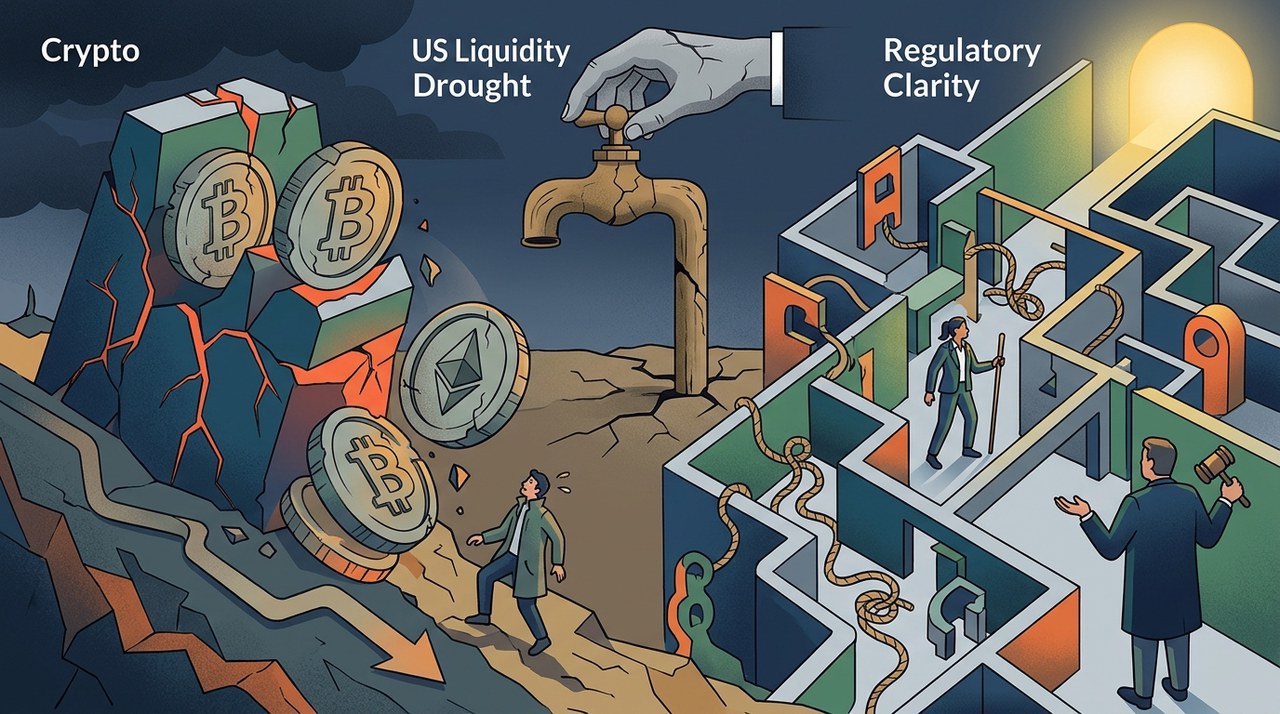
To understand what is happening behind the scenes, macro investor and Real Vision founder Raoul Pal, along with veteran investor Kevin O'Leary, shared their perspectives. They point to two major hurdles: a slowdown in global money supply and a lack of regulatory clarity in the United States.
While macroeconomic conditions restrict the flow of cash into high-risk assets, unclear rules prevent traditional companies from entering the space. Together, these headwinds create a challenging environment for digital assets.
Reason 1: The US Liquidity Drought (Raoul Pal's View)
Raoul Pal believes that the primary cause of weak crypto prices is a lack of financial liquidity. Liquidity refers to how easily cash flows through the economy and financial system.
Why Does Crypto Need Liquidity to Grow?
Think of market liquidity like water in a garden. When money is flowing freely through banks and credit markets, excess cash tends to trickle into growth-oriented assets like technology stocks and cryptocurrencies. However, when liquidity dries up, investment activity slows down across the board.
According to Pal, total US liquidity—which includes commercial bank loans, leases, and overall money creation—has remained flat since July 2026. Several factors are constraining money creation:
- A stronger US dollar makes global borrowing more expensive.
- Elevated interest rates slow down bank lending to businesses and consumers.
- A flatter yield curve reduces economic incentives for banks to extend long-term credit.
Because digital assets require expanding liquidity to sustain prolonged price increases, current financial conditions are providing limited support.
Raoul Pal's Market Outlook and Scenarios
Despite current market conditions, Pal mentioned that he continues to accumulate crypto assets gradually. He revealed making two strategic purchases in 2026, including one during a significant market sell-off in February. However, purchasing during periods of market weakness carries inherent volatility risks.
Markets have gone nowhere. Narrow liquidity, so this is total liquidity including the banking system loans and leases. It's not growing as fast.
Pal considers Bitcoin to be undervalued based on long-term liquidity trends. Still, he does not anticipate an immediate sharp recovery until underlying macroeconomic conditions shift.
The Macro Conditions Needed for Recovery
For the digital asset market to regain momentum, broad economic conditions must become more favorable. Pal expects the US Dollar Index to eventually drop toward 93. Lower interest rates combined with a weaker US dollar could boost liquidity and support crypto prices over time.
Long-Term Scenarios for EthereumETH-0.17%
Pal also outlined potential long-term growth scenarios for Ethereum and SolanaSOL+0.12%. Under a hypothetical scenario where liquidity growth resumes and network adoption continues its historical trajectory, he suggested Ethereum could reach $18,000 by Q2 2027 and $60,000 by mid-2028.
Crucially, Pal clarified that these targets are not guarantees. They represent one possible trajectory dependent on specific conditions, such as sustained institutional adoption and expanding liquidity. On the downside, he pointed to $1,500 as a key technical support and risk level for Ethereum if macro conditions worsen.
Past performance of digital assets is not a guarantee of future returns. You can check current market prices at bitkub.com/th/market/BTC.
Reason 2: Regulatory Delays (Kevin O'Leary's View)
While Raoul Pal focuses on global money supply, investor Kevin O'Leary points to legal uncertainty in the United States as another major headwind.
Why Businesses Are Holding Back
O'Leary explains that major companies and financial institutions operate under strict oversight. Without clear federal guidelines, corporate compliance departments will not authorize managers to use blockchain infrastructure or hold digital assets.
O'Leary noted that his own holding companies actively use USD Coin (USDCUSDC+0.48%) for corporate treasury operations and cross-border payments. Stablecoins allow them to move funds internationally faster and cheaper than traditional bank transfers.
However, most traditional enterprises are waiting for formal legal clarity before integrating similar blockchain-based financial products into their workflows.
The rest of the infrastructure and blockchain and everything else in treasury management isn't done till the compliance department of institutions say you can do it.
Legislative Progress: The GENIUS Act vs. The CLARITY Act
To understand O'Leary's perspective, it helps to examine the regulatory updates taking place in Washington D.C.
What the GENIUS Act Solved
The passage of the GENIUS Act established a formal legal framework for stablecoins in the United States. This gave companies clear ground rules for using fiat-backed digital tokens in payment processing and settlement services.
Why the CLARITY Act Remains Essential
While stablecoins have a framework, broader blockchain applications still lack comprehensive rules. The pending CLARITY Act aims to define how crypto assets and decentralized protocols interact with existing financial regulations.
We really need to get that done.
Until lawmakers pass comprehensive rules like the CLARITY Act, institutional capital will likely remain on the sidelines, slowing wider adoption.
What This Means for Digital Asset Investors
Combining the analysis of Raoul Pal and Kevin O'Leary offers a balanced picture of current market challenges:
- Macroeconomic factors like bank liquidity and interest rates heavily influence short-term price action.
- Regulatory legislation in major economies remains necessary to unlock sustained institutional demand.
- Long-term adoption plans continue, but market recovery depends on broader structural changes.
Understanding these macro factors can help investors evaluate market movements with a clearer perspective. As always, digital asset markets experience high volatility, making risk management essential for market participants.
Latest blog posts


South Korea Gives Exchanges Power to Freeze Crypto on Suspicion
South Korean regulators now permit crypto exchanges to halt withdrawals during suspected hacks, balancing faster asset protection against temporary user access locks.
|

Is the AI Trade Over? What It Means for Bitcoin
Fidelity analyst Jurrien Timmer suggests the AI stock boom may be cooling, raising questions about whether investor funds could rotate into Bitcoin.
|
Canaan Considers Bitcoin Sales After Mining Revenue Drops 96%
Canaan has launched a $20 million share buyback program despite a 96% fall in mining rig revenue, potentially selling Bitcoin reserves to fund it.
|