

Wall Street Wants to Tokenize Assets, But Who Is Buying?
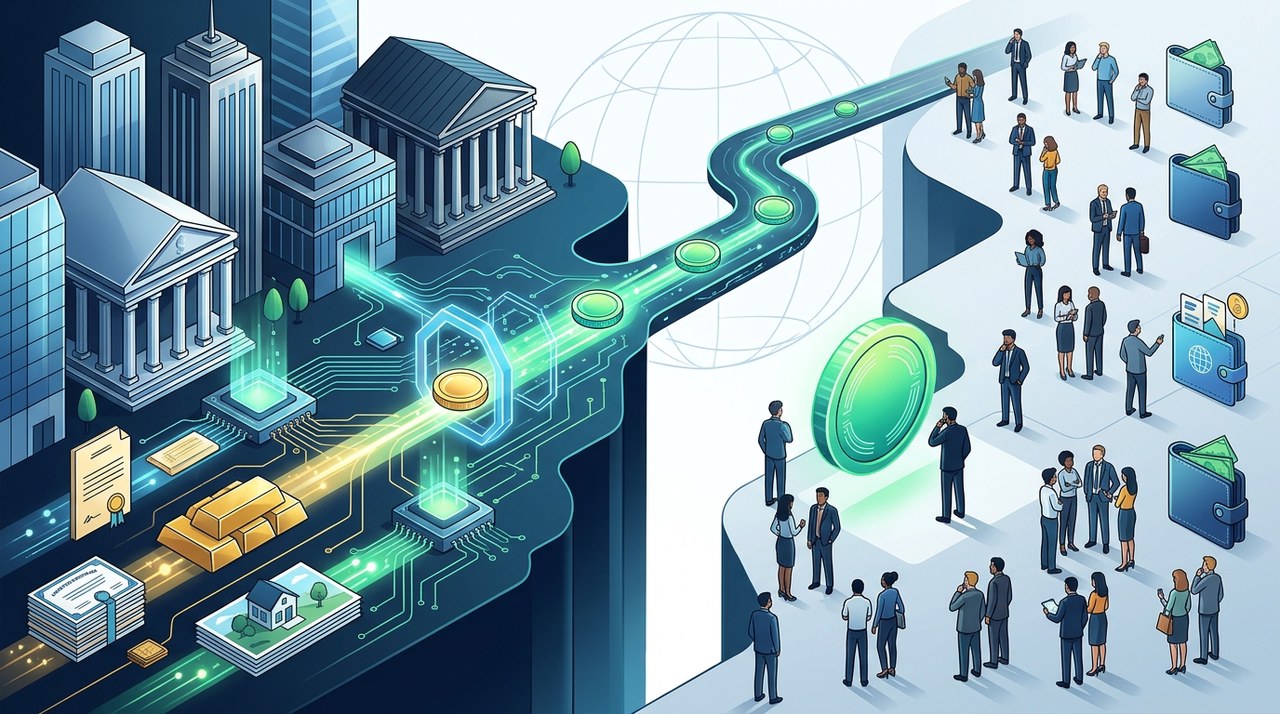
Wall Street Push Into Asset Tokenization
Wall Street institutions are moving quickly to bring traditional finance onto the blockchain. By late 2026, the real-world asset tokenization sector approached nearly $40 billion in market value.
Major banks and asset managers see huge potential in digital tokens. However, converting an asset into a digital token does not automatically mean buyers will appear.
Industry experts at the TOKEN2049 conference recently shared key insights about this growing market challenge. Representatives from financial infrastructure firms R3, T-RIZE, and XDCXDC-2.54% discussed how buyer demand will shape the future of tokenized finance.
Why Banks Want Blockchain Distribution
For decades, traditional financial institutions relied on established, legacy systems to distribute investment products. Blockchain technology offers banks an alternative path to connect with global investors directly.
The business motivation behind this shift is very straightforward.
It is about how banks and others make money,
explained Todd McDonald, co-founder of R3. Banks can sell tokenized funds to new customer segments without spending heavily on brand-new distribution networks.
However, traditional finance faces a major dilemma. Banks usually prefer private, permissioned networks to keep firm control over user access and maintain transactional privacy.
This setup causes issues when prospective investors operate on public blockchains instead. As McDonald pointed out, building a private network without active users leaves banks with zero transactions.
The Real State of the Tokenization Market
Recent market research analyzed 7,000 tokenized products and 12 asset classes across a broader $60 billion market ecosystem. The study revealed a major split between listed products and actual trading activity.
Nearly half of the tokenized market shows little to no secondary transaction volume. Out of 1,289 tokenized assets valued above $100,000, many struggle to generate ongoing buyer interest.
- OndoONDO-7.83% leads real-world asset tokenization with $4.0 billion in market capitalization.
- Sky follows closely with $3.9 billion in tokenized market cap.
- Securitize holds $3.4 billion in tokenized value.
- Together, these three major players account for 22.5% of the $50.3 billion RWA sector.
Past performance of digital assets or operational results is not an indication of future returns or performance. Asset prices can fluctuate depending on overall market conditions.
Why Investors Still Need a Reason to Buy
Moving assets onto a blockchain network solves only part of the puzzle. Investors still demand clear products, attractive returns relative to risk, and reliable ways to exit their positions.
You have to understand what the client actually needs — to raise money, launch a new investment product, or connect to existing rails — and then help them reach liquidity,
said Thien Duy Tran of financial infrastructure firm T-RIZE.
Real estate tokenization illustrates these challenges well. Dividing real property into digital tokens lets smaller investors participate in theory. In practice, buyers often find it difficult to evaluate property quality and fair pricing.
Because of these valuation hurdles, standardized investments like private credit and tokenized funds have gained adoption faster than complex physical properties.
Solving the $2.5 Trillion Trade-Finance Gap
Tokenization extends well beyond standard investment portfolios. The Asian Development Bank reported that global businesses faced a $2.5 trillion trade-finance gap in 2025.
Consider a small exporter in Indonesia sending goods to a buyer in Singapore. The exporter might need short-term financing for just two or three days while waiting for final payment.
Tokenization can turn that unpaid invoice into a digital investment opportunity. Lenders anywhere in the world can then fund the trade instantly over the blockchain.
Compliance Hurdles and Secondary Market Liquidity
Before committing funds to tokenized invoices or assets, institutional investors perform standard due diligence checks.
Investors ask what the compliance position is, what the credibility of the project is, what the consignment consists of?
explained Ritesh Kakkad, co-founder of XDC Network.
A distributed ledger can record ownership transparently, but lenders must still evaluate underlying credit risk. Furthermore, secondary market liquidity remains a major hurdle for illiquid assets.
If an investor purchases a token meant for a one-year lockup but needs cash after six months, finding a secondary buyer on-chain can be difficult without active markets.
Regulatory Outlook and Future Adoption
Uncertainty around liquidity and investor safety has drawn increasing scrutiny from global regulators. In November, Irish central bank governor Gabriel Makhlouf voiced caution regarding digital asset innovation.
Makhlouf noted that overall investor benefits, commercial viability, and operational resilience in tokenized finance still face significant questions.
Wall Street possesses plenty of financial products to tokenize, and blockchain technology offers flexible global distribution. The ultimate success of tokenization depends on whether active buyers decide to commit capital over the long run.
Latest blog posts


 +2
Ripple’s RLUSD Overtakes Telegram’s Gram in Crypto Rankings
Ripple's stablecoin RLUSD reached a $2.82 billion market cap, surpassing Telegram's Gram token as Gram's price dropped below $1.
|
Anchorage Digital Launches 61st Parallel Asset Management
Crypto custody firm Anchorage Digital is expanding its institutional reach by launching a standalone subsidiary called 61st Parallel Asset Management.


Bitcoin Hits Record 411-Day Bear Market as Holders Realize Losses
Grayscale views current Bitcoin levels as oversold after a 411-day bear market, even as long-term holders realize average losses of 33%.
|