


Tether Freezes USDT in Minutes, but Victims Face 20% Fee
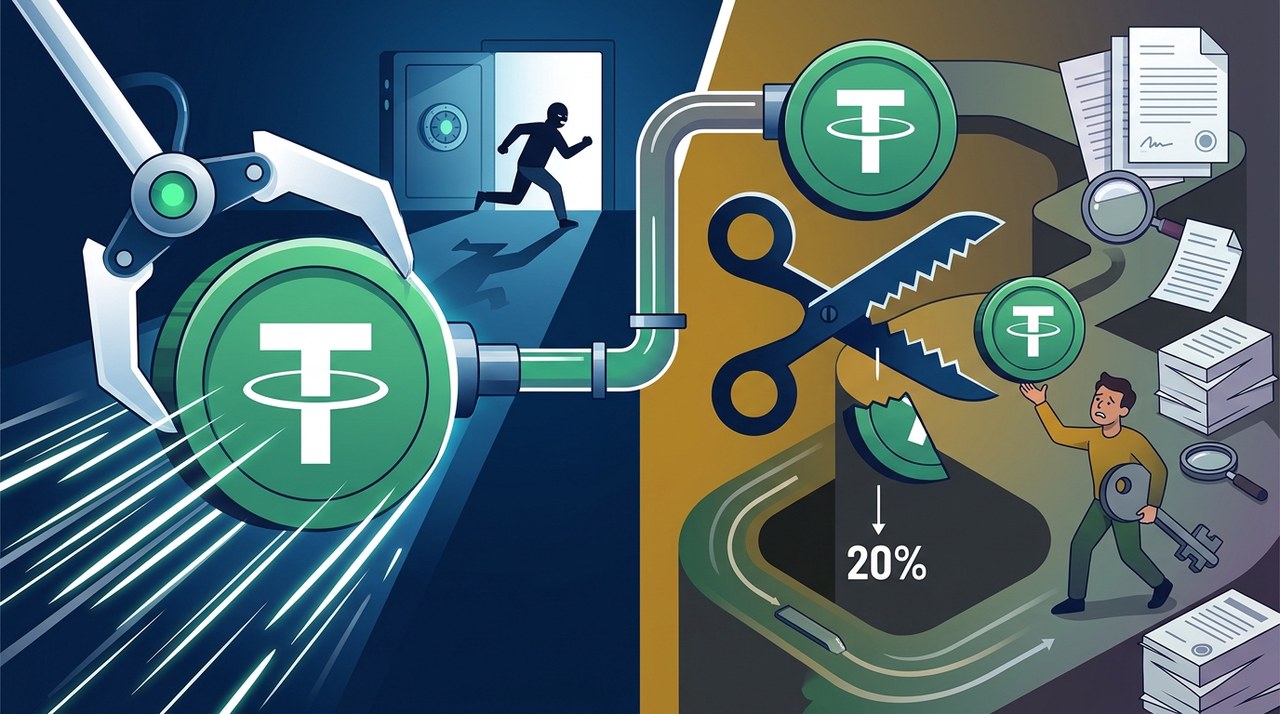
TetherUSDT+0.32%'s Swift Asset Freezes Come with High Recovery Costs
Imagine having your funds stolen in a cyberattack, seeing the issuer step in to block the thief within minutes, but then discovering it could take years and cost 20% of your money to get it back. That is the reality facing some crypto victims dealing with stablecoin issuer Tether, according to an investigation by Bloomberg.
While Tether has built powerful tools to stop hackers from moving stolen funds, recovering those frozen assets involves legal hurdles, long waiting periods, and high fees. The findings highlight growing questions about how stablecoin issuers handle customer assets after security breaches.
During the period of these reports, major digital assets experienced market fluctuations, with BitcoinBTC-1.70% trading around $58,669 (down 2.80%) and EthereumETH-1.95% at $1,646 (down 3.25%). Past performance of digital assets is not an indicator of future results. View market trends on bitkub.com/th/market/USDT.
The 20% Reissuance Fee Explained
Tether issues USDT, the world's largest stablecoin pegged to the US dollar. Because Tether operates centralized smart contracts on various blockchains, it holds the ability to blacklist specific wallet addresses linked to criminal activity or security breaches.
When Tether blacklists a wallet, the USDT inside becomes unusable. To return the funds to legitimate owners, Tether must permanently burn the blacklisted tokens and mint new USDT to send to verified victims—a process called reissuance.
However, Bloomberg's investigation revealed that Tether has sought reissuance fees of up to 20% of the total recovered amount in several cases. For victims trying to recover millions of dollars, this policy means losing one-fifth of their capital during the recovery process.
The Five-Year Wait: Bittok's $50 Million Hack
The real-world impact of these policies is illustrated by the case of Bittok, a crypto exchange based in Singapore. In June 2020, Bittok suffered a severe cyberattack resulting in the theft of $50 million in crypto assets.
Tether acted quickly to freeze the stolen USDT following the incident. However, more than five years later, Bittok has still not recovered its funds.
Emails reviewed by Bloomberg show that a lawyer representing Tether informed the entity that acquired Bittok about a 20% reissuance fee on any funds eventually returned. The investigation uncovered similar arrangements with other victims, who received frozen USDT in gradual installments while paying comparable fee deductions.
Tether's Defense: Legal Risks and Regulatory Vacuum
Tether Chief Executive Officer Paolo Ardoino defended the company's framework, pointing out that returning frozen funds involves complex legal risks and competing ownership claims.
The problem is there is no guidance; there is no law that guides this.
Ardoino explained that Tether returns funds gradually in civil disputes to manage legal exposure. Without clear regulatory standards governing stablecoin asset recovery, issuers must navigate complex international claims independently.
A Tether spokesperson stated that the company has successfully reissued $1.2 billion in USDT to date. The firm maintains that recovery fees are necessary to cover legal expenditures, compliance verification, and operational costs associated with manual asset recovery.
Massive Scale of Frozen Assets Across the Market
The speed at which stablecoin issuers can act was recently demonstrated during a massive $6.3 billion cyberattack targeting Binance. In that event, Tether froze over $1.5 billion in USDT within just 30 minutes of notification.
During the same security breach, rival issuer Circle blocked $1.1 billion in USDCUSDC+0.29% to prevent illicit transfers.
- Tether froze over $1.5 billion in USDT within 30 minutes during a major $6.3 billion exchange exploit.
- Circle blacklisted $1.1 billion in USDC in response to the same incident.
- Tether has successfully reissued $1.2 billion in USDT to legitimate claimants over time.
- Direct emergency communication lines are being created between stablecoin issuers and major exchanges.
To further improve response times, Tether is establishing direct emergency communication channels with major global cryptocurrency exchanges. However, as issuers gain faster freezing capabilities, the long-term resolution process remains a critical operational issue.
Related Developments: Ethereum Doubles Security Team Over AI Threats
As stablecoin issuers battle hack recoveries, security risks continue to evolve across the broader ecosystem. The Ethereum Foundation announced it has doubled the size of its protocol security team to combat emerging threats.
The foundation warned that rapid advances in artificial intelligence (AI) present a more immediate threat to smart contract security than quantum computing. Automated AI exploits require increased protocol-level vigilance and faster defensive updates.
Key Lessons for Crypto Investors
The findings around USDT recovery offer important takeaways for both individual users and institutional market participants:
- Fast freezing does not mean fast return: Blocking stolen funds happens in minutes, but reissuing them can take years.
- Recovery comes at a cost: Processing and legal costs can reduce total returned funds by up to 20%.
- Regulatory gaps persist: The absence of standardized legal procedures leaves recovery terms largely to issuer discretion.
- Centralized control brings trade-offs: Asset freeze features protect ecosystems from bad actors, but introduce reliance on private issuers.
Disclaimer: Crypto asset investments carry inherent market risks. Past performance of digital assets or operators does not guarantee future performance. Investors should assess all technical and operational risks before participating in digital asset markets.
Latest blog posts

Elon Musk Warns Scammers as X Wins $271K Fraud Case
X secured a default court judgment against two individuals accused of operating a $271,000 creator payout scheme using crypto content farms.
|
UniCredit Offers Bitcoin Exposure with Capital Protection
Italian banking giant UniCredit is launching a six-year investment product offering retail clients exposure to Bitcoin with principal protection and capped returns.
|

API3 Caps Token Supply at 200 Million to Focus on AI
API3 has permanently capped its token supply at 200 million and ended emissions, clearing the way to expand into AI data infrastructure and on-chain curation.
|