
TeraWulf CEO Says AI Demand Remains Strong Despite Stock Dip
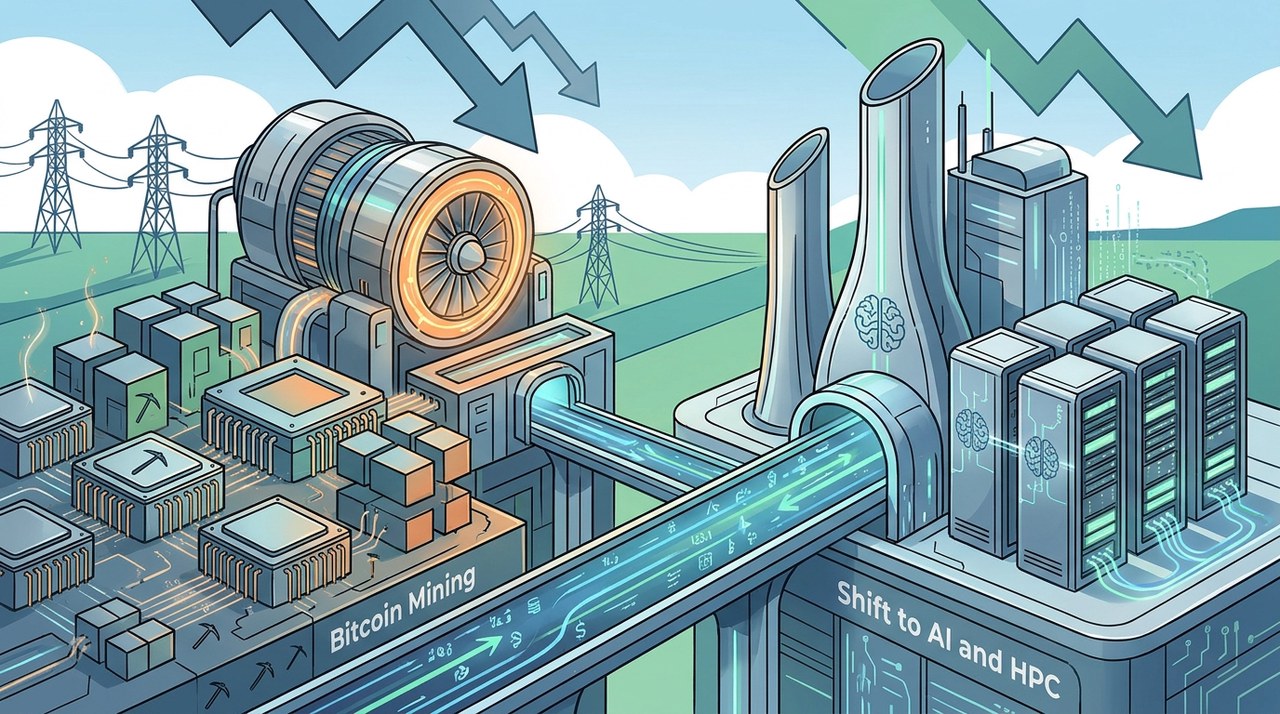
From Bitcoin Mining to AI Infrastructure Landlord
The cryptocurrency mining industry is undergoing a major transformation. Companies that once spent all their energy solving mathematical blocks for Bitcoin rewards are now looking at a brand new revenue stream: artificial intelligence.
One of the key players leading this shift is TeraWulf (WULF). While TeraWulf built its foundation as a dedicated Bitcoin (BTCBTC-2.42%) miner, it has aggressively pivoted into high-performance computing (HPC) hosting services. Today, high-performance computing leases supply about 83% of TeraWulf's total revenue.
High-performance computing refers to the massive computational power required to train complex AI models and run large data centers. Because Bitcoin miners already possess power infrastructure, high-voltage interconnections, and industrial cooling setups, they are uniquely positioned to serve as landlords for AI tech giants.
Market Panic vs. Real-World Power Demand
Despite this strategic pivot, overall financial markets have recently experienced a broader selloff in tech and artificial intelligence stocks. This downward pressure has dragged TeraWulf's share price down to near $10.
However, TeraWulf Chief Executive Officer Paul Prager argues that Wall Street traders are mistaking daily stock market volatility for a collapse in actual business demand. According to Prager, public equity markets are treating TeraWulf like a speculative tech stock, even though its operational foundation is built on ultra-long-term real estate and power commitments.
Speaking to CNBC, Prager emphasized that TeraWulf's target clients are investment-grade companies—meaning top-tier, low-default-risk corporate borrowers—who sign long-term hosting agreements spanning 15 to 20 years.
"I understand there may be panic in sort of market pricing but there is no panic in terms of demand for the energy infrastructure asset," said Paul Prager, CEO of TeraWulf.
Prager's confidence stems from a simple reality in the tech world: electrical power and fully permitted data center sites are extremely scarce. Building new power capacity takes years, giving existing power-rich infrastructure owners significant market leverage.
Analyzing Wall Street Price Targets and Financial Risks
Financial analysts tracked by CNBC have maintained optimistic price targets for TeraWulf stock, with some targets set above $27. However, realizing these target valuations depends on key business assumptions.
If TeraWulf successfully locks in long-term enterprise tenants for its unleased power sites and keeps capital costs under control, the company could see significant valuation upside. Conversely, if rising interest rates increase project financing costs or if site leases take longer than expected to finalize, the stock could experience continued volatility or downside pressure.
It is also essential for investors to look at core operating metrics alongside revenue growth. In the third quarter, TeraWulf reported that its adjusted EBITDA (earnings before interest, taxes, depreciation, and amortization) remained negative at approximately $12.8 million, illustrating that infrastructure expansion comes with substantial short-term operational expenses.
The Anthropic Deal and the Google Backstop
To understand TeraWulf's commercial momentum, look no further than its major deal involving AI firm Anthropic. This flagship agreement anchors TeraWulf's long-term enterprise vision.
- Capacity Covered: Roughly 401 megawatts (MW) of power capacity.
- Contract Length: Locked in for 20 years.
- Projected Revenue: Generates roughly $19 billion in contracted revenue over the initial term.
Adding further stability to this massive project is financial backing involving Google. According to company filings, a Google credit backstop supports the planned project financing. A credit backstop acts as a secondary safety net for lenders, significantly lowering borrowing risks and making it easier for TeraWulf to secure favorable debt terms for data center construction.
The Muskie Site Dilemma in Kentucky
While the Anthropic agreement provides a solid baseline, TeraWulf faces an ongoing challenge at its Muskie facility located in Kentucky.
In October, TeraWulf announced plans to double its contracted power footprint at Muskie, expanding the site's planned capacity from 500 MW to 1 gigawatt (GW), subject to approval from Kentucky's utility regulator. Expanding to a full gigawatt represents massive computing scale.
However, the Muskie site currently has no signed tenant. Developing massive power infrastructure without a signed client creates financial risk, leaving TeraWulf shareholders directly exposed to ongoing funding and carrying costs while construction proceeds.
Addressing this exposure, Prager noted that competition for the site remains active. He stated that three hyperscalers (large cloud service providers like Amazon, Microsoft, or Google) and two leading AI model developers are actively bidding for access to the Muskie facility. Furthermore, Prager mentioned that these prospective tenants are discussing financial structures to help share construction costs if overall borrowing rates remain elevated.
Share Dilution and Managing Capital Costs
Building gigawatt-scale data centers requires billions of dollars in capital. To fund this rapid expansion, many growing infrastructure firms issue extra company stock—a process known as share dilution.
TeraWulf's SEC filings reveal that its total outstanding shares expanded by roughly 19% over nine months, reaching approximately 501 million shares. Dilution can reduce existing shareholders' percentage ownership in a company, which often worries retail investors.
On November 22, 2026, Paul Prager addressed these shareholder concerns directly in a public post on X (formerly Twitter), reassuring investors that management is focused on long-term value.
"Let’s start with the obvious. This has been a terrible market. I’m a shareholder too. I feel it. But I think it is important to separate what has changed from what hasn’t. The cost of capital has changed. Risk appetite has changed. Public market valuations has changed. What has [not changed is demand for energy infrastructure]," wrote Paul Prager on X.
Prager stressed that while he personally dislikes share dilution, navigating a high-interest-rate environment requires carefully balancing corporate equity sales against project debt.
Why Bitcoin Miners Are Rebranding as AI Landlords
TeraWulf is far from alone in this strategy. Institutional research firm 10x Research pointed out in July that global financial markets are increasingly pricing top-tier Bitcoin miners as AI energy infrastructure companies rather than pure-play Bitcoin proxies.
Following Bitcoin halving events, which cut block reward revenues in half every four years, crypto miners must optimize their power contracts. Securing stable, multi-decade leasing revenue from corporate AI tenants offers predictable cash flows that balance out the volatile nature of cryptocurrency markets.
Whether TeraWulf can maintain its growth trajectory without heavily diluting existing stock will likely depend on how quickly it signs a major tenant for the Muskie site.
Investor Takeaways and Market Context
The pivot from Bitcoin mining to AI data center hosting offers significant long-term growth opportunities, but it also carries distinct risks. Investors should carefully weigh the potential of long-term hosting contracts against the financial costs of data center buildouts, operational cash burn, and potential stock dilution.
To keep track of broader digital asset prices and market trends, you can explore live trading data on Bitkub Market.
Disclaimer: Past performance of digital assets or corporate operations is not indicative of future results. Crypto assets involve inherent volatility and market risks; investors should thoroughly evaluate their risk tolerance before making financial decisions.
Latest blog posts

South Korea Crypto Bill Could Redefine Stablecoins
South Korea's draft crypto bill favors bank-led stablecoin issuance while allowing fintech and technology companies to hold major ownership stakes.


Solana Devs Move to Stop Wasted Validator Power on Lost Blocks
Solana developers are working on an update to stop validators from wasting processing power on blocks already rejected by the network.
|
Europol Traces $28.5 Million in Crypto Piracy Crackdown
Law enforcement across 11 countries traced $28.5 million in crypto linked to illegal streaming services and shut down 57 unauthorized platforms.
|