
Oil Drops on U.S.-Iran Deal Report: Impact on Bitcoin
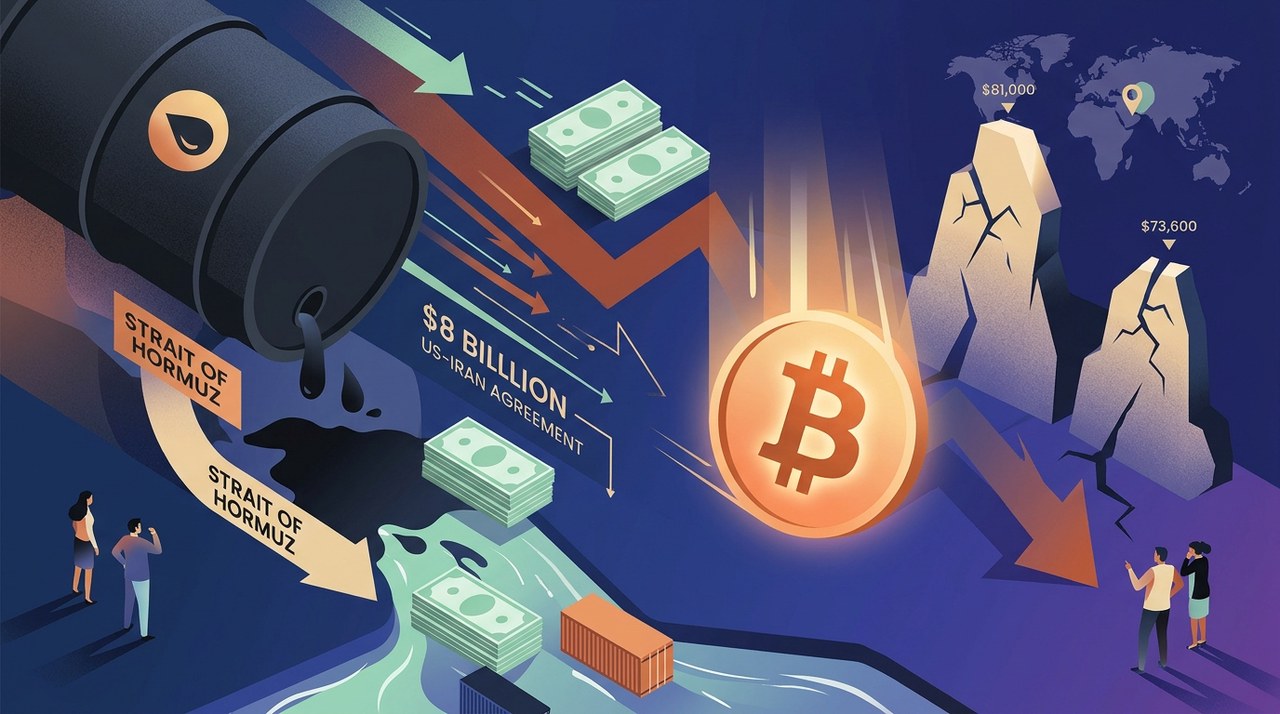
Oil Drops Following Reported $8 Billion U.S.-Iran Deal
Global energy markets experienced a sharp shift on Monday. Brent crude oil prices fell roughly 4.6% after reports emerged that Iran offered to reopen the Strait of Hormuz in exchange for $8 billion in unfrozen assets.
Lower energy prices often provide temporary relief to financial markets. However, Bitcoin (BTCBTC-2.11%) did not join in on the immediate rebound. The leading digital asset dropped to around $73,600 before trading near $74,437. This marks an 8% decline from its peak near $81,000 on November 5. Crypto assets remain highly volatile, and short-term price movements can reverse quickly.
Key Terms of the Proposed Strait of Hormuz Agreement
The Strait of Hormuz is one of the world's most critical oil transit chokepoints. Israeli news outlet Israel Hayom reported that Washington and Tehran are negotiating a potential resolution, citing two diplomatic sources.
Under the proposed framework, the agreement involves four primary actions:
- The U.S. releases $8 billion in frozen Iranian funds held in Qatar.
- The U.S. lifts its naval blockade against Iran.
- Iran reopens the Strait of Hormuz for commercial shipping.
- Iran stops attacks on Gulf shipping and drops demands to control the strait or collect transit fees.
Vice President JD Vance has been advocating for the deal. President Donald Trump reportedly agreed to accelerate negotiations following recent midterm election losses for Republicans. However, Secretary of State Marco Rubio and Treasury Secretary Scott Bessent oppose the plan, warning it could aid Tehran's government. President Trump was scheduled to meet with Qatar's prime minister in Washington on Monday, while Iran's nuclear program remains excluded from the discussion.
How Oil Prices and Interest Rates Influence Bitcoin
The connection between crude oil prices and Bitcoin comes down to inflation and central bank monetary policy. When energy prices rise, consumer inflation usually follows.
Data from the U.S. Labor Department showed that gasoline costs accounted for more than half of September's headline inflation increase. AAA reported the national average gasoline price reached $4.10 per gallon on November 5. High fuel prices make it difficult for inflation to slow down.
Persistent inflation increases the likelihood that the Federal Reserve will raise interest rates. On November 6, the CME FedWatch tool showed a 76.8% chance of a quarter-point rate hike in December. Higher interest rates typically tighten liquidity across financial markets, creating headwinds for risk assets like cryptocurrencies.
Why Bitcoin Did Not Rebound with Falling Oil
While cheaper oil can reduce inflation pressures, market reactions are not always consistent. On November 4, Bitcoin reclaimed $80,000 as crude oil fell about 12%. Conversely, on November 2, peace talk headlines boosted traditional assets like gold and silver while Bitcoin lagged behind.
Past performance of digital assets is not an indicator of future performance. Investors can monitor live spot prices directly on the Bitkub BTC Market.
On Monday, Brent crude settled at $93.81 per barrel, down from $98.32 on Friday. Despite this drop, crypto traders remained cautious ahead of key economic data releases.
Market Outlook and Scenarios Ahead
Geopolitical agreements in the region remain fragile. A similar deal negotiated in Switzerland in May fell apart following an attack on an Iranian tanker.
Market analyst Giuseppe Dellamotta outlined potential market scenarios depending on geopolitical developments:
- Positive Scenario: If the Hormuz deal succeeds, oil prices could decline toward pre-conflict levels. Lower energy costs would help cool inflation, potentially reducing the need for Fed rate hikes and improving liquidity for Bitcoin. However, market volatility remains a factor.
- Negative Scenario: If negotiations fail or military conflicts resume, crude oil prices could surge. Higher energy prices could drive inflation up, encouraging further Fed rate hikes, which could put downward pressure on Bitcoin prices.
Investors are now focusing on Tuesday's U.S. October inflation report. The CPI metrics will provide clearer signals on whether falling oil prices are translating into broader price stability, impacting interest rate expectations and crypto market trends.
Latest blog posts



Cardano Hits Epoch 666 as Network Advances Technical Roadmap
Cardano reached its 666th epoch while processing over 127 million transactions and rolling out updates to Dijkstra Net and the Midnight network.
|
NYSE Chooses Avalanche to Settle Tokenized Stocks
The New York Stock Exchange selected Avalanche as the main settlement ledger for its planned tokenized stock trading platform.

Strive Buys $2.2M in Bitcoin as Buying Slows Down
Strive added 29 Bitcoin to its treasury for $2.2 million, bringing total holdings to 43,153 BTC as corporate accumulation continues.
|