
New US Tariffs Loom: What It Means for Stocks and Bitcoin
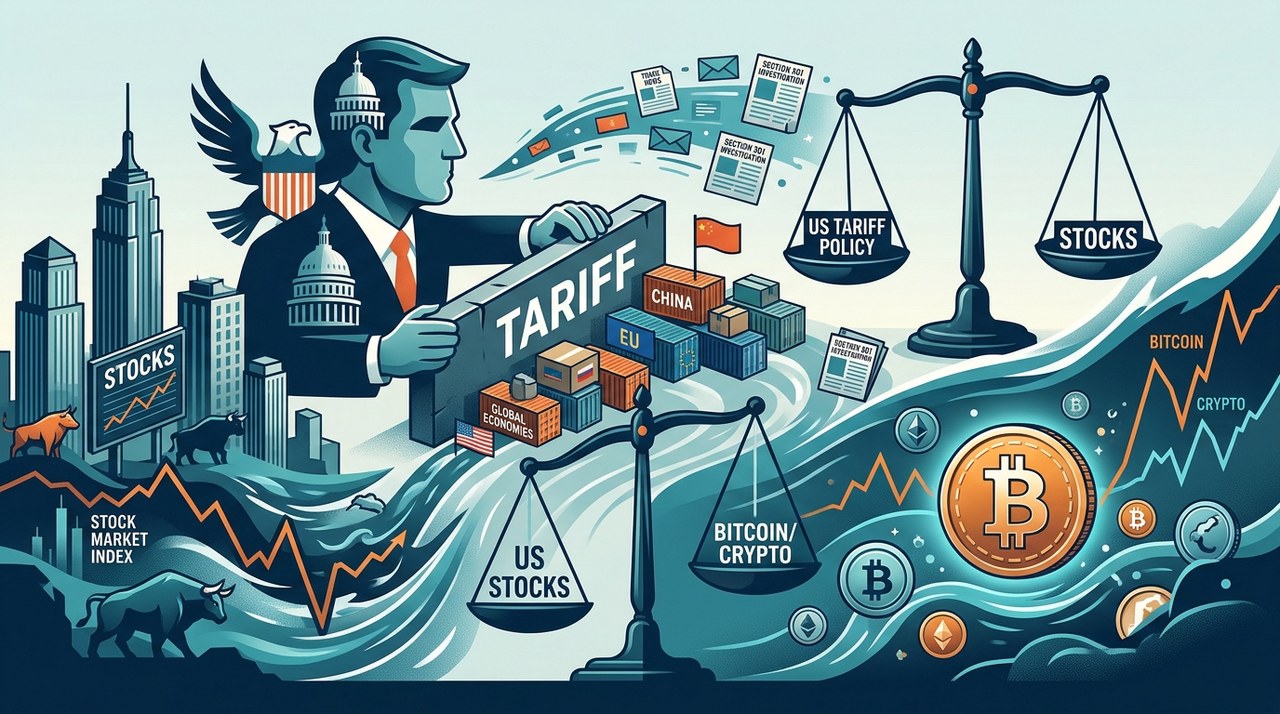
Trade news is back in the spotlight, and investors across traditional finance and crypto are paying close attention. The US government is preparing to announce higher tariffs on imports from China, the European Union, and 14 other global economies.
According to a report from The Wall Street Journal published on Tuesday, November 24, 2026, US Trade Representative Jamieson Greer could unveil the new policy as soon as this week. While final tariff rates are still being calculated, past history shows that rising trade tensions can trigger sharp moves in both stock and crypto markets.
Why Washington Is Targeting Foreign Factory Subsidies
This upcoming tariff announcement represents the conclusion of an investigation launched by the Office of the US Trade Representative (USTR) back on March 11. The probe relied on Section 301, a landmark 1974 trade law that gives the US president broad authority to impose tariffs when foreign nations engage in unfair trade practices.
The investigation focused on whether foreign state subsidies encourage overseas factories to manufacture far more goods than their domestic markets can consume. Washington shifted focus to Section 301 after the US Supreme Court struck down President Donald Trump's earlier tariff measures in February.
According to sources cited by The Wall Street Journal, the newly proposed duties will cover a broad range of imported goods. However, products that are already subject to separate trade duties might be partially excluded, and the final timeline could still shift.
Different Tariff Rates for Different Nations
The proposed tax rates will not be uniform across all trade partners. Countries with existing trade agreements with the US will likely see lower rates:
- Lower tier (15% or less): The European Union, Japan, and South Korea are expected to face rates capped at 15%. This aligns with existing trade deals that set a 15% ceiling on import taxes for these regions.
- Higher tier: Nations such as China, Vietnam, and India face the potential for significantly higher tariff rates.
US Trade Representative Jamieson Greer previously highlighted this distinction in September, stating:
"...we value those deals, and we will certainly take them into account."
Financial news accounts, including Walter Bloomberg (@DeItaone), also confirmed on November 24, 2026, that sweeping new tariffs on China, the EU, and other partner economies are in active preparation under Greer's direction.
Lessons from History: How Past Tariffs Hit Markets
To understand why traders react quickly to tariff headlines, it helps to look back at how markets behaved during similar escalation events in 2025.
In April 2025, the US introduced a 34% levy on Chinese goods. Beijing quickly retaliated with its own 34% tariff on all American goods. That sudden escalation triggered a severe drop in equities, sending the S&P 500 index down by 6% on April 4, 2025 alone, contributing to its worst overall trading week since March 2020.
Market volatility flared up again on October 10, 2025. After China restricted exports of rare earth elements—critical raw materials used in smartphones, jet engines, and advanced electronics—the US administration threatened a massive increase in tariffs. The S&P 500 fell 2.7% on that day, marking its sharpest single-day decline since April.
Crypto Shock and Leveraged Liquidations
During the October 10, 2025 market selloff, cryptocurrency markets experienced even sharper fluctuations than traditional stocks. Bitcoin (BTCBTC-4.80%) dropped nearly 10% within 30 minutes, temporarily falling below $105,000.
Because many traders use borrowed funds (leverage) to amplify their positions, the sudden price drop triggered a massive wave of forced liquidations. Over $19 billion in leveraged crypto bets were automatically closed by exchanges as losses mounted, setting a historical record for single-day liquidations.
Past performance of digital assets is not a guarantee of future results. Investors can check current prices and market details at Bitkub BTC Market.
Current Market Conditions and the US-China Truce
Following the latest reports on Tuesday, November 24, 2026, stock futures turned downward. Financial media account Bull Theory (@BullTheoryio) noted that S&P 500 futures fell 1.22% while Nasdaq futures dropped 2.0% following news of the impending announcements.
This round of trade news arrives at a delicate moment for traditional equities. The S&P 500 fell 3.7% on Friday, pushing the benchmark index more than 10% below its recent peak and placing it inside official correction territory.
However, there is an important economic buffer in place that did not exist during the April 2025 shock. A formal US-China trade truce established in October 2025 remains extended until January 10, 2027.
Furthermore, President Trump and Chinese President Xi Jinping recently met at the Asia-Pacific Economic Cooperation (APEC) summit in Shenzhen. According to China Briefing, neither side announced changes to existing tariff structures during the meeting.
What to Watch Next
Whether this new policy triggers broader market pullbacks or remains relatively contained depends on a few upcoming factors:
- The official rates announced by USTR Jamieson Greer: If China rates remain moderate or within expected bounds, markets may react less severely.
- Beijing's response before January 10, 2027: If China responds with retaliatory tariffs or trade restrictions, volatility could spike across both stocks and crypto assets. Conversely, if both sides maintain their truce agreement, market impacts may stay limited.
As policy details emerge over the coming days, investors will be keeping a close eye on official announcements and subsequent diplomatic responses.
Latest blog posts


XRPL DEX Daily Volume Reaches 4.51 Million XRP in Q3
Evernorth data shows XRP Ledger DEX averaged 4.51M XRP daily in Q3, with major traders driving 65% of volume and RLUSD rising 74%.
|


Neuberger Berman Brings Tokenized HINC Fund to Aave Horizon
Neuberger Berman has launched its tokenized high-yield credit fund, HINC, on Aave Horizon, allowing eligible investors to borrow USDC, GHO, and RLUSD.
|


Swiss Central Bank, UBS, and SIX Study Shared Ledger
The Swiss National Bank, UBS, and SIX are examining whether a single shared ledger can host central bank money, commercial bank money, and tokenized securities.
|