

Crypto Rules Shift to SEC and CFTC After Clarity Act Stalls
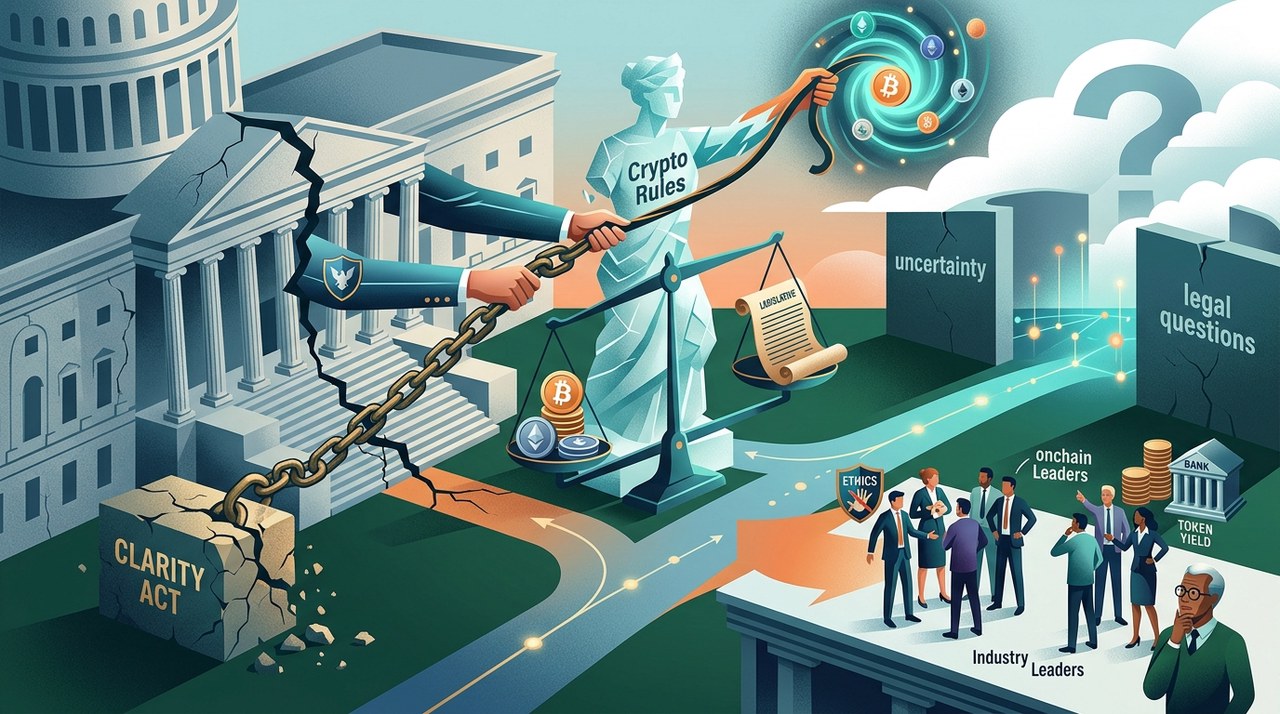
The U.S. crypto market is hitting an interesting turning point. The Digital Asset Market Clarity Act failed to advance in the Senate. Because of this legislative setback, Congress is no longer leading the immediate charge on digital asset rules.
Instead, the task of setting rules falls back onto two main regulators. These are the Securities and Exchange Commission (SEC) and the Commodity Futures Trading Commission (CFTC).
On one hand, this shift allows agencies to move fast and expand onchain trading. On the other hand, it leaves a big question open: How much permanent certainty can regulators actually give without a full law from Congress?
Why the Crypto Industry Split Over the Clarity Act
Lev Breydo, an assistant professor of law at William & Mary Law School, shared key insights on why the bill stalled. He noted that the Clarity Act exposed deep divisions inside the crypto industry.
Crypto industry leaders disagreed on several key points. These included ethics provisions and fights over token yield products with community banks.
"A coalition that looked unified against Gensler found out definitions create winners and losers," Breydo explained.
How SEC and CFTC Are Moving to Fill the Gap
Even though Congress did not pass the bill, regulatory agencies are acting quickly. They are rolling out new exemptions and proposals to handle digital assets under existing laws.
The SEC's 5-Year Innovation Exemption
On September 17, the SEC introduced a five-year Innovation Exemption. This rule allows qualified trading venues to trade tokenized U.S. stocks using blockchain liquidity pools.
This setup gives platforms room to operate while the agency works on permanent long-term rules.
CFTC's Push on Retail Trading and Registration
Shortly after, on October 5, the CFTC stepped up. The agency asked the public for input on new rules for leveraged retail crypto trading.
The CFTC is also reviewing a new market registration category tailored for crypto markets. This starts a formal rulemaking and comment process rather than putting instant rules into effect.
SEC Rules for Crypto Custody
In addition, on October 1, the SEC unveiled a new custody proposal. Under this framework, state trust companies could safeguard client digital assets.
Investment advisers and funds could also hold client crypto directly under specific conditions.
What to Expect as We Head Toward 2027
Looking ahead to 2027, Breydo expects the SEC to finish its token offering and custody rules. He also foresees the SEC expanding its tokenized-stock exemption.
He highlighted a joint interpretive release issued by the SEC and CFTC in March as a vital foundation. This release replaces older guidance and helps agencies coordinate using current law.
The Unresolved Spot Market Gap
Despite these agency steps, a central gap remains. Ordinary, unleveraged spot crypto trading still lacks clear federal oversight.
Currently, the CFTC can only intervene using its standard anti-fraud and anti-manipulation powers. Closing this gap was a core goal of the Clarity Act.
Investors should keep in mind that crypto spot markets remain volatile, and shifting regulatory interpretations can affect market dynamics.
Faster Commercial Opportunities for Crypto Companies
For several industry executives, moving forward through agency rules might actually open commercial paths faster than waiting on legislation.
Unlocking Mergers and Acquisitions
Paul McCaffery, head of digital assets at investment bank KBW, sees positive momentum in the agency-led approach.
"The SEC and CFTC are already moving proactively to provide the regulatory certainty markets need, and that's unlocking a wave of M&A across digital assets, traditional financial services, and fintech alike," McCaffery said.
A Push for Token Buybacks
Matt Hougan, Chief Investment Officer at Bitwise, noted that agency rules avoid years of follow-up rulemaking that legislation usually requires.
He expects more protocols to launch token buybacks—specifically buy-and-burn models. Clearer statements from the SEC give projects more confidence to use these models.
What This Means for Developers, DeFi, and Big Exchanges
How will agency rulemaking shape software developers, decentralized finance, and existing exchanges?
Protecting Software Developers
Software creators want regulators to distinguish writing code from managing a financial service.
Cathy Yoon, Chief Legal Officer at SolanaSOL+0.97%-focused firm Temporal, hopes the SEC treats developers as software creators rather than securities operators.
"The fact that the SEC staff is even willing to say these things explicitly is a win," Yoon noted, though she reminded traders that staff FAQs are not formal SEC rules.
Global Competition and 24/7 Trading
Michael Lie, global head of digital assets at market maker Flow Traders, believes broad rules are inevitable as markets shift to 24/7 trading.
He is watching innovation exemptions and changes to transfer-agent rules. Lie added that regulatory frameworks in Europe and Asia are already moving forward.
Implementation Hurdles in DeFi
Legal experts emphasize that agency guidance brings real practical challenges during implementation.
Derek Lowrey, head of legal at Newton Labs (formerly Magic Labs), said supervising venues, DeFi platforms, and spot markets without legislation remains tough.
Still, existing compliance obligations for Anti-Money Laundering (AML), sanctions, and record-keeping give teams a solid starting point.
Tokenizing Real-World Assets
Kevin Kreuser, general counsel at domain tokenization firm D3, stressed that tokenized real-world assets need clear legal jurisdictions.
"Agency action is welcome, but it does not provide the same long-term certainty as legislation," Kreuser explained.
DeFi Expansion vs. Exchange Protection
Jim Petrila, Chief Legal Officer at Dromos Labs (developer of AerodromeAERO+1.80% and Velodrome), takes a positive view on DeFi growth.
He believes rising liquidity and tokenized securities on public blockchains will make reversals difficult within two years. "For DeFi, the signal is bullish," Petrila stated. However, investors should remember that DeFi platforms carry technical and market risks.
Meanwhile, Bitwise's Matt Hougan pointed out that the Clarity Act's failure preserves a regulatory moat for major exchanges like Coinbase and Kraken. Delaying new competition protects established incumbents while slowing down fee cuts for everyday users.
Why Congress Is Still Needed for Long-Term Certainty
While SEC and CFTC steps give immediate structure, Lev Breydo emphasized that agency rules lack constitutional permanence. Rules created by agencies can change when political administrations or legal interpretations shift.
In the end, only Congress can pass a lasting federal framework that gives the U.S. crypto market complete long-term stability.
Latest blog posts


Gnosis Pay Data Breach: User Data Exposed, Crypto Safe
Gnosis Pay confirmed a breach of its legacy card processing system on November 3, exposing user data while leaving crypto funds secure.
|


 +1
USDG Stablecoin Supply Jumps 10x as Arbitrum Backs Builders
USDG supply on GMX grew from $1.5 million to nearly $17 million, prompting Arbitrum to offer rewards for developers using the stablecoin.
|
Crypto Liquidations Surpass $1 Billion as Bitcoin Hits 11-Week Low
Total crypto liquidations exceeded $1 billion as Bitcoin tested an 11-week low, driving heightened activity across prediction markets.
|