


Crypto Regulations in the United Kingdom 2026
Understanding the UK's New Crypto Regulatory Framework
The United Kingdom has entered a new phase of cryptocurrency regulation in 2026. The government has moved past general discussion and turned key rules into official law.
Crypto businesses are now preparing for formal authorization. At the same time, tax authorities are launching reporting systems, and regulators are setting guidelines for stablecoins, trading exchanges, custody services, and staking.
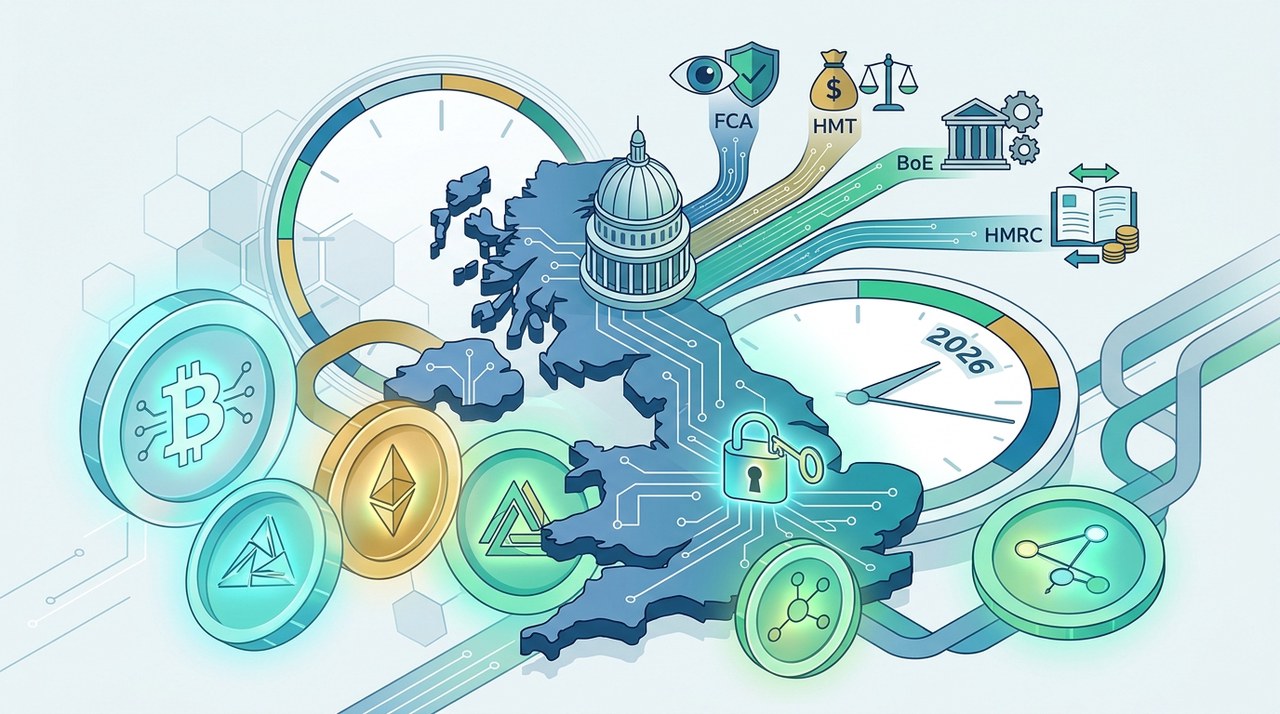
Four main institutions are directing these changes: the Financial Conduct Authority (FCA), HM Treasury (HMT), the Bank of England (BoE), and HM Revenue & Customs (HMRC). Below is a complete breakdown of the timeline, rules, and expectations.
UK Crypto Regulation Timeline 2026
Throughout 2026, the UK government implemented several milestones to regulate digital assets.
- January 1, 2026 – Crypto Transaction Reporting Rules: The UK introduced the Cryptoasset Reporting Framework (CARF). Crypto exchanges, brokers, and service providers must collect customer identity and transaction data. The initial reporting period covers 2026 activity and is due by May 31, 2027.
- January 23, 2026 – FCA Proposes New Business Rules: Through consultation paper CP26/4, the FCA proposed extending Consumer Duty, customer protection, safeguarding, training, and reporting requirements to crypto firms. The consultation ended on March 12, and final rules were published on June 30.
- February 4, 2026 – Major Crypto Regulation Law Enacted: Parliament enacted the Financial Services and Markets Act 2000 (Cryptoassets) Regulations 2026. Treasury commissioners Stephen Morgan and Christian Wakeford signed the legislation, placing trading, custody, stablecoins, and staking under FCA oversight. The full regime is set to take effect on October 25, 2027.
- April 2026 – Stablecoin Proposals: HM Treasury released a draft proposal moving specific UK-issued stablecoin activities from general crypto trading rules into a separate payments framework. The FCA simultaneously opened a consultation to define supervised crypto activities, which closed on June 3, 2026.
- June 30, 2026 – Final Rules for Market Listings: The FCA published PS26/9 regarding cryptoasset admissions, public offers, and market abuse. It introduced disclosure requirements, due diligence standards, and controls against market manipulation and insider trading on regulated platforms.
- July 13, 2026 – DeFi Tax Relief Proposals: HMRC published draft legislation revising how crypto loans and liquidity pools are taxed. This prevents users from facing Capital Gains Tax (CGT) on certain DeFi activities when no cash is received and no assets are sold. The change was confirmed in the October 28 Autumn Budget.
- September 15, 2026 – Rule Clarifications: HM Treasury presented the Financial Services and Markets Act 2000 (Cryptoassets) (Miscellaneous Amendments) Regulations to Parliament. These covered stablecoin payment setups, temporary settlement services, proprietary trading, and technical services for decentralized protocols.
- September 30, 2026 – Final Licensing Guidance: The FCA released PS26/18, detailing which activities require regulatory approval. Existing crypto firms can apply for authorization until February 28, 2027, to receive transitional protections.
- October 28, 2026 – Budget Tax Announcements: Chancellor John Healey presented Budget 2026, confirming updated tax treatments for eligible stablecoins, crypto loans, and liquidity pools under Finance Bill 2026–27.
- November 2, 2026 – CARF Guidance Updates: HMRC updated CARF reporting guidelines for customer data submissions. It removed the planned January 2027 reporting launch due to online service delays, while keeping the first reporting deadline of May 31, 2027.
- November 18, 2026 – Regulatory Exemptions: Treasury commissioners Christian Wakeford and Shaun Davies signed the Cryptoassets (Miscellaneous Amendments) Regulations 2026, exempting certain market-making, proprietary trading, and technical services from authorization. Most provisions took effect the next day.
Who Regulates Crypto in the UK?
The UK does not rely on a single entity for crypto oversight. Instead, regulatory authority is split among four primary institutions.
Financial Conduct Authority (FCA)
The FCA serves as the primary day-to-day supervisor for crypto companies. Its duties cover anti-money laundering (AML) registration, financial promotion compliance, market abuse enforcement, and consumer protection.
Bank of England (BoE)
The Bank of England maintains financial stability and handles stablecoin oversight. It works alongside the FCA to supervise systemic stablecoins and operates the Digital Securities Sandbox.
HM Treasury (HMT)
HM Treasury establishes the overarching legislative framework. It determines which digital asset operations fall within statutory regulations and holds the power to designate stablecoins or payment systems as systemic under the Banking Act 2009.
HM Revenue & Customs (HMRC)
HMRC oversees crypto taxation, including Capital Gains Tax, Income Tax, and Corporation Tax. It also manages the UK's execution of the Crypto-Asset Reporting Framework (CARF).
Crypto Taxation in the UK 2026
Crypto tax obligations depend on the type of transaction and individual financial thresholds.
Capital Gains Tax (CGT)
- Rates & Allowance: CGT rates are 18% or 24%, with an annual tax-free allowance of £3,000.
- Taxable Events: Tax applies when selling crypto, swapping tokens, spending crypto, or making taxable gifts.
- Reporting: Gains must be reported via form SA108 if gains exceed £3,000, total disposal proceeds exceed £50,000, or when claiming losses.
Income Tax
- Rates & Allowance: Income tax rates are set at 20%, 40%, or 45%. The annual allowance is £1,000, which will rise to £3,000 starting April 6, 2027.
- Taxable Events: Applies to staking rewards, mining income, qualifying airdrops, and crypto received as employment payment.
- Reporting: Income must be declared via form SA100 once taxable earnings exceed the £1,000 allowance.
Exemptions and Capital Loss Claims
Simply buying and holding crypto, or transferring tokens between self-owned wallets, does not trigger Capital Gains Tax. Tax relief is also available for qualifying transfers to spouses, civil partners, or registered charities.
If you sell, swap, or spend crypto at a loss, those losses can be claimed through form SA108 or directly with HMRC to offset capital gains in current or future tax years.
Crypto Mining Rules and Regulations
Crypto mining remains legal in the UK and does not require an FCA operating license. However, miners must meet electricity supply standard business codes and adhere to HMRC taxation guidelines.
HMRC categorizes mining as either a hobby or a commercial business. Hobby miners pay Income Tax on the fair market value of rewards received. Commercial miners pay tax on net trading profits and may deduct allowable business expenses.
If mined tokens are later sold, swapped, or spent, any price appreciation is subject to Capital Gains Tax (18% or 24% above the £3,000 allowance).
Crypto Adoption Rates in the UK
Participation in digital assets remains notable across the United Kingdom:
- Ownership: Approximately 8% of UK adults owned crypto in 2026. This is down from 12% in 2024, but double the 4% recorded in 2021. General crypto awareness stands at 91%.
- Demographics: 15% of adults aged 18–34 own crypto, compared to 9% of those aged 35–54, and 2% among those 55 and older. By gender, 11% of men own crypto compared to 5% of women.
- Asset Preferences: Bitcoin is held by 57% of UK crypto investors, followed by EthereumETH+2.85% (43%), SolanaSOL+3.70% (21%), DogecoinDOGE+2.02% (20%), and XRPXRP+2.04% (20%).
- Storage Habits: Around 73%–74% of investors use centralized exchanges to trade or store assets, while 13% utilize non-custodial cold wallets.
The UK Government's Bitcoin Holdings
The UK government holds approximately 61,245 Bitcoin (BTCBTC+3.78%), making it the third-largest sovereign Bitcoin holder globally behind the US and China. These holdings are valued between $3.5 billion and $3.8 billion.
These assets were not acquired for a strategic reserve. The Metropolitan Police seized over 61,000 BTC during an investigation involving Zhimin Qian, who operated a major investment fraud scheme in China from 2014 to 2017 before relocating to the UK.
Key Regulatory Dates Ahead
The full UK crypto regulatory framework is scheduled to take effect on October 25, 2027.
Before this date, existing crypto firms must complete the FCA authorization process, with the key deadline for transitional protections set for February 28, 2027. Additionally, the first CARF tax submissions for 2026 transactions are due by May 31, 2027.
Frequently Asked Questions
Who regulates crypto in the UK?
The Financial Conduct Authority (FCA) oversees day-to-day operations and consumer protection, working alongside HM Treasury, the Bank of England, and HMRC.
What are the UK crypto tax rates?
Capital Gains Tax ranges from 18% to 24% for gains above £3,000. Income tax ranges from 20% to 45% for mining, staking, or earned crypto above the £1,000 allowance.
Latest blog posts


Ex-Mt. Gox CEO Warns Pump.fun Users on Key Security
Former Mt. Gox CEO Mark Karpelès has warned Pump.fun users that importing private keys during the platform's account migration could expose them to security risks.
|

Meta AI Chief Warns Superintelligence Is Arriving Soon
Meta AI chief Alexandr Wang points to a 167-year-old math proof as evidence of superintelligence, despite Meta spending billions on AI.
|
US Bitcoin ETFs See $1.79B Outflow as BlackRock Leads Exits
US spot Bitcoin ETFs recorded $1.79 billion in net outflows between Nov 16 and 20, driven largely by redemptions from BlackRock's IBIT fund.
|