


Crypto Market Structure 101: A Beginner Guide
What Is Crypto Market Structure?
Have you ever wondered what actually happens behind the scenes when you click buy or sell on a crypto app? Just like traditional stock markets, cryptocurrency trading relies on a complex network of platforms, rules, and participants. This setup is known as market structure.
Understanding crypto market structure is like learning the rules of the road before driving a car. It helps you understand where liquidity comes from, how prices are set, and how your trades get processed. Whether you are brand new to digital assets or looking to deepen your knowledge, mastering these fundamentals will make you a smarter trader.
Centralized vs. Decentralized Exchanges
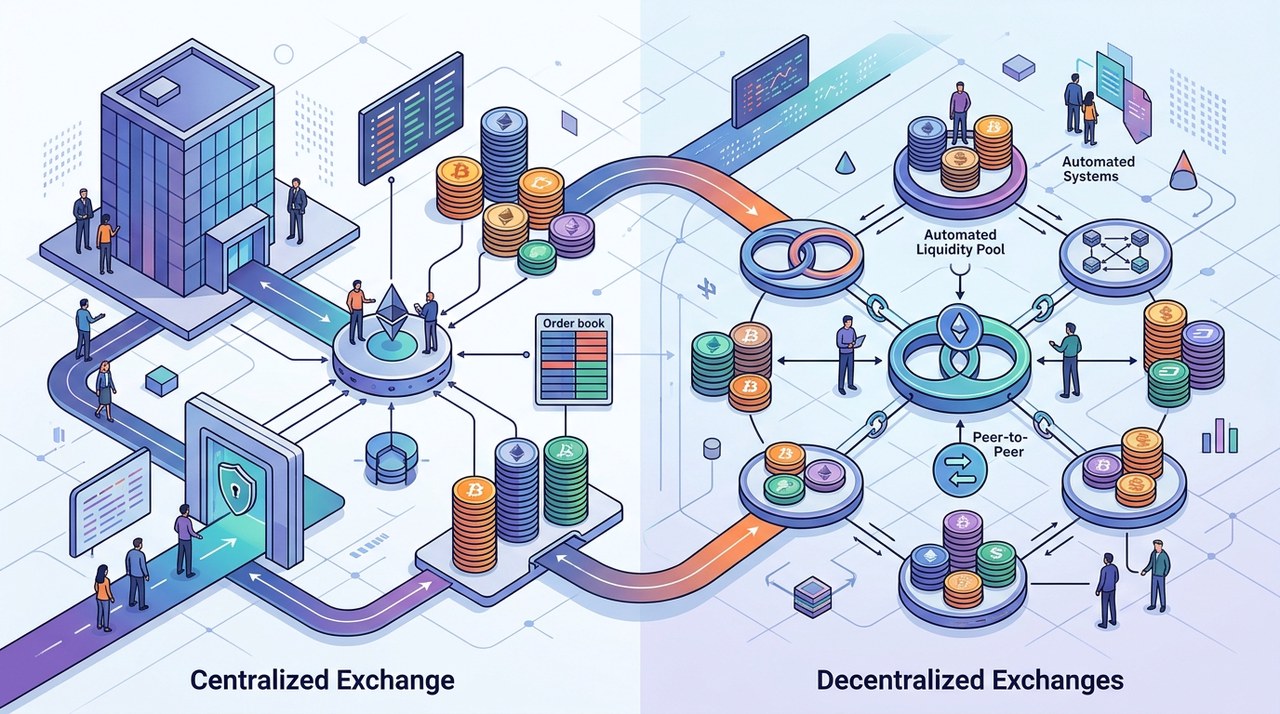
Cryptocurrency trading primarily happens across two types of platforms: Centralized Exchanges (CEXs) and Decentralized Exchanges (DEXs). Both serve the goal of trading assets, but they work in completely different ways.
Centralized Exchanges (CEXs)
A centralized exchange acts as an intermediary between buyers and sellers. You can think of a CEX like a traditional bank or stock brokerage. When you use a CEX, you deposit funds into an account controlled by the company running the exchange.
CEXs use an internal database called an order book to match buyers and sellers in real time. Because transactions occur off-chain within the exchange system, trades on a CEX are blazing fast and cheap. However, the trade-off is custody: you must trust the exchange to secure your funds.
Decentralized Exchanges (DEXs)
A decentralized exchange operates without a central company or middleman. Instead of trusting an intermediary, traders interact directly with smart contracts on the blockchain using self-custody wallets.
Instead of traditional order books, most DEXs use Automated Market Makers (AMMs). AMMs rely on liquidity pools—funds provided by users—to automatically execute trades using mathematical formulas. While DEXs offer full user control over private keys, transactions occur on-chain, which means users pay network gas fees.
- CEX Features: Easy onboarding, fiat support, high speed, custodial risk.
- DEX Features: Peer-to-peer trading, non-custodial, transparent smart contracts, gas fee dependence.
Trading Pairs and Settlement
In crypto markets, assets are always traded in pairs. A trading pair tells you which asset you are selling and which asset you are receiving in return.
For example, in the BTCBTC-2.53%/USDT trading pair, Bitcoin (BTC) is the base currency and TetherUSDT-0.61% is the quote currency. If the price of BTC/USDT is 60,000, it means 1 Bitcoin costs 60,000 USDT.
Settlement refers to the final step where ownership of the asset is officially transferred. On centralized exchanges, settlement happens instantly on internal ledgers. On decentralized exchanges, settlement occurs directly on the underlying blockchain network once the transaction is validated by miners or validators.
Understanding Order Types
When you enter a trade, you have to tell the exchange how you want your order executed. Different order types give you control over execution speed and price accuracy.
- Market Order: Fills immediately at the current best available market price. It guarantees speed but not exact price.
- Limit Order: Sets a specific price at which you are willing to buy or sell. It guarantees price accuracy, but the trade will only fill if the market reaches your target.
- Stop-Loss Order: An automated instruction to sell an asset when it drops to a set trigger price, helping limit downside risk during sudden price falls.
Leverage and Perpetual Futures
Beyond spot markets where you buy and sell actual tokens, crypto markets feature active derivatives trading. Derivatives are financial contracts that derive their value from an underlying cryptocurrency.
The most popular crypto derivative is the Perpetual Swap (Perp). Unlike traditional futures contracts that have an expiration date, perpetual futures can be held indefinitely. Exchanges use a mechanism called the funding rate to keep perpetual contract prices aligned with spot market prices.
Traders often use leverage in futures markets, borrowing funds from the exchange to open larger positions. While leverage can magnify gains, it equally magnifies losses and introduces the risk of instant liquidation if the market moves against you. High-leveraged trading involves significant risk and requires strict risk management practices.
The Role of Market Makers and Liquidity
Liquidity measures how easily an asset can be bought or sold without causing a significant price change. A highly liquid market has plenty of buyers and sellers, resulting in smooth trading and narrow bid-ask spreads.
Market Makers are key participants who ensure liquidity exists. These specialized firms place buy and sell orders simultaneously on order books, standing ready to trade with anyone. By doing so, market makers keep markets running smoothly, reduce slippage, and lower transaction costs for everyday retail traders.
Key Market Players in the Ecosystem
The crypto market ecosystem brings together a diverse set of participants, each fulfilling a unique role:
- Retail Traders: Individual investors buying and selling crypto for personal portfolios.
- Institutional Investors: Hedge funds, family offices, and corporations that trade large volumes of capital.
- Whales: Large holders of specific cryptocurrencies whose individual trades can cause noticeable market ripples.
- Arbitrageurs: Traders who profit from minor price differences for the same asset across different exchanges.
- Infrastructure Providers: Node operators, validators, custodians, and blockchain developers who maintain the tech stack.
How Crypto Fundraising Works
Crypto projects raise capital through specialized Web3 fundraising models designed to distribute tokens to early supporters and investors.
Common fundraising methods include:
- ICO (Initial Coin Offering): Early public token sales directly hosted by the project team.
- IEO (Initial Exchange Offering): Token sales hosted and vetted by centralized exchanges.
- IDO (Initial DEX Offering): Decentralized token launches conducted via liquidity pools on DEX launchpads.
- Venture Capital (VC): Private investment rounds where specialized crypto venture firms provide early-stage capital in exchange for equity or tokens.
Final Thoughts for Beginners
Understanding market structure allows you to navigate the crypto landscape with greater confidence. By learning how exchanges match orders, how liquidity flows, and how derivatives function, you can make more informed choices for your crypto journey.
Past performance of digital assets is not a guarantee of future returns. Crypto markets remain volatile, and investors should always evaluate their personal risk tolerance.
Latest blog posts

Bitcoin Pulls Back to $60,000 as Stock Rally Fails to Budge Crypto
Bitcoin has pulled back to around the $60,000 mark following a brief price bounce, even as U.S. stock markets show signs of cooling off.
|
Bitcoin Drops as Spot ETF Outflows Reach Record $4.71B
Bitcoin experienced price pressure as spot Bitcoin ETFs recorded a massive $4.71 billion in net outflows during November 2026.
|
South Korea Proposes Bank-Led Stablecoins and ICO Comeback
South Korea's new draft bill proposes bank-led stablecoins, lifting the 2017 ICO ban, and setting a 20% cap on crypto exchange stakes.