
Core Scientific to Exit Bitcoin Mining by 2026 to Focus on AI
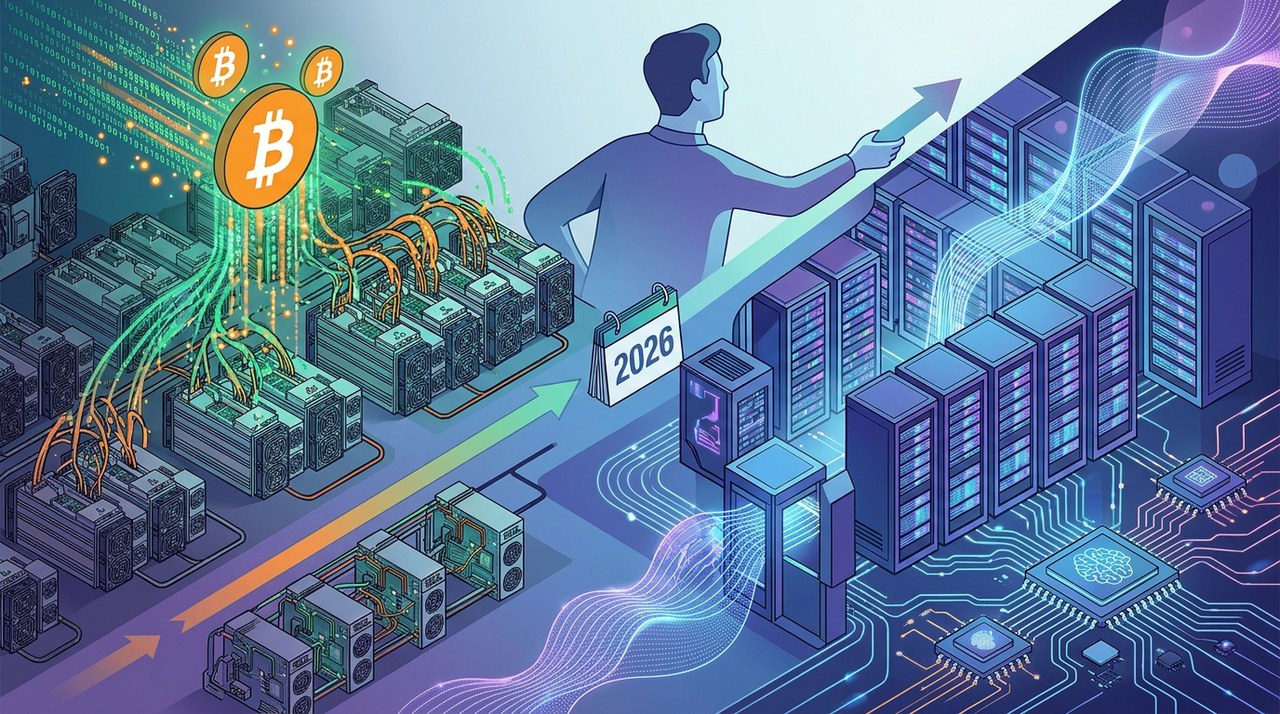
Core Scientific, one of the largest names in cryptocurrency mining, is officially preparing to leave the Bitcoin mining business behind. During its Q3 2026 earnings call, the company confirmed plans to fully wind down its self-mining operations by the end of Q4 2026.
Starting in 2027, Core Scientific will pivot its business model entirely to providing data center space for artificial intelligence (AI) and high-performance computing (HPC) workloads. The company is not alone in making this strategic decision. A growing list of major public mining firms—including MARA Holdings, Riot Platforms, HIVE Digital, and Hut 8—are also redirecting their energy capacity away from Bitcoin to capture higher profits in the booming AI sector.
Inside Core Scientific's Financial Pivot
The financial results from Core Scientific's Q3 2026 report clearly illustrate why the company is shifting direction. Data center colocation revenue reached $215.4 million for the quarter, marking a nearly 60% increase from the previous quarter.
Colocation services accounted for a massive 93% of the company's total revenue during Q3. In contrast, Bitcoin self-mining generated just $12.3 million over the same timeframe. The business model shift delivered strong profitability, driving Adjusted EBITDA to $133.6 million with a 57% margin.
As of September 30, 2026, Core Scientific was actively billing clients for 485 megawatts (MW) of power capacity. To speed up the transition to AI hosting, the firm has taken several decisive steps:
- Reduced its active Bitcoin mining fleet by nearly 50% compared to end-of-2025 levels.
- Paid $41.9 million to terminate its mining equipment supply deal with Block and Proto, stopping all future hardware deliveries.
- Absorbed a $266.5 million asset impairment loss earlier in the year due to challenging Bitcoin mining economics.
Why Bitcoin Miners Are Pivoting to AI Data Centers
The underlying economics of Bitcoin mining have become increasingly difficult for large-scale operations. Following the April 2024 Bitcoin halving, the block reward dropped from 6.25 BTCBTC-5.37% down to 3.125 BTC.
As a result, the average cost for public mining companies to produce a single Bitcoin rose to approximately $88,341. When Bitcoin trades near or below $80,000, miners risk losing money on every coin mined. Even during price rebounds above $80,000, operational margins remain under significant pressure.
Past performance of digital assets does not guarantee future results. Digital asset prices are highly volatile, and mining profitability depends heavily on fluctuating power costs and asset values. Investors can review historical prices and market pairs on Bitkub Market.
At the same time, electrical infrastructure yields far higher financial returns when serving AI data centers instead of processing Bitcoin blocks. According to energy infrastructure analysts, one megawatt of power generates roughly $1.9 million in revenue over five years through Bitcoin mining. That same megawatt can generate approximately $7.9 million over five years when dedicated to AI workloads.
This vast difference makes long-term AI hosting contracts far more attractive for infrastructure owners. Core Scientific has already capitalized on this demand through an agreement with AMD and Neocloud covering roughly 530 MW of capacity. AMD also holds reservation rights for up to 1,925 MW of additional potential capacity.
A Major Industry-Wide Transformation
Core Scientific's decision reflects a broader wave of transformation across the crypto mining industry. Several other key market players are making similar moves:
- MARA Holdings: Sold approximately 15,133 BTC in March for around $1.1 billion and reduced its workforce by 15% to reallocate capital toward balance sheet strength and new growth avenues.
- Riot Platforms: Secured a 20-year lease for 191 MW of critical IT capacity with a prominent AI laboratory, projecting roughly $9.1 billion in revenue over the initial lease term.
- HIVE Digital: Winding down its legacy Bitcoin mining footprint in Sweden while actively expanding AI and high-performance computing facilities in Canada.
- Hut 8: Expanding into high-performance computing infrastructure to diversify away from pure play crypto mining.
In total, industry estimates indicate that at least 35 Exahashes per second (EH/s) of computing power will be retired from publicly traded Bitcoin miners as facilities are retrofitted to power the global AI expansion.
Latest blog posts


 +1
Why the Crypto Market Lost $120 Billion Today
The crypto market experienced a sharp drop today as major digital assets fell following stock market pullbacks and leverage liquidations.
|
Ethereum Faces Rollercoaster Volatility as Analysts Eyeball Key Levels
Ethereum briefly surpassed $2,400 before pulling back under $2,300, leaving traders to weigh technical buy signals against overbought risk indicators.
|
 +2
Crypto Market Crashes as Bitcoin Drops to $76K
A sharp downturn in US tech stocks triggered a broad crypto sell-off, wiping out over $1 billion in leveraged bets as Bitcoin fell to $76,073.
|