Can Stablecoins Pay Interest? Yield and the GENIUS Act
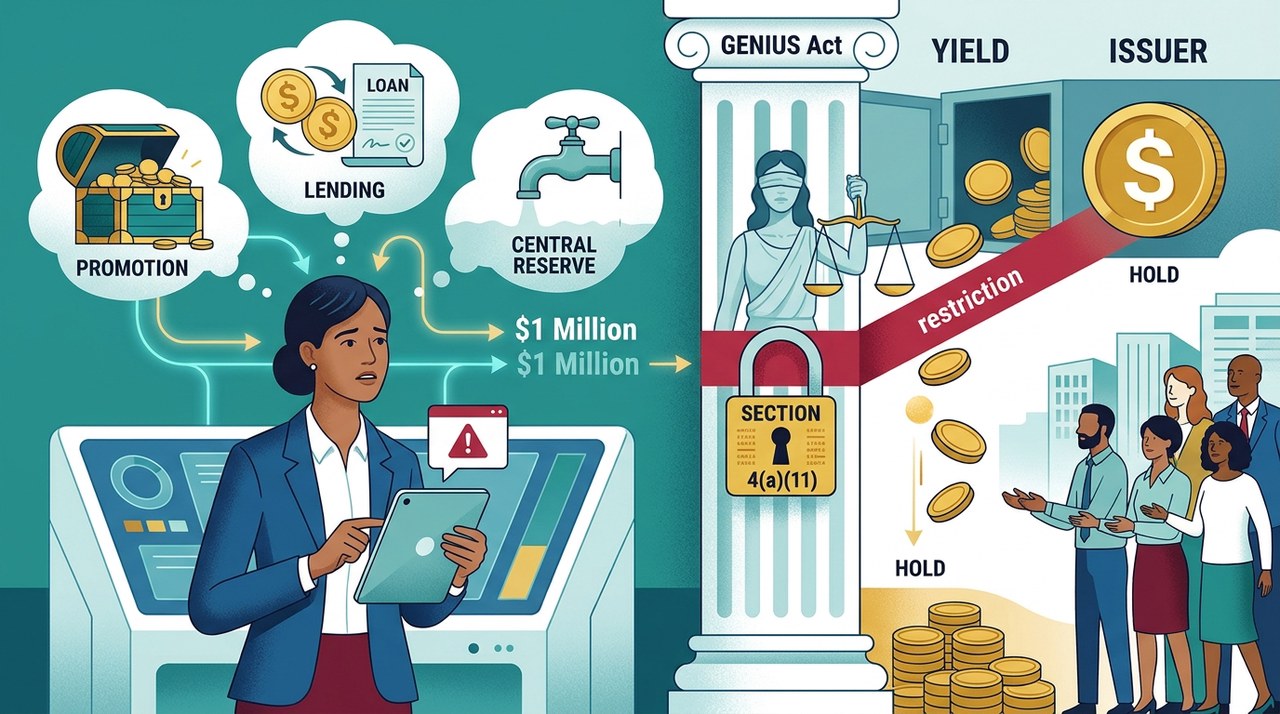
The $1 Million Payroll Dilemma
Imagine you are the treasurer of a growing company. You hold $1 million in U.S. dollar-backed stablecoins to pay your international team every Friday.
One morning, your digital wallet app displays a pop-up offering 3% annual yield on your total balance.
Before you click enroll, you must ask a crucial question: where does that 3% actually come from? Is the issuer paying you directly, is the exchange running a temporary promotion, or are you lending out your payroll funds?
The distinction matters immensely for legal compliance and financial security. Under new U.S. regulations, your legal rights and risks change completely depending on who funds the payout.
What Is the GENIUS Act and Section 4(a)(11)?
The GENIUS Act sets clear statutory boundaries for digital assets. Specifically, Section 4(a)(11) targets interest payments from stablecoin creators.
Once its restriction takes effect on January 18, 2027, a covered issuer cannot pay a holder interest or yield solely for holding, using, or retaining a payment stablecoin.
This restriction applies broadly across the digital asset market:
- Permitted payment stablecoin issuers operating within the United States
- Foreign payment stablecoin issuers serving U.S. markets
- All forms of consideration, including cash, extra tokens, and digital credits
Simply changing the name of the payout does not bypass the law. If an issuer credits your account with extra tokens or loyalty points based on your average monthly balance, it is treated as a prohibited yield payment.
Why Issuers Cannot Share Their Treasury Profits
Stablecoin issuers back their tokens with reserve assets like cash and short-term U.S. Treasury securities. These reserve assets generate interest income for the issuer.
However, earning income on backing reserves does not mean the issuer can pass those earnings to token holders. A legal promise to redeem a token for $1.00 is distinct from sharing interest profits on reserve Treasury bills.
Shifting funds between internal accounts does not solve the compliance problem either. An issuer cannot use its marketing account instead of its reserve account to fund balance rewards. If the same issuer pays the same holder for retaining tokens, it violates Section 4(a)(11).
The OCC Final Rule and the January 18, 2027 Deadline
On October 23, 2026, the Office of the Comptroller of the Currency (OCC) published its final rule enforcing the GENIUS Act provisions.
The OCC confirmed that January 18, 2027 is the strict effective date for entities within its jurisdiction.
Importantly, the rule does not grant automatic exemptions for existing promotional programs. Any business running an active yield campaign must re-evaluate its contractual obligations before that date.
Can Crypto Exchanges Still Offer Yield and Rewards?
The GENIUS Act specifically names stablecoin issuers, rather than imposing a general ban on every payment an independent business makes to a token holder.
Suppose a crypto exchange promises customers 3% annually on eligible balances. The exchange sets the rate, pays it entirely from its own corporate revenue, and receives no reimbursement from the issuer.
In this scenario, Section 4(a)(11) does not automatically ban the reward, because the exchange bears the financial obligation independently.
The Issuer-Reimbursed Pass-Through Loophole
What happens if the funding structure changes behind the scenes?
Imagine an issuer pays an exchange an amount matching customer rewards every month, and the exchange simply passes those funds along to users.
Even if users see a standard 3% exchange reward on their monthly statement, regulators will examine who supplies the underlying cash. If the issuer supplies the funds and directs the distribution, regulators have a substantial basis to treat the exchange as acting on the issuer's behalf.
As noted in legal analysis by Kelman PLLC on the OCC rule, the agency dropped a proposed presumption rule regarding third-party affiliates. However, the agency retained full authority to address rule evasion and declined blanket exemptions for white-label partners.
The Practical Test: Follow the Money Trail
Legal counsel reviewing distribution agreements often start with one simple question:
If the issuer stopped paying the exchange tomorrow, would the exchange still owe customers the reward?
While the answer is evidence rather than a standalone legal test, courts and regulators will compare it against invoices, reimbursement terms, and rate-setting authority to determine who actually funds the reward.
Commercial Discounts vs. Referral Fees vs. Balance Bonuses
Not all financial incentives are treated equally under the GENIUS Act. Regulators distinguish between commercial transactions and balance-based yields.
Allowed: Merchant Purchase Discounts
If a merchant takes $5 off a $100 invoice to encourage payment in stablecoins, that is fully permissible. The merchant is reducing the price of its own goods. The customer earns nothing by leaving $100 in a wallet for a month.
Allowed: Genuine Service and Referral Fees
If a platform pays a user $20 for introducing a new customer, this pays for a clear service: the referral. The OCC noted that payments for bona fide services generally fall outside the prohibition absent contrary facts.
Prohibited: Issuer Balance Bonuses
Consider an issuer offering a welcome bonus of $20 if a customer keeps 1,000 tokens untouched for 90 days.
Even though it is a one-time fixed dollar payout, the reward depends on maintaining a balance over time. The OCC considers this a prohibited yield payment.
Similarly, requiring one token transfer does not automatically make an issuer's reward permissible. Congress included token use alongside holding and retention in the statutory ban.
Stablecoin Lending: Higher Yields with Distinct Risks
Returning to the payroll scenario, what if clicking enroll transfers your stablecoins to a third-party borrower for 30 days in exchange for interest?
Crypto lending operates under a completely different framework than holding rewards, introducing specific counterparty and market risks:
- Counterparty Default Risk: Even if a stablecoin maintains its dollar peg, a borrower can default on repayment obligations.
- Liquidity Constraints: Even if a borrower pays in full on day 30, operational expenses like payroll may be due on day 10.
- Securities Regulations: In 2022, the SEC issued a settled order involving BlockFi Interest Accounts, finding that crypto lending accounts functioned as securities on those facts.
While BlockFi settled without admitting or denying findings before the GENIUS Act was passed, the key lesson remains: transferring assets in exchange for an investment return creates distinct legal obligations from holding a payment token.
Treasury teams should carefully read the withdrawal clause before enrolling in any yield product. You must verify who owes repayment, when you can demand your funds, and who holds the power to suspend withdrawals.
Please note: Returns on digital assets carry market risks. Past performance of digital assets or platforms does not guarantee future results.
Frequently Asked Questions (FAQ)
Does the rule treat institutional treasury accounts differently from retail holders?
No. The OCC applies the issuer restriction equally to retail investors and institutional corporate accounts. Treasury departments cannot bypass the rule by labeling interest payments as volume rebates.
Is there a minimum dollar exemption for small rewards?
No. The OCC declined to create a de minimis dollar exemption. A $5 merchant discount and a $5 issuer payment for keeping tokens in a wallet yield different outcomes because they pay for different activities, not because of the dollar amount.
What steps should platforms take before January 18, 2027?
Businesses operating rewards or yield programs should perform a comprehensive review before the effective date:
- Select each customer payout program and trace it from the user interface back to the entity bearing the financial cost.
- Compare user terms with issuer agreements and internal marketing contracts.
- Resolve discrepancies where one document describes a payment as a service fee while another ties it to daily balances or advertises it as interest.
Conclusion and Legal Context
The GENIUS Act and OCC guidelines fundamentally change how stablecoin yield products operate in the U.S. market. While issuers face strict bans on paying interest directly to holders, independent merchant discounts and genuine referral incentives remain valid.
Businesses preparing to launch or update a rewards program can consult digital asset attorneys at Kelman PLLC to review how their funding paths, terms, and customer disclosures align with current laws.
Digital asset regulatory landscapes evolve continuously. Market participants should review terms carefully and assess liquidity risks before allocating funds to yield-generating arrangements.
Latest blog posts


Anthony Scaramucci Points to Possible Bitcoin Bottom
Anthony Scaramucci and Mike Novogratz discussed potential Bitcoin bottom dates, macro factors, and key price levels during a recent market update.
|


CYBER Transfers Paused in Korea Following Bridge Exploit
South Korean exchanges suspended CYBER transfers after unexpected token minting on Solana and Ethereum bridge movements triggered an investigation.
|
Bitcoin Volume Surges to Highest Level Since February
Bitcoin daily trading volume hit multi-month highs following a drop to $55,100, triggering $562 million in liquidations as prices bounced back.
|