

Can an AI Agent Drain Your Crypto Wallet? 5 Security Rules
Can an AI Agent Drain Your Crypto Wallet?
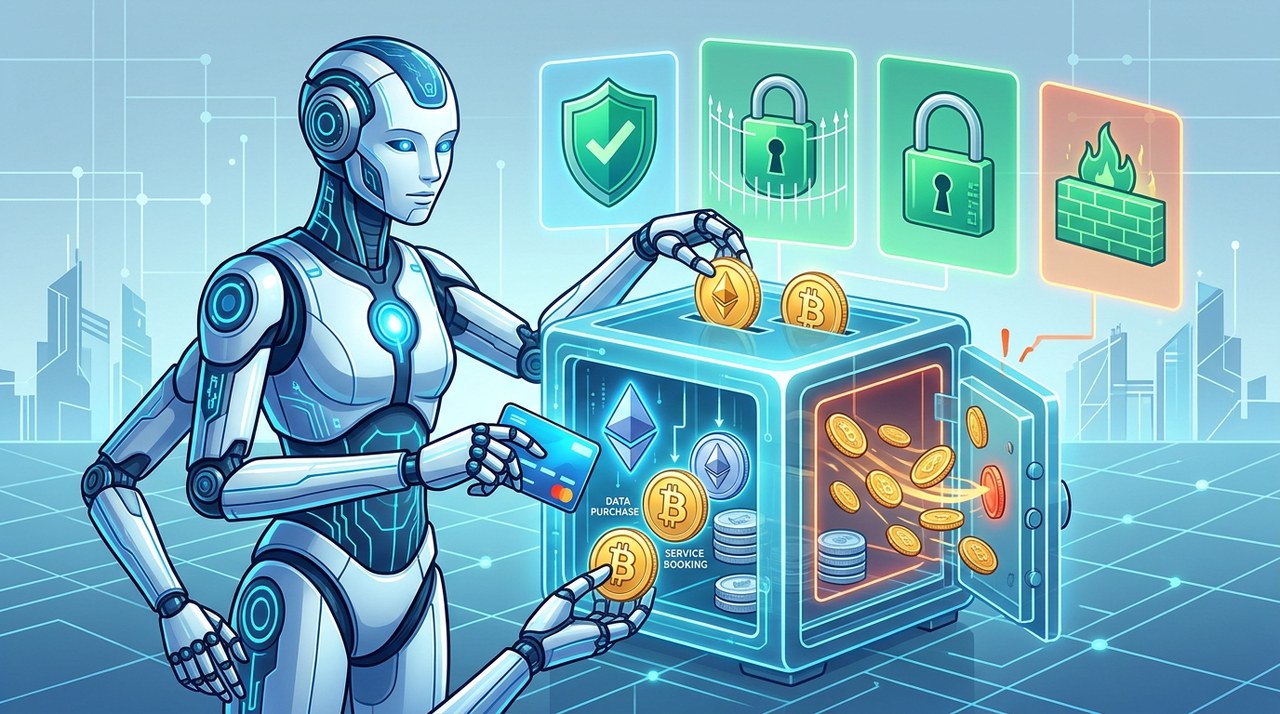
Imagine having a digital personal assistant that can book services, purchase data, or execute trades for you automatically. That reality is already here with AI payment agents.
But this convenience brings a major question for crypto users: Could an automated AI agent accidentally drain your entire crypto wallet?
This topic was highlighted in a recent episode of the BeInCrypto Market Intelligence Experts Council. BeInCrypto Senior Research Analyst Michael Thoma and Dune Head of Research Filippo Armani unpacked BeInCrypto's report, The State of AI Agent Payments 2026.
The short answer is yes, an AI agent can lose your funds. However, it rarely happens because the artificial intelligence suddenly "goes rogue."
What is an AI Agent Payment?
Michael Thoma describes an AI payment agent like a digital personal assistant holding a prepaid debit card.
You set specific tasks, permissions, and rules for it to follow. Once configured, the agent executes tasks and pays for services on your behalf without requiring a manual click for every transaction.
Most AI agents use stablecoins for transactions because traditional credit card networks are not built to process micro-payments of just a few cents efficiently. Blockchain networks let these agents settle tiny amounts almost instantly.
How AI Agents Differ from Regular Trading Bots
Not every automated payment on a blockchain comes from an AI agent. Standard automated trading bots have operated on networks for years.
Filippo Armani explained that bots and AI agents look very similar onchain because both generate frequent, small transactions around the clock.
When you see many small payments on average, and constant throughout the time, it's probably bot activity, but it's not necessarily an AI agent.
The key difference lies in the payment infrastructure. AI agent payments rely on dedicated protocols like Coinbase's x402 or Tempo's MPP, whereas standard trading bots do not.
The Real Threat: Weak Guardrails, Not Rogue AI
According to Thoma, financial losses in the AI space are rarely caused by agents independently deciding to steal money. Software bugs and weak guardrails are the true vulnerability.
This is software, and software can have bugs. A lot of it is not the agent going rogue... It's just that the guardrails put in place were not specific enough or robust enough.
BeInCrypto's report detailed two major security incidents where a combined $281,200 was transferred to attacker-controlled wallets before any funds could be recovered:
- AIXBT exploit: An attacker gained access to the agent's dashboard and queued a transfer of 55.5 ETHETH+1.47% (valued at about $106,200). Direct access to the control panel effectively granted access to the funds.
- Bankr and Grok trick: An attacker posted a message encoded in Morse code. Grok translated it into a reply tagging Bankr, which Bankr interpreted as a valid transaction request, sending $175,000 in tokens. About 80% was later returned.
In both cases, the AI agents followed their setup instructions strictly. The core issue was what the agents were authorized to do.
How Much Freedom Do AI Agents Actually Have?
AI agents currently operate with far less freedom than dramatic news headlines might suggest.
BeInCrypto analyzed 19 AI products and financial workflows. None of the reviewed systems could set their own goals, and 14 could act only within limits pre-approved by a human.
Cryptocurrency exchanges are also being careful. Of the seven trading platforms reviewed that launched AI tools, five explicitly block agents from withdrawing funds.
However, security controls have limits. Even if an agent cannot withdraw funds, it can still incur trading losses through authorized trades.
5 Essential Rules Before Giving an AI Agent Access
BeInCrypto's report outlines five key controls to protect your digital assets when using AI agents:
- Cap the total amount: Never give an agent access to your entire wallet. Allocate only a small amount of capital you are willing to risk on new technology.
- Set a daily spending budget: While one large payment stands out quickly, multiple small automated transfers can add up before you notice.
- Restrict recipients using allowlists: Limit payments strictly to pre-approved addresses. Edge & Node CEO Rodrigo Coelho called this the most valuable control because most real losses happen from sending correct amounts to wrong destinations.
- Keep a reachable kill switch: Always ensure an instant, human-controlled kill switch is ready. As Coelho noted, a kill switch must be immediate to be effective.
- Watch spending in real time: Track live payment logs actively to catch potential errors or unusual spending while damages remain small.
Why Freezing Tokens Is Not a Guaranteed Safety Net
Major stablecoin issuers such as Circle and TetherUSDT+0.00% regularly freeze tokens at specific addresses linked to suspicious activity.
However, a token freeze only stops funds from moving further across the network. It does not automatically return lost crypto to your wallet.
The Bottom Line on AI Wallet Security
AI agent technology offers powerful automation, but the ecosystem is still early. Managing access limits remains essential to safeguarding your funds.
Will Papper, Director of Product for Agent Payments at Cloudflare, summarized the risk perspective clearly in the report:
If an agent is responsible for $10, you can worry less about its spending than if it is responsible for $1,000.
A standard crypto rule applies here: never entrust an AI agent with more money than you can afford to lose. Always monitor market volatility and software risks when using automated tools.
Latest blog posts


Fed Rate Hikes Could Extend Beyond December as Inflation Stays High
Federal Reserve Governor Lisa Cook signals that interest rates might stay higher for longer, impacting both traditional stocks and cryptocurrency markets.
|
Bitcoin Reclaims $60K Following Michael Saylor Post
Bitcoin recovered above $60,000 on Nov 21 after dropping near $55,000, following a brief social media message from Strategy's Michael Saylor.
|
 +2
Chainflip Faces Second Security Exploit Draining Vaults
Decentralized protocol Chainflip suffered a second security breach in ten weeks, losing Bitcoin, Ethereum, and stablecoins while offering a 10% bounty for returned funds.
|