
Bitcoin Miners Hijacked as Luxor Promises Full Refunds
Security Hijack Hits Luxor Bitcoin Mining Platform
Imagine running a business, paying electricity bills, and doing all the hard work, only to discover your payments were redirected to someone else. That is precisely what happened recently to a select group of Bitcoin miners.
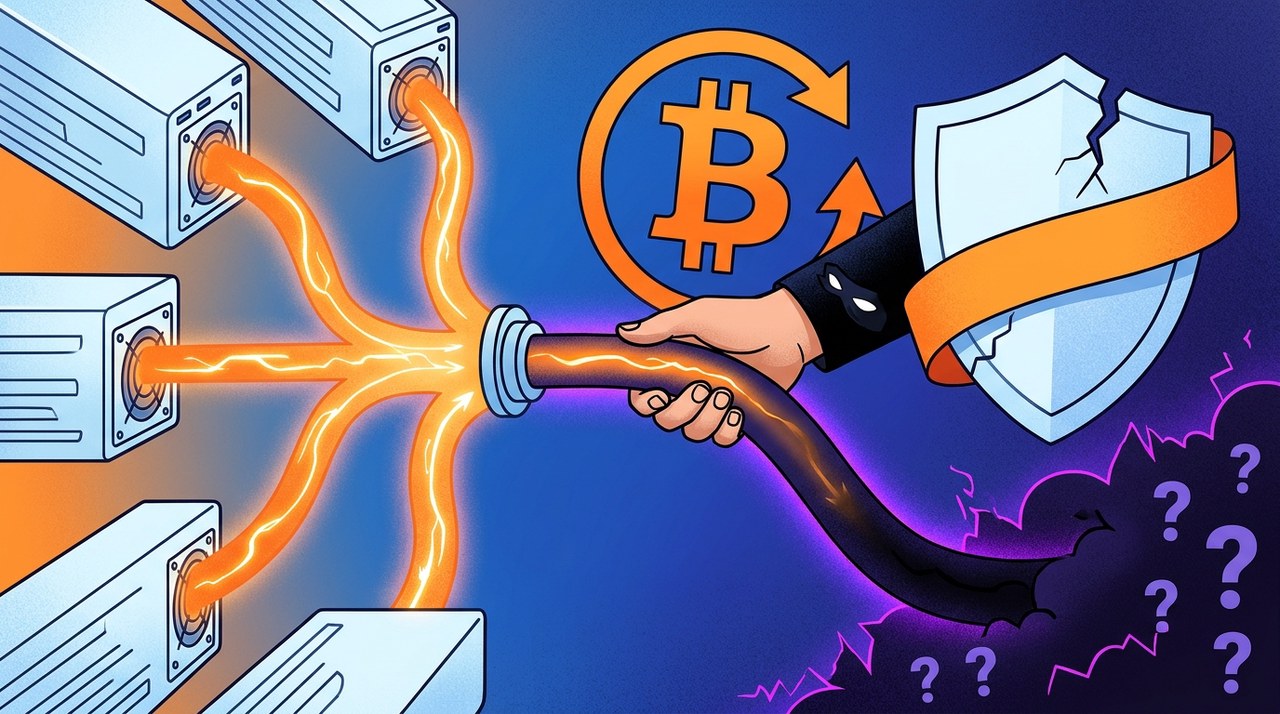
Bitcoin mining firm Luxor reported that a security incident compromised just over a dozen of its customers. An attacker managed to gain control of the connection settings, redirecting the miners' computing power—and the resulting Bitcoin (BTCBTC+0.88%) rewards—to a different pool.
How Bitcoin Mining Pools Work
To understand how this attack happened, it helps to understand the role of a mining pool.
Think of a mining pool like a group of people buying lottery tickets together. Finding a new Bitcoin block independently requires massive computing power. To smooth out earnings, individual miners connect their hardware together in pools.
The pooled computing strength—known as hashrate—increases the probability of finding a block. When the pool successfully solves a block, the reward gets split among all participants according to how much computational work they provided.
What Happened During the Hashrate Redirection Attack?
In standard operations, a miner configures their equipment to point toward a specific pool's server address using secret credentials or specific user settings.
During this attack, the unauthorized third party breached account controls or configuration paths. Instead of sending the hash power to Luxor's official payout destination, the attacker diverted the machines toward a external mining pool under their control.
The physical hardware continued operating normally and consuming power, but the payout address received by the blockchain belonged to the attacker instead of the legitimate owner.
Luxor Promises Complete Reimbursement for Affected Clients
Following the discovery of the attack, Luxor intervened to secure its platform and address the impact on affected miners.
Luxor stated that just over a dozen customers were impacted by the security breach. The company confirmed that all affected users will be fully reimbursed for the lost mining rewards accrued during the redirection period.
By offering complete financial compensation, Luxor aims to cover the missed payouts while updating its security procedures to prevent similar configuration breaches in the future.
Key Takeaways for Crypto Infrastructure Security
It is important to clarify that this breach was not a flaw in the underlying Bitcoin blockchain protocol. Instead, it was an attack on the account management and endpoint routing layer connecting individual miners to their pool operator.
As crypto mining grows more specialized, securing access points remains essential for operations of all sizes.
Best Practices for Securing Mining Rigs
- Enable Two-Factor Authentication: Secure all web portals and pool accounts with strong multi-factor authentication.
- Set Up Real-Time Hashrate Alerts: Monitor your hash power output constantly to spot unexpected drops or endpoint changes.
- Update Hardware Firmware: Keep mining software updated exclusively using official vendor downloads.
- Audit Pool Configuration: Periodically verify stratum server addresses to ensure data flows to authorized destinations.
Understanding Operational Risks in Crypto
Participating in cryptocurrency ecosystems involves managing operational risks, hardware upkeep, network security, and market fluctuations. Investors and miners must evaluate operational security as carefully as market dynamics.
Past performance of digital assets or mining outputs does not guarantee future results. You can review current prices and market trends anytime on Bitkub Market.
Latest blog posts

 +1
Spot XRP ETFs Shed $19M as Grayscale Leads Outflows
U.S. spot XRP ETFs recorded $19.13 million in weekly net outflows led by Grayscale, while XRP trades around $0.95 amid a wider market pullback.
|
Next ECB Leadership and the Future of Crypto in Europe
Christine Lagarde will step down as ECB President in February 2027, and her potential successors share a skeptical stance on digital assets.
|
How Did a Bitcoin Miner Hacker Get Paid Without Finding a Block?
A hacker hijacked thousands of Bitcoin mining rigs and redirected their power to OCEAN pool, making over $10,000 without finding a block.
|