


Bear Market Back? Crypto and Macro Highlights Explained
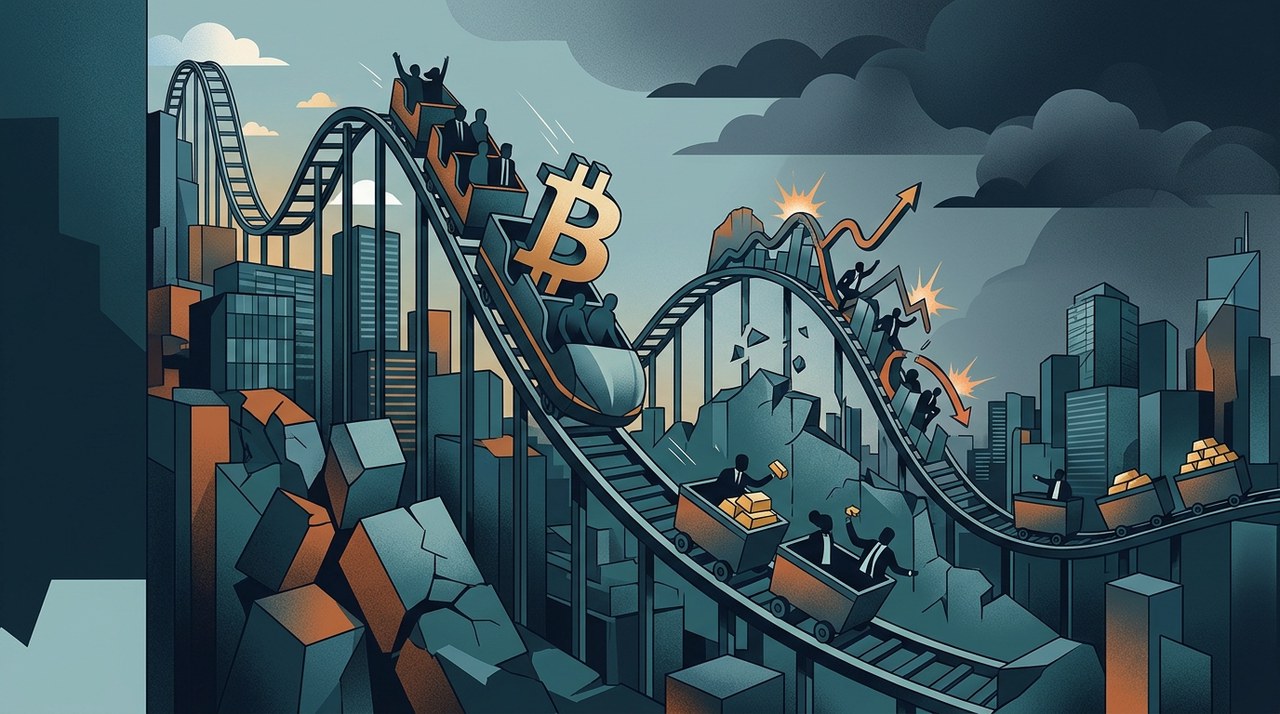
A Rollercoaster Week: Bitcoin, Stock Swings, and Gold's Drop
Welcome back! If you took a look at your portfolio recently, you might have felt a bit of market whiplash. Let's break down everything that happened across crypto, stock markets, and commodities in simple, plain English.
As of late November 2026, Bitcoin (BTCBTC+1.34%) was hovering around $61,400. On paper, that looked fairly close to where it stood the previous week. However, the path to get there was anything but calm. Over the weekend, Bitcoin slipped all the way down to $55,100, undercutting its July intraday low before staging a minor bounce.
Traditional stock markets experienced even wider swings. On Monday, the Nasdaq index surged 6.5% following news that tech giant Nvidia reinstated Jensen Huang as CEO after President Donald Trump provided the board with national security assurances. Nvidia shares jumped 31% on that announcement alone.
That stock rally proved short-lived. By Wednesday, the Nasdaq 100 index briefly plunged 20% below its record high close, while AI startup Anthropic slid below its $83 initial public offering (IPO) price. Market pressure mounted as new sweeping tariffs were proposed for 14 major trading partners, including China and the European Union—though these trade policies remain months away from full implementation.
Precious metals also felt intense pressure. Gold dropped roughly 9% during the week ending November 20, marking one of its steepest weekly declines in 25 years. Macro analyst Luke Gromen explained that negative real interest rates were previously holding up the U.S. fiscal position, Western sovereign bonds, AI equities, and major banking institutions. Gromen warned that if real interest rates remain at current levels for an extended period, other asset classes could eventually follow gold's downward trajectory.
Asian markets are already responding to these economic pressures. Over a single weekend, financial authorities in South Korea, Taiwan, and China activated emergency market protocols:
- South Korea: Officials prepared a market stabilization fund as Korean equities sat nearly 50% below their all-time peak.
- Taiwan: Regulators implemented temporary restrictions on stock short-selling.
- China: Authorities relaxed margin trading rules to support market liquidity.
Macro strategist Andreas Steno characterized these widespread interventions as signs of an acute market crisis, noting that such extreme measures often signal the tail end of forced liquidation cycles.
Are We Officially in a Crypto Bear Market?
The big question on many traders' minds is whether the digital asset sector has re-entered a prolonged bear market. Alex Thorn, head of firmwide research at Galaxy, recently withdrew his earlier October call that Bitcoin's bear market had concluded in June.
Thorn noted that Bitcoin broke below its 50-week moving average and undercut its summer low—a technical breakdown that historically has not occurred after a successful price recovery. Galaxy's technical analysis suggests that a daily close below $58,525 could open the door to lower price levels.
Under Galaxy's technical models, potential downside targets include $48,500 in a mild pullback scenario, or around $28,200 in a median historical drawdown scenario. It is important to remember that past performance of digital assets is not an indicator of future results. These price levels represent technical chart scenarios based on historical data. If broader macroeconomic conditions improve or buyer demand increases, prices could stabilize or reverse higher; conversely, continued market sell-offs could push prices toward or below those downside levels.
This technical outlook aligns with analysis from Michael Howell of CrossBorder Capital, who highlighted that global liquidity has been contracting throughout 2026. Howell outlined how the liquidity cycle typically impacts different financial markets:
- Bitcoin First: As the asset most sensitive to liquidity conditions, Bitcoin reached its peak near the turn of the year.
- Precious Metals: Gold and silver followed with peaks around January.
- Yield Curves: Government bond yield curves in the US, Japan, and Germany flattened starting in Q1.
- Equities Last: Stock markets are feeling the contraction last and are adjusting currently.
Howell anticipates that global liquidity will likely reach a bottom during the first or second quarter of 2027. He noted that when liquidity conditions eventually shift positive, the assets most sensitive to liquidity—namely gold, silver, and Bitcoin—are historically among the first to respond, though macro shifts remain subject to broader economic risks.
Additionally, crypto asset manager 21Shares highlighted Bitcoin's realized price of $53,250 as a critical support level. The firm observed that market liquidations accelerated following reports of a security incident at Binance. During this period, stablecoin supply contracted by $10.7 billion—the largest 18-day drop recorded since the collapse of the TerraLUNA-0.82% ecosystem. Spot Bitcoin ETFs also registered nearly $5 billion in monthly net outflows, marking their largest monthly redemptions on record.
Market sentiment reached exceptionally low levels. Market commentator Tatiana Koffman expressed a pessimistic view, arguing that crypto had struggled to prove its long-term utility model. Meanwhile, a prominent podcast host and token creator shared on social media: "Crypto is just sad. Get out while you still can." Much of this frustration was triggered by a high-profile exploit targeting a major memecoin creator.
Blockchain Security, L1 Rivalries, and Real-World Apps
Beyond price action, several technical developments and layer-1 blockchain strategies surfaced this week.
On the security front, Glassnode reported that a record 7.12 million BTC currently reside on wallet addresses with exposed public keys. This metric received heightened attention following online rumors that artificial intelligence labs might be getting closer to solving mathematical algorithms related to public-key cryptography. Industry experts note, however, that any real breakthrough in cracking standard encryption would affect global banking and secure communications far beyond the digital asset industry.
Despite general market headwinds, major layer-1 networks continue to pursue distinct strategic roadmaps, as highlighted by industry analyst Lorenzo Valente:
EthereumETH+1.15% Focuses on Neutrality
Lorenzo Valente noted that Ethereum is positioning itself primarily as a neutral, censorship-resistant base layer focused on acting as a store-of-value infrastructure. However, price expectations among analysts remain divided:
- Analyst Santiago Roel Santos suggested ETH could gradually drift lower toward the mid-hundreds over a two-year horizon.
- Trader Peter Brandt noted that if ETH fails to hold the $1,383 support zone, technical charts could point toward sub-$500 levels.
These analyst targets are speculative scenarios based on chart technicals. If network activity, staking demand, or layer-2 adoption surges, Ethereum's market trajectory could differ significantly from these downside projections.
SolanaSOL+2.27% Drives Commercial Growth
In contrast to Ethereum, Valente observed that Solana is embracing a more hands-on commercial strategy. Solana Labs and the Solana Foundation are actively launching applications, acquiring businesses, and expanding their ecosystem presence.
Asset manager Bitwise released a detailed valuation report for Solana, which analyst Jeff Dorman commended for applying fundamental valuation frameworks to layer-1 tokens. In Bitwise's base-case long-term projection for 2031, they outlined a theoretical price target of $385 for SOL. This projection depends on assumptions of steady user growth, developer retention, and network performance over the next several years; unforeseen network issues or shifting user preferences could lead to very different outcomes.
Stablecoin Trends and Institutional Products
Stablecoin market share continues to evolve. Network data shows TRON now accounts for 33.2% of all circulating stablecoins, up from 26.4% a year ago. Meanwhile, perpetual futures contracts now represent roughly half of all trading volume on decentralized launchpads like Fomo and Pump.fun as spot memecoin trading volume slows down.
On the institutional side, Bloomberg reported that major financial dealers, including JPMorgan, executed trades involving a new digital gold product in London. Furthermore, Polymarket CEO Shayne Coplan announced new prediction markets tracking future compute costs for Nvidia H100, B200, and B300 graphics processing units (GPUs) through 2028, effectively establishing an early pricing curve for AI compute capacity.
Privacy Tech News and Cybersecurity Incidents
Privacy-focused projects experienced a mix of regulatory and technical developments this week:
- Venice Privacy Concerns: AI platform Venice faced claims that it routed private user prompts to third-party providers rather than self-hosting. Founder Erik Voorhees dismissed allegations of data leaks, clarifying that private models retain zero user data regardless of hardware location, though he admitted documentation wording needed updates. Despite no confirmed data exposure, Venice's VVV token dropped 14% in two hours.
- Monero (XMR) Delisting: Cryptocurrency exchange KuCoin announced it will delist Monero on November 30, contributing to a 15% price drop in XMR.
- Zcash (ZEC) Adoption: On a positive note, Zcash is being considered as an integrated payment option for OpenAI's upcoming private AI inference features.
The week also saw notable cybersecurity incidents affecting both individual crypto accounts and government agencies:
Onchain tracking group Lookonchain reported that a wallet associated with crypto influencer Ansem was compromised, resulting in the unauthorized transfer of $2.15 million in USDCUSDC+0.06%. Ansem attributed the incident to unauthorized access to his Bullpen account profile. Bullpen later stated that 18 to 19 early-beta accounts were affected during the breach.
Meanwhile, U.S. government systems faced security breaches. Hackers accessed the FBI's National Crime Information Center, followed by unauthorized access to systems at the CIA and the Office of the Director of National Intelligence. CNN reported that investigators suspect an AI hacking tool known as "Artex"—which the FBI had warned about a week prior. Officials confirmed that classified computer networks were not impacted.
Finally, Microsoft issued an internal "code red" status regarding Microsoft 365 service health following a major technical outage on November 12, aiming to improve global incident response times to under one hour.
Summary: Navigating Market Cycles
Market downturns and macro shifts can feel overwhelming, but they are a regular feature of both traditional finance and crypto asset cycles. While macroeconomic headwinds, liquidity contractions, and security challenges persist, long-term protocol development and institutional exploration continue behind the scenes.
As always, staying informed, understanding risk factors, and practicing good personal security remain key when navigating digital asset markets.
Latest blog posts

XRP Spot Trading Volume Hits $21B Despite Price Drop
XRP fell below $1 in November 2026, but spot trading volume climbed to $21 billion as traders actively repositioned their holdings.
|
Adam Back Reassures Crypto World: AI Cannot Break Bitcoin
Cryptographer and Bitcoin pioneer Adam Back has dismissed fears that recent advances in artificial intelligence pose a threat to Bitcoin's security.
|

Russian Investor Holds Stake in Tether as US Debt Hits $132B
A report reveals a Russian venture capitalist holds a multibillion-dollar stake in Tether, the issuer of the USDT stablecoin holding over $132 billion in US debt.
|