
Will the P vs NP Math Problem Break Bitcoin and Crypto?
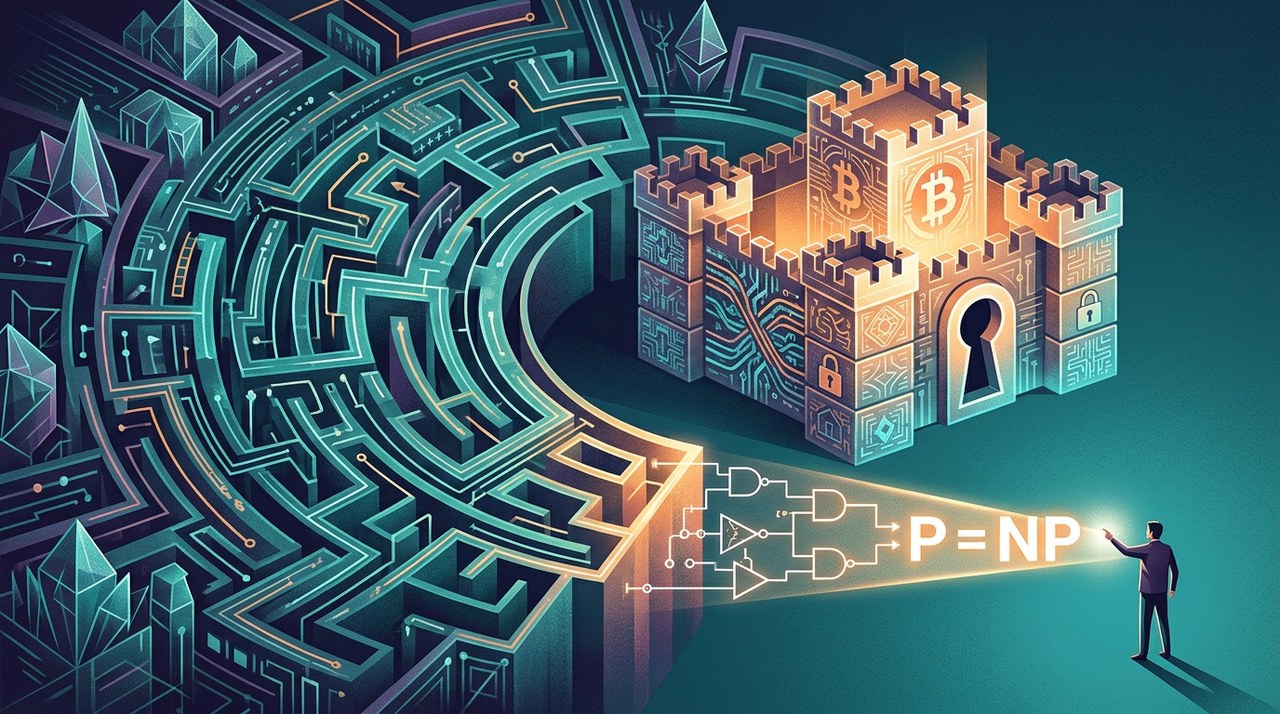
What Is the P vs NP Problem?
Have you ever wondered if a supercomputer could easily crack the codes that protect your BitcoinBTC+2.42%? To understand that possibility, we need to look at one of the biggest unsolved mysteries in computer science: the P vs NP problem.
This topic has been making the rounds across tech feeds recently. It is one of seven famous Clay Millennium Prize problems, which offer a million-dollar reward for anyone who can solve them.
At its core, the P vs NP question asks a simple question: if it is easy for a computer to check whether a solution is correct, is it also easy for that computer to find the solution from scratch?
Think of a complex Sudoku puzzle. If a friend gives you a completed grid, you can quickly double-check that every row and column has the numbers 1 through 9. That fast checking process represents NP. But filling out that empty board by yourself from scratch takes much more time and effort. Finding that answer efficiently represents P.
Can P vs NP Actually Break Bitcoin?
The short answer is no, it will not break Bitcoin.
P vs NP is fundamentally a question about computational efficiency. Most computer scientists strongly believe that P does not equal NP (P != NP). This means that some complex problems will always be much harder to solve than they are to check.
As long as P != NP holds true, the cryptographic math behind Bitcoin and crypto wallets remains secure. The real challenge for computer scientists is mathematically proving that this assumption is true.
Why Does This Matter for Cryptography and ZK-Proofs?
Modern cryptography relies entirely on hard mathematical equations. Because of this, any breakthrough in computational theory impacts digital security.
Take Zero-Knowledge proofs (ZK-proofs) as an example. ZK-proofs are popular privacy features used in modern blockchain networks. They allow a system to verify that a transaction is valid without revealing any underlying private data.
ZK-proofs connect directly to NP problems. They work efficiently because verifying a mathematical proof takes very little computational effort, while guessing the secret key without permission is virtually impossible.
What Would Happen If P Equals NP?
What if scientists eventually proved that P = NP? In that hypothetical world, any problem that is easy to check would also become easy to solve.
If that ever happened, public-key cryptography could face real security risks. This would not only affect blockchains and crypto wallets, but it would also threaten standard internet security protocols like HTTPS that protect online banking and everyday websites.
However, researchers consider this scenario extremely unlikely based on decades of mathematical research.
Can Cryptocurrencies Solve the P vs NP Problem?
Crypto networks cannot solve the P vs NP problem through software updates.
You cannot alter fundamental rules of mathematics with code. Trying to force a blockchain to solve P vs NP would be like trying to pass a network upgrade to change the fact that 2 = 2. Math is universal.
Instead of solving the math problem, crypto projects would simply adapt to new discoveries. If math rules or computing power change, developers can upgrade encryption methods to keep networks safe.
How Does Quantum Computing Fit Into the Picture?
People often confuse the theoretical P vs NP problem with the development of quantum computing, but they are two very different topics.
P vs NP is a theoretical question about the boundaries of mathematical logic. It asks what standard computers can or cannot do theoretically.
Quantum computing, on the other hand, is a physical technology currently being built in labs. Quantum computers use principles of physics to solve specific complex algorithms much faster than traditional supercomputers.
Because quantum hardware could eventually threaten older encryption algorithms, developers are already designing quantum-resistant cryptography to secure Bitcoin and other networks well ahead of time.
The Takeaway for Crypto Security
While theoretical computer science problems sound intimidating, Bitcoin and modern blockchain networks are built on robust mathematical principles. Developers continuously track advancements in both mathematics and hardware to ensure security systems stay ahead of future challenges.
Latest blog posts

Bitcoin Traders Prepare as $7 Billion in Options Expire
Around $7 billion in Bitcoin options contracts are expiring this Friday, with market data showing a shift toward defensive positioning among traders.
|


U.S. Spot XRP ETFs Buck Market Trend with $4M Daily Inflow
U.S. spot XRP ETFs registered $4.07 million in net inflows on Nov. 25, 2026, standing out as the only crypto ETF sector to gain fresh capital that day.
|

Did AI Break Encryption? What It Means for Bitcoin
Rumors suggest AI labs may have cracked key RSA encryption math, but Bitcoin relies on different security models. Here is what you need to know.
|