

Where You Stake Crypto Directly Impact Your Yields
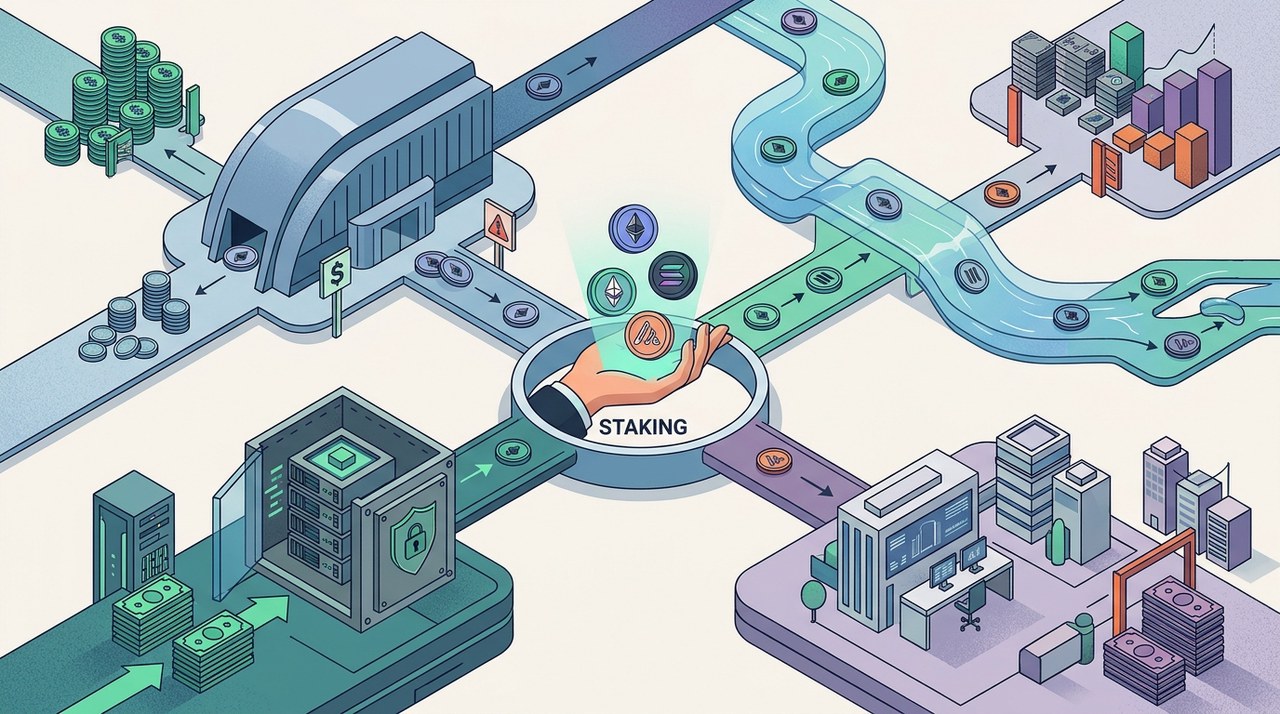
What Is Crypto Staking and Why Does Location Matter?
Crypto staking is a way to earn rewards by helping secure a blockchain network. Proof-of-Stake blockchains like EthereumETH-6.93% or SolanaSOL-6.73% rely on holders to lock up tokens to validate transactions.
Think of staking like depositing money to earn interest. However, where an investor stakes their assets changes the net return significantly.
Investors can choose between centralized platforms, liquid protocols, self-custody nodes, or institutional infrastructure providers. Each venue charges different fees and introduces unique risk factors.
Option 1: Staking on Centralized Exchanges
Centralized exchanges (CEXs) are the simplest entry point for beginners and many wealth advisors. These platforms handle all the complex server operations behind the scenes.
With just a few clicks, user tokens start earning rewards without setup headaches. Convenience comes at a cost though, as exchanges take a commission on earned rewards.
- High Convenience: No technical skill required.
- Custodial Risk: The exchange controls the private keys.
- Higher Fees: Exchanges typically take 10% to 25% of overall staking yields.
Option 2: Liquid Staking Protocols
Liquid staking protocols let users stake tokens while receiving a liquid receipt token in return. This receipt token represents the staked position and can be traded or used in decentralized finance (DeFi).
This setup solves the traditional lock-up problem. Investors do not need to wait weeks to unbond their assets if they want to sell or adjust positions.
- Capital Efficiency: Maintain liquidity while earning staking yields.
- Smart Contract Risk: Code bugs or exploits could result in lost funds.
- Low Fees: Decentralized protocols typically retain around 10% of yields to fund operator nodes.
Option 3: Native Self-Custody Staking
Native staking involves running a dedicated validator node or delegating directly from a self-custody wallet. This route cuts out intermediary platforms entirely.
Because there are fewer middleman fees, investors keep maximum yield rewards. However, running independent validator hardware requires constant uptime and technical maintenance.
- Maximum Rewards: Keep 100% of rewards (minus tiny network delegation fees).
- Full Control: Complete ownership over assets and private keys.
- Technical Barrier: Requires hardware management, internet reliability, and setup knowledge.
Option 4: Staking-as-a-Service (StaaS)
Staking-as-a-Service providers offer intermediate solutions for institutions and financial advisors. Users keep key ownership while outsourcing server operation to enterprise infrastructure firms.
This balance combines non-custodial security with professional server monitoring. StaaS providers usually take a small fixed service fee or percentage of rewards.
How Fee Structures Impact Net Returns
Platform commissions directly reduce total investor yield over time. A 4% base reward rate subject to a 20% platform fee yields a net 3.2% return.
Over long investment horizons, compounding fee differences create substantial payout gaps. Choosing an efficient staking platform can noticeably preserve overall portfolio growth.
Understanding Key Risks Involved in Staking
While staking provides recurring yield, it carries distinct operational and market risks that advisors should weigh carefully.
Slashing is a penalty where network nodes lose tokens for signing invalid transactions or going offline. Using reliable, high-uptime validators minimizes this risk.
Market volatility remains another critical factor. Staking yields are paid in native tokens, meaning dollar value moves alongside underlying token price swings.
If network activity remains strong and token prices stabilize, staking returns will stay steady in token terms. If token market prices drop sharply, net fiat portfolio valuations will decline despite accumulated rewards.
Past returns of digital assets or past performance do not guarantee future returns or performance.
Conclusion: Choosing the Right Staking Strategy
Where an investor stakes crypto depends on their priorities regarding security, convenience, and control. Beginners often trade higher fees for platform simplicity.
Institutions and experienced investors usually favor liquid staking or self-custody options. Evaluating fee cuts alongside technical risks helps ensure optimal alignment with financial goals.
Latest blog posts


Anchorage Digital Applies for CFTC Swap Dealer Registration
Anchorage Digital has applied for CFTC swap dealer registration to offer European-style Bitcoin and Ether options to institutional clients upon regulatory approval.
|

David Schwartz Shares XRP Node Data, Facing Price Queries
Ripple CTO Emeritus David Schwartz shared technical metrics for his XRP Ledger hub, but community members quickly brought the conversation back to token prices.
|
 +2
BeInCrypto at MERGE Madrid: Banks Build Stablecoin Infra
Traditional financial institutions at MERGE Madrid revealed how they are shifting from basic crypto trading to building core infrastructure for stablecoins and tokenized assets.
|