
What is Optimism (OP)?
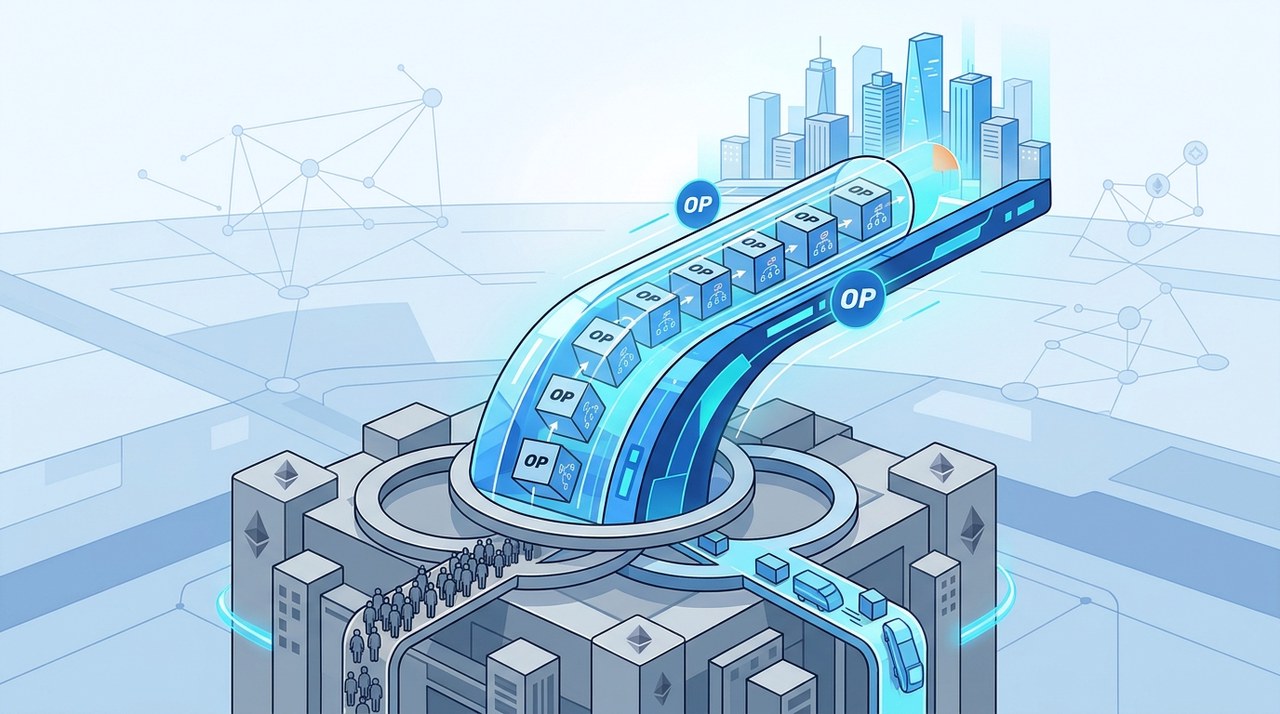
- Optimism (OP) is a leading Layer 2 scaling solution for Ethereum using Optimistic Rollups to offer faster transactions and significantly lower gas fees.
- The platform features full EVM Equivalence, allowing developers to deploy existing Ethereum smart contracts with zero code modifications.
- Through the OP Stack framework, Optimism powers the Superchain—an interconnected network of Layer 2 blockchains including Base and Worldchain.
- OP is the native governance token used to vote on protocol upgrades, treasury allocations, and ecosystem public goods funding (RetroPGF).
Introduction to Optimism (OP)
As Ethereum has grown to become the premier smart contract platform in the cryptocurrency ecosystem, it has also encountered severe network congestion and high transaction costs. The inherent architecture of Ethereum prioritizes security and decentralization, which limits the number of transactions the base layer can process per second. This bottleneck led to the emergence of Layer 2 scaling solutions designed to increase transaction throughput and lower user fees without sacrificing the underlying security provided by the Ethereum mainnet.
Optimism (OP) stands out as one of the most prominent Layer 2 scaling platforms built for Ethereum. By leveraging an innovative technology known as Optimistic Rollups, Optimism bundles hundreds of off-chain transactions into a single batch before submitting them back to the main Ethereum blockchain. This approach drastically reduces gas fees—often by 10x to 100x compared to Layer 1—while retaining the immutable security guarantees of Ethereum.
Beyond its scaling technology, Optimism has evolved into a broader ecosystem centered around open-source software and collective governance. Driven by its native governance token, OP, Optimism aims to build a sustainable, public-goods-oriented financial infrastructure through its vision of the Superchain—an interconnected network of Layer 2 blockchains sharing security, communications, and open-source infrastructure.
History and Background of Optimism
The roots of Optimism date back to 2019 with the research efforts of Plasma Group, a non-profit group of Ethereum researchers focused on Layer 2 scaling research. Key co-founders, including Jinglan Wang, Ben Jones, and Karl Floersch, recognized that while Plasma was a promising concept, it presented severe data availability and user experience limitations for complex smart contracts.
Transitioning from non-profit research to active execution, the team founded Optimism PBC (Public Benefit Corporation), later rebranded to OP Labs. Their mission was clear: construct a developer-friendly Layer 2 rollup that preserved full compatibility with the Ethereum Virtual Machine (EVM). This initiative was backed by prominent venture capital firms, including Paradigm and Andreessen Horowitz (a16z), underscoring strong institutional interest in Ethereum scaling infrastructure.
In January 2021, Optimism launched its initial soft mainnet for select protocols, followed by a public mainnet deployment later that year. In April 2022, Optimism introduced the Optimism Collective—a digital governance experiment split into two chambers—and announced the launch of the native OP governance token. The first retroactive token airdrop in May 2022 distributed OP to early adopters, active Ethereum users, and multisig signers, marking a pivotal moment in decentralized governance.
How Optimism Works: The Technical Architecture
The Concept of Optimistic Rollups
To understand Optimism, one must first grasp how rollups operate. Rollups execute transaction logic off-chain on a dedicated Layer 2 network, compress the execution data, and post the compressed batch back to Layer 1 (Ethereum). Because the data is stored permanently on Ethereum mainnet, the state of the L2 chain remains fully verifiable by anyone operating an Ethereum node.
Optimism uses Optimistic Rollups, named because the protocol optimistically assumes that all transaction data submitted to Layer 1 is valid and free of malicious activity. Rather than spending computational resources calculating complex mathematical proofs for every single batch of transactions, Optimism processes transactions instantly and assumes correctness by default.
Fraud Proofs and the Dispute Window
To guarantee security under this optimistic assumption, Optimism implements a mechanism known as Fault Proofs (formerly Fraud Proofs). Whenever a transaction batch is submitted to Ethereum, a 7-day challenge window (dispute window) opens.
During this 7-day period, any network participant (verifier or validator) can inspect the submitted transactions. If a verifier detects an invalid transaction or state transition, they can submit a fault proof to Layer 1. The Ethereum mainnet smart contract then re-executes the disputed computation. If the proof demonstrates that fraud occurred, the malicious sequencer is penalized, the incorrect state is reverted, and the honest challenger is rewarded.
This economic incentive structure ensures that executing fraud is financially prohibitive, thereby protecting the integrity of the network without requiring heavy on-chain computational overhead for valid transactions.
EVM Equivalence vs. EVM Compatibility
A key technological milestone for Optimism was achieving full EVM Equivalence, going beyond simple EVM Compatibility. Early Layer 2 solutions created custom virtual machines that required developers to rewrite or modify their smart contracts before deploying on L2.
EVM Equivalence means that Optimism adheres strictly to the official Ethereum Yellow Paper specification. Developers can deploy existing Ethereum smart contracts using standard Ethereum tooling—such as Hardhat, Foundry, Remix, and Web3.js—with zero modifications. For developers, building on OP MainnetOP-7.98% feels identical to building on Ethereum mainnet, significantly lowering the barrier to entry for decentralized application (dApp) deployment.
The Sequencer Role and Decentralization Roadmap
On OP Mainnet, transaction ordering, execution, and batch submission to Ethereum are currently managed by an entity called the Sequencer. The Sequencer acts as a block producer, offering users instant transaction confirmations and a smooth user experience.
While reliance on a centralized sequencer allows for lightning-fast speeds and micro-cent transaction fees, the Optimism core team is actively working toward sequencer decentralization. Under the modular architecture of the OP Stack, the network is transitioning to a decentralized sequencer set, ensuring that no single operator maintains control over transaction sequencing or network access.
Key Features and Ecosystem Innovations
The OP Stack: Modular Blockchain Architecture
The OP Stack is Optimism's open-source, standardized software stack that powers OP Mainnet and enables developers to build custom Layer 2 rollups. It separates blockchain operations into distinct layers: Governance, Execution, Settlement, Data Availability, and Consensus.
By modularizing these components, developers can easily plug and play tailored features. For example, a project can use Ethereum for data availability or opt for alternative solutions like Celestia or EigenDA to lower costs further, while still benefiting from the OP Stack execution environment.
The Superchain Vision
The ultimate expression of the OP Stack is the Superchain—a horizontally scalable network of independent Layer 2 chains (called OP Chains) that share a unified communication protocol, security layer, and open-source codebase.
Major industry participants have adopted the OP Stack to launch their own L2 networks within the Superchain ecosystem. Notable projects include Base (incubated by Coinbase), Worldchain (by Worldcoin), Zora Network, and Mode Network. As these chains interoperate seamlessly, users will eventually be able to move assets and data across multiple OP Chains without complex manual bridging procedures.
Retroactive Public Goods Funding (RetroPGF)
Optimism operates under the economic principle that impact = profit. Through Retroactive Public Goods Funding (RetroPGF), the Optimism Collective allocates protocol revenues and token allocations to fund developers, open-source contributors, educational creators, and infrastructure maintainers based on the impact they have already delivered.
Rather than funding speculative future projects, RetroPGF rewards proven historical contributions. This model creates strong incentives for talented developers to build open-source tools and infrastructure that benefit the broader Ethereum ecosystem.
Utility of the OP Token and Two-House Governance
The OP token is the native utility and governance token of the Optimism network. Governance is uniquely split into two distinct bodies within the Optimism Collective:
- Token House: Composed of OP token holders and their delegates. The Token House votes on technical protocol upgrades, inflation rates, ecosystem fund distributions, and governance parameters.
- Citizens' House: A non-plutocratic, soulbound identity-based chamber. Citizens govern the RetroPGF process, allocating funds to public goods without token-weighted bias.
While ETH is currently used as the gas fee asset on OP Mainnet, OP token holders exercise direct governance authority over the future evolution of the OP Stack, treasury allocations, and Superchain fee-sharing structures.
Optimism (OP) in the Crypto Market
Optimism has established itself as one of the leading digital assets by market capitalization within the Layer 2 sector. Total Value Locked (TVL) on OP Mainnet and across the broader Superchain ecosystem has experienced substantial growth as decentralized finance (DeFi) protocols, non-fungible token (NFT) marketplaces, and consumer applications migrate to L2 for cheaper execution.
Past performance of digital assets is not a guarantee of future performance.
When evaluating OP within the market, investors should analyze key fundamental metrics, including transaction volume, active wallet addresses, developer activity on the OP Stack, and competition from rival scaling technologies like Zero-Knowledge (ZK) Rollups and other Optimistic Rollups.
The broader market dynamics for OP are heavily influenced by Ethereum protocol upgrades. For instance, the implementation of EIP-4844 (Proto-Danksharding) introduced specialized data blobs, dramatically lowering the cost for Layer 2 rollups to submit data to Layer 1. Lower L2 gas fees typically spur user adoption and transaction volume; however, market values remain subject to broader macroeconomic trends and crypto asset volatility.
From an analytical perspective, market scenarios for OP depend on multiple adoption factors:
- Bullish Scenario: If adoption of the Superchain architecture expands rapidly—with major institutions deploying OP Stack chains and cumulative network usage increasing—demand for OP governance and ecosystem utility may rise over a 12-to-24-month horizon.
- Bearish Scenario: If competing Layer 2 frameworks capture market share or if Ethereum mainnet gas fees drop significantly, transaction migration to L2 could slow, potentially reducing token activity and downward-pressuring OP market evaluation.
- Neutral Scenario: If the L2 ecosystem grows moderately while competitive balances remain unchanged, OP market prices may reflect steady range-bound behavior in line with overall crypto market sentiment.
How to Buy Optimism (OP) on Bitkub
For traders and investors in Thailand who wish to access Optimism, OP can be traded securely on Bitkub Exchange, Thailand's leading regulated digital asset exchange platform. Below is a step-by-step guide to acquiring OP:
- Create and Verify Account: Download the Bitkub app or visit the website. Complete your registration and submit identity verification (KYC) to activate full trading capabilities.
- Deposit Thai Baht (THB): Link your Thai bank account and deposit THB directly via instant QR code transfer or mobile banking payment.
- Search for OP: Go to the Market page and select the OP/THB trading pair.
- Place an Order: Choose your preferred order type—either a Limit Order (setting your target purchase price) or a Market Order (executing instantly at the prevailing market price). Input the desired THB amount and confirm your trade.
- Store Securely: Once your trade is executed, your OP tokens will appear in your Bitkub Wallet. You can keep them securely on the platform or transfer them to a personal Web3 wallet compatible with the Optimism network.
Conclusion
Optimism (OP) represents a cornerstone of Ethereum's scaling ecosystem. By pioneering Optimistic Rollup technology, achieving full EVM Equivalence, and launching the modular OP Stack framework, Optimism has transformed from a single L2 rollup into a interconnected network of chains known as the Superchain.
Its unique bi-cameral governance model and commitment to funding public goods through RetroPGF differentiate Optimism as an ecosystem focused on long-term sustainability and public infrastructure. As Layer 2 adoption continues to evolve, Optimism remains a vital protocol for developers, users, and investors interested in the future of scalable decentralized finance. As with any digital asset investment, market participants should thoroughly analyze technology trends, risks, and personal financial goals before trading.