
What Is Canton (CC)? Exploring the Blockchain Built for Institutional Finance
As blockchain technology expands into traditional finance, financial institutions are exploring ways to bring assets and transactions on-chain. Canton Network aims to support this transition through blockchain infrastructure designed for institutional finance, emphasizing privacy, interoperability, and real-world asset (RWA) tokenization.
What Is Canton (CC)?
Canton Network is a public Layer 1 blockchain network designed to connect financial institutions, applications, and digital assets while preserving transaction privacy.
Unlike conventional public blockchains, where transaction data is broadly visible, Canton enables selective information sharing among authorized participants. This approach supports regulated financial activities, including securities trading, settlement, and tokenized assets.
Canton Network was announced in May 2023, followed by the launch of its decentralized Global Synchronizer mainnet in June 2024.
What Makes Canton Different? Key Features and Technology
Canton combines several technologies to address institutional blockchain requirements.
1. Privacy by Design
Canton uses a need-to-know privacy model, allowing transaction information to be accessed only by authorized participants rather than exposing sensitive details publicly.
2. Interoperability Through the Global Synchronizer
The Global Synchronizer enables independent applications to coordinate transactions while maintaining privacy, allowing financial institutions to exchange assets across connected systems.
3. Daml Smart Contracts
Canton uses Daml, a smart contract programming language designed for complex financial workflows. It enables developers to define contractual rights, obligations, and access permissions.
4. Real-World Asset Tokenization
Canton supports applications involving tokenized securities, bonds, and other financial instruments, potentially improving settlement efficiency and coordination between institutions.
Who Founded Canton Network?
Canton Network was developed by Digital Asset, a blockchain technology company founded in 2014.
Digital Asset's co-founders include Yuval Rooz, Eric Saraniecki, and Shaul Kfir. Rooz, the company's CEO, played a central role in Canton's development and launch.

Today, the independent Canton Foundation coordinates governance of the Global Synchronizer, while Digital Asset and other contributors support network development.
What Is Canton Coin (CC)?
Canton Coin (CC) is the native utility token of the Global Synchronizer ecosystem.
CC serves three primary functions:
Network fees: Paying for transaction processing through Traffic Credits.
Infrastructure incentives: Rewarding eligible Validators and Super Validators.
Application incentives: Rewarding application providers and participants contributing valuable network activity.
Its economic model is designed to link token issuance and demand to network participation and usage.
Canton Coin Tokenomics and Token Allocation
Canton Coin operates through a Burn-and-Mint Equilibrium mechanism.
Users burn CC to purchase Traffic Credits, which are consumed when submitting transactions through the Global Synchronizer. Meanwhile, newly minted CC rewards eligible network participants.
Unlike many cryptocurrency projects, Canton Coin launched without an initial coin offering (ICO), pre-mining, or reserved initial allocations for founders and venture capital investors.
How Are CC Rewards Allocated?
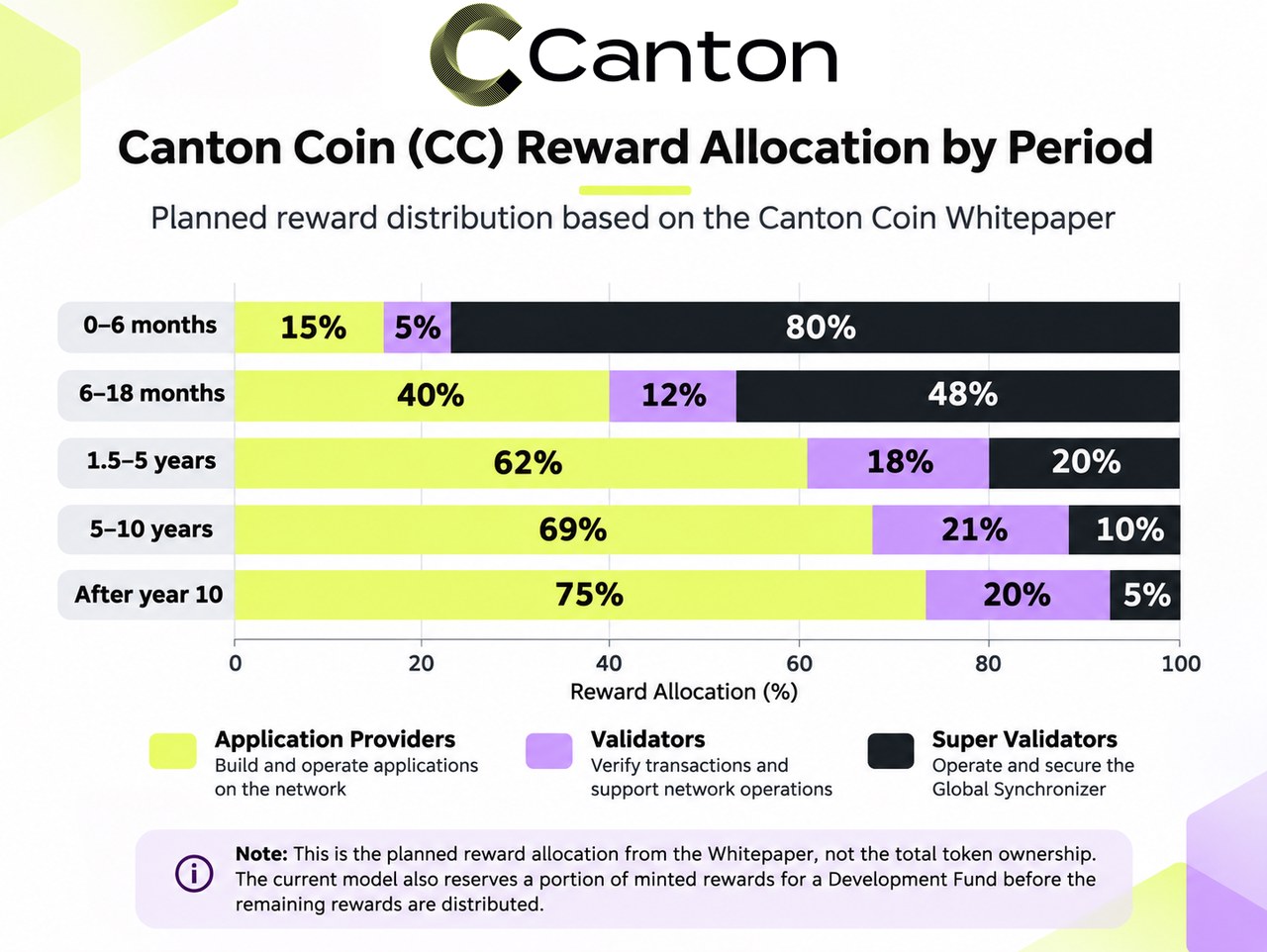
Canton's original whitepaper outlines a reward distribution schedule that gradually shifts incentives from infrastructure operators toward application providers.
Source: Canton Coin Whitepaper. Figures represent the original planned reward allocation, not total token ownership or necessarily current distributions. Subsequent governance changes, including Development Fund allocations, affect actual rewards.
Initially, Super Validators received the largest allocation to support network infrastructure. Over time, the planned share for Application Providers increases, reflecting greater emphasis on application development and network adoption.
CC Supply and Issuance
Canton's original issuance schedule allows up to 100 billion CC to be minted during the first ten years, followed by up to 2.5 billion CC annually.
These figures represent issuance limits rather than a fixed maximum supply.
Actual circulating supply depends on newly minted rewards, token burning, and applicable protocol rules.
Conclusion
Canton Network offers a blockchain infrastructure model focused on institutional finance, combining transaction privacy, interoperability, and activity-based token incentives.
However, institutional adoption does not necessarily translate into higher CC prices. Token value remains influenced by issuance, burning activity, network demand, and broader market conditions.
References
Canton Network — Official Whitepapers
Canton Coin: A Responsible Approach to Digital Tokens
Canton Network Documentation — Canton Coin Tokenomics
Canton Network Documentation — Tokenomics of the Global Synchronizer
Digital Asset — Official Website
Disclaimer: Cryptocurrency and digital tokens involve high risks; investors may lose all investment money and should study information carefully and make investments according to their own risk profile.
