

Vitalik Buterin Urges Ethereum to Focus on Store of Value
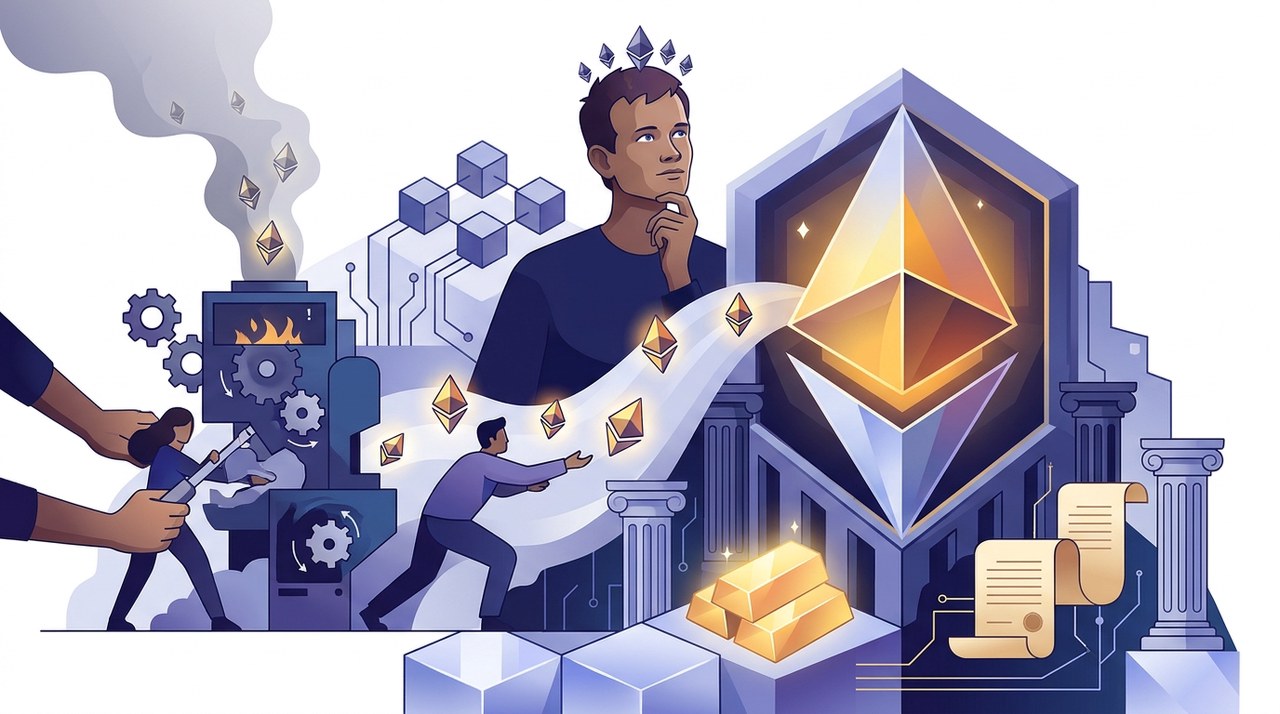
EthereumETH-2.76%'s Big Shift: Moving Beyond Fee Burning
On Sunday, November 9, 2026, Ethereum co-founder Vitalik Buterin shared a fresh perspective on the network's long-term identity. He argued that Ethereum (ETH) should embrace being a Store of Value (SoV) rather than focusing heavily on burning network fees.
At the time of his remarks, market prices showed Bitcoin (BTCBTC-2.03%) trading around $74,465 (down 1.81%) and Ethereum (ETH) hovering at $2,121 (down 5.17%). As always, remember that historical performance of digital assets is not an indicator of future results.
Vitalik explained that trying to optimize Ethereum primarily as a fee-burning machine forces the network to act like a corporate enterprise. In his view, that corporate mindset directly conflicts with Ethereum's core mission of remaining decentralized and open to everyone.
What Does 'Store of Value' Mean for Ethereum?
To understand Vitalik's argument, it helps to break down how people view crypto assets. A Store of Value is an asset that maintains its utility and purchasing confidence over time without relying on aggressive corporate revenue models. Think of physical gold or digital property.
For years, many crypto users pushed the idea that ETH should act as an 'ultrasound money' engine. Under that view, every network transaction burns a portion of ETH fees, reducing the total supply and making the token scarcer over time.
However, Vitalik believes relying on high transaction fees to drive value has major limitations. When network activity drops during market downturns, fee revenue dries up quickly.
Why Fee Burning Isn't a Permanent Solution
Back in 2021, Ethereum introduced the EIP-1559 upgrade, which began burning a portion of base transaction fees. During the height of the non-fungible token (NFT) boom, fee burning exploded, leading many analysts to praise the mechanism.
But Vitalik pointed out that those massive fee surges were driven by internal crypto trends with limited staying power. When market asset prices drop sharply, user spending power shrinks across decentralized finance (DeFi) and digital collectibles.
If ETH had dropped by 10x, then the profits from those use cases would have also dropped, because all the buyers would have had much less money to pay with.
Vitalik noted that Ethereum is moving away from speculative fee spikes toward a mature business model. Today, network activity relies more on stable, real-world utility rather than temporary hype cycles.
The Corporate Dilemma: The L'Oreal Comparison
Vitalik made a striking comparison between Ethereum's roughly $270 billion market capitalization and traditional global corporations like cosmetics giant L'Oreal.
He explained that if Ethereum tried to justify its valuation purely as a fee-earning corporate business, its operational demands would be unsustainable.
- L'Oreal spends about 0.58% of its market capitalization on research and development (R&D).
- For Ethereum, matching that ratio would require spending roughly 700,000 ETH every year.
- Spending that amount of funds on corporate operations would rapidly bankrupt the Ethereum Foundation.
Beyond the math, corporations must make opinionated choices to target specific customer demographics. If Ethereum prioritized fee profitability over neutral access, it would price out everyday users. That approach would violate its fundamental principle of open access.
The CROPS Framework: Ethereum's True Core Strength
Instead of chasing corporate fee structures, Vitalik highlighted what he sees as Ethereum's true competitive advantage: the CROPS framework.
- Censorship Resistance: No central entity can block or freeze legitimate transactions.
- Open Source: The underlying software is completely transparent and free for anyone to inspect.
- Privacy: Users should have options to protect their personal transaction data.
- Security: The blockchain remains resilient against malicious network attacks.
Vitalik believes that institutional builders choose Ethereum precisely because of these CROPS properties. A neutral, secure foundation gives developers confidence to launch long-term applications.
How Real-World Assets (RWAs) Power the Store of Value Thesis
A key piece of the Store of Value vision is the growth of Real-World Asset (RWA) tokenization. Major institutions are increasingly bringing traditional financial assets—like treasury bills and real estate—onto the Ethereum network.
RWA tokenization does not rely on massive gas fee spikes to create value. Instead, it expands what holders can do with ETH across the digital economy.
Under this model, ETH functions as neutral digital collateral. Users can easily trade ETH for other assets or lock it up to back real-world financial products.
The best social reason to care about Ethereum is because it makes decentralization and CROPS properties a reality for more people and uses. The best private reason to hold ETH is its So V properties, which are a direct consequence of that decentralization and CROPS.
How the Crypto Community Reacted
Vitalik's comments sparked wide discussion across the crypto industry, generating both praise and constructive debate.
Gabriel Shapiro, CEO and founder of Meta Le X, praised the statement as a positive sign of maturity. He called it a 'nature is healing' moment, emphasizing that smart contracts create a healthy circular economy when paired with base layer decentralization.
On the other hand, Muneeb Ali, co-founder of Stack, expressed caution. He pointed out that shifting the narrative toward a Store of Value model will face similar adoption challenges as the previous ultrasound money messaging.
Developer News: Glamsterdam Upgrade Delayed on Hoodi Testnet
Alongside the narrative discussions, Ethereum developers face technical challenges. Developers recently announced a postponement of the upcoming Glamsterdam upgrade on the Hoodi testnet.
The delay came after security researchers identified flaws in 13 smart contracts that could pose operational risks if left unaddressed.
Developer teams are actively reviewing the issue to ensure the network maintains strict safety and stability standards before rolling out the update to mainnet.
What This Means for Crypto Market Participants
Vitalik Buterin's call to embrace the Store of Value thesis highlights an evolution in how top blockchain networks view their long-term role.
If Ethereum successfully solidifies its Store of Value status through RWA integration and protocol security, it could strengthen its position as foundational financial infrastructure.
However, market conditions, competing Layer-1 blockchains, and regulatory shifts introduce ongoing uncertainty. Investors should remember that cryptocurrency markets remain volatile, and asset valuations can fluctuate significantly based on broader macroeconomic trends.
Latest blog posts

 +2
Kalshi Traders See 55% Chance XRP Could Retest $0.70
XRP fell over 8% in a single day, leading Kalshi prediction market traders to price in a 55% chance of a $0.70 retest before 2026 ends.
|

BTCS Warns SEC That Its $54M Aave Loan Faces Liquidation Risk
BTCS reduced its Aave debt by $10 million in ten days, but falling Ether prices continue to pressure its collateral.
|
Wells Fargo Leads Record $29.8B US Bitcoin ETF Holdings
US institutional investors accumulated 49,229 Bitcoin in Q3, bringing total holdings to a record 356,491 BTC despite November market pullbacks.
|