
Vitalik Buterin Sees Fast Route to Quantum-Safe Ethereum

Quantum computing has long been viewed as a distant storm cloud on the cryptocurrency horizon. If powerful quantum computers eventually arrive, they could theoretically crack the math that keeps digital wallets safe. For a long time, preparing for this threat seemed like a slow and painful journey that might make everyday transactions far more expensive.
That outlook is changing fast. EthereumETH-0.07% co-founder Vitalik Buterin recently voiced strong optimism—describing himself as a total bull—on a newly proposed route that could make Ethereum quantum-resistant much faster than previously thought, all without driving up transaction costs for everyday users.
Why Quantum Computers Threaten Crypto Wallets
To understand why this breakthrough matters, it helps to look at how public-key cryptography works today. Right now, your Ethereum wallet uses a mathematical algorithm called ECDSA (Elliptic Curve Digital Signature Algorithm).
Think of your public address like a transparent mail slot. Anyone can see it and send payments to it. Your private key is like the unique metal key that unlocks the box to spend the funds inside.
With traditional computers, calculating your private key from your public address is practically impossible. It would take classical supercomputers billions of years to guess the right combination.
However, quantum computers operate on entirely different physical principles. Using specialized mathematical algorithms, a sufficiently powerful quantum computer could derive private keys from public keys in a short timeframe. If that happens, any wallet with a publicly visible key could become vulnerable to unauthorized access.
The Post-Quantum Dilemma: Heavy Data and Sky-High Fees
Cryptographers have already created post-quantum cryptography (PQC) algorithms that quantum computers cannot crack. So why hasn't Ethereum switched to them already? The issue comes down to data size and computational cost.
- Standard ECDSA signatures are tiny, taking up about 64 bytes of data.
- Quantum-safe signatures are massive, often requiring several kilobytes of data per transaction.
- Higher data payload means every transaction consumes more block space on the blockchain.
- Increased space demands directly lead to network congestion and much higher gas fees.
If every simple token transfer required kilobytes of cryptographic data, sending a quick payment could cost users ten to twenty times more in gas fees. That trade-off between security and affordability presented a major hurdle for developers.
The Proposed Solution: Signature Aggregation
The core breakthrough highlighted by Vitalik Buterin relies on a technique called signature aggregation powered by zero-knowledge proofs.
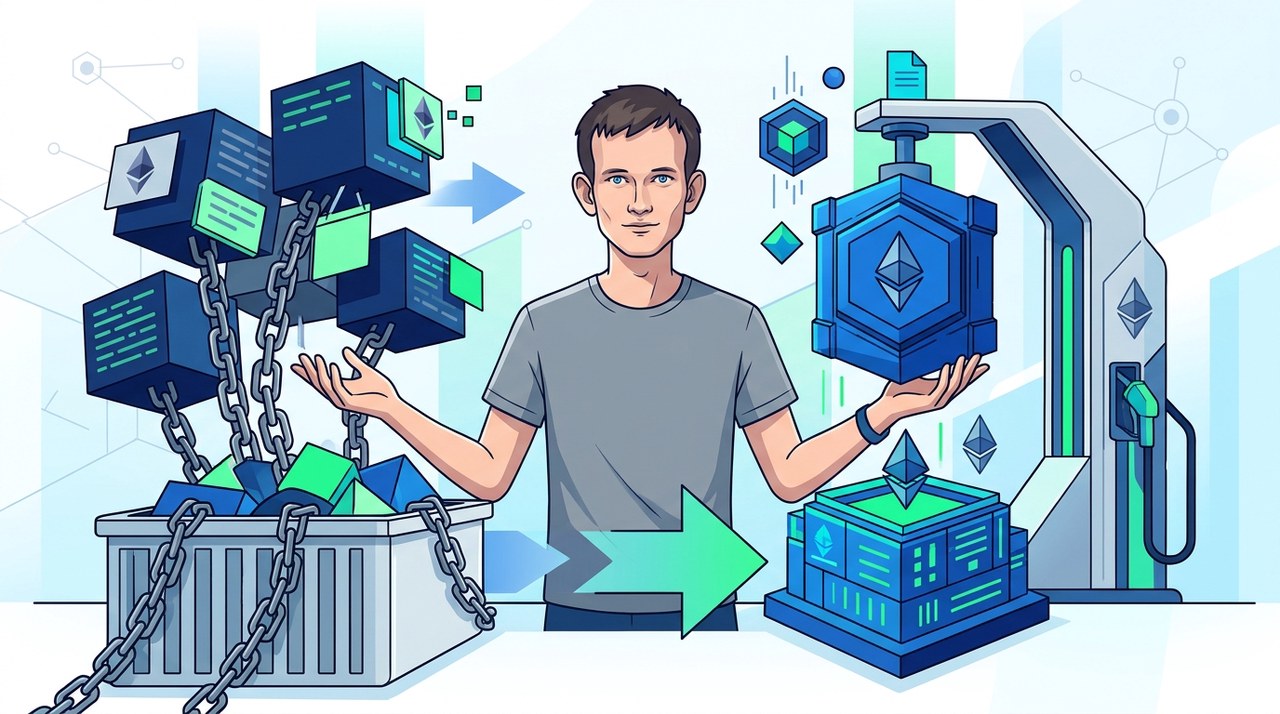
Instead of requiring every single user to attach a large, bulky quantum-safe signature to their individual transaction, a batching system compresses thousands of signatures into a single shared proof.
A proposed system would combine bulky digital signatures into a shared proof, helping protect wallets without making every payment much more expensive.
How Proof Aggregation Works: An Everyday Analogy
Imagine a tour bus carrying 100 passengers. If every passenger has to step off the bus individually, pull out a thick binder of identity documents, and get verified by a guard, the line moves at a crawl.
Now imagine the tour guide verifies all 100 binders in advance, creates a single certified summary sheet, and hands it to the guard. The guard verifies the single summary sheet in seconds, and the whole bus enters smoothly. That is essentially what shared proof aggregation achieves for Ethereum transactions.
How Account Abstraction Fits In
This quantum defense strategy builds heavily on Account Abstraction (often implemented via standards like ERC-4337).
Account Abstraction turns standard Ethereum accounts into flexible smart contract wallets. This flexiblity allows wallets to update their security rules without requiring a massive, disruptive hard fork across the entire base layer.
- Smart contract wallets validate user intent using customizable verification logic.
- Off-chain aggregators collect transactions and bundle their quantum-safe signatures together.
- A Zero-Knowledge STARK (ZK-STARK) proof is generated to verify that all bundled signatures are valid.
- The Ethereum mainnet verifies the single succinct ZK-proof, updating all wallet balances efficiently.
Why Vitalik Turned 'Total Bull' on Quantum Readiness
Vitalik Buterin's optimism stems from how cleanly this architectural design solves two problems at once: robust long-term security and low end-user costs.
Previously, developers feared that adding quantum safety would compromise network performance or require complex changes to basic wallet user experience. With advanced zero-knowledge proof systems maturing quickly, the transition path looks far smoother.
By shifting the heavy computational burden off-chain and submitting a lightweight proof on-chain, Ethereum can achieve quantum resilience ahead of schedule.
What This Means for Ethereum Users and Market Outlook
For regular crypto holders, this development is a reassuring sign of long-term network planning. Quantum computers capable of breaking 256-bit elliptic curve encryption do not exist yet, and experts estimate they are still several years or even decades away.
However, developing, testing, and deploying cryptographic upgrades across a global decentralized network takes significant time. Proactive upgrades ensure that user assets remain secure well before quantum threats become operational.
While technical improvements strengthen Ethereum's infrastructure, investors should remember that protocol developments carry implementation risks and technical complexity. Network upgrades, gas fee dynamics, and broader economic conditions can influence asset valuations in unpredictable ways.
Past performance of digital assets is not an indication of future performance. Investors interested in tracking network metrics and market activity for ETH should evaluate technical progress alongside general market volatility.
Latest blog posts


Major Wealth Firm Boosts XRP ETF Holdings by 37%
California-based EP Wealth Advisors disclosed an 18,400-share position in the Volatility Shares XRP ETF in its Q3 SEC filing, marking a 37% increase.
|

ASTER Spikes to $0.71 Before Sharp 32% Drop in Minutes
Aster (ASTER) surged 30% before falling 32% within minutes, liquidating over $9M in positions while team investigates suspected manipulation.
|
Vitalik Buterin Defends Ethereum EIP-8037 Update
Ethereum co-founder Vitalik Buterin has addressed concerns around EIP-8037, explaining why higher gas fees for account creation are needed to protect the network.
|