US Stocks Near Trading Freeze: How Circuit Breakers Work
A Tense Day on Wall Street
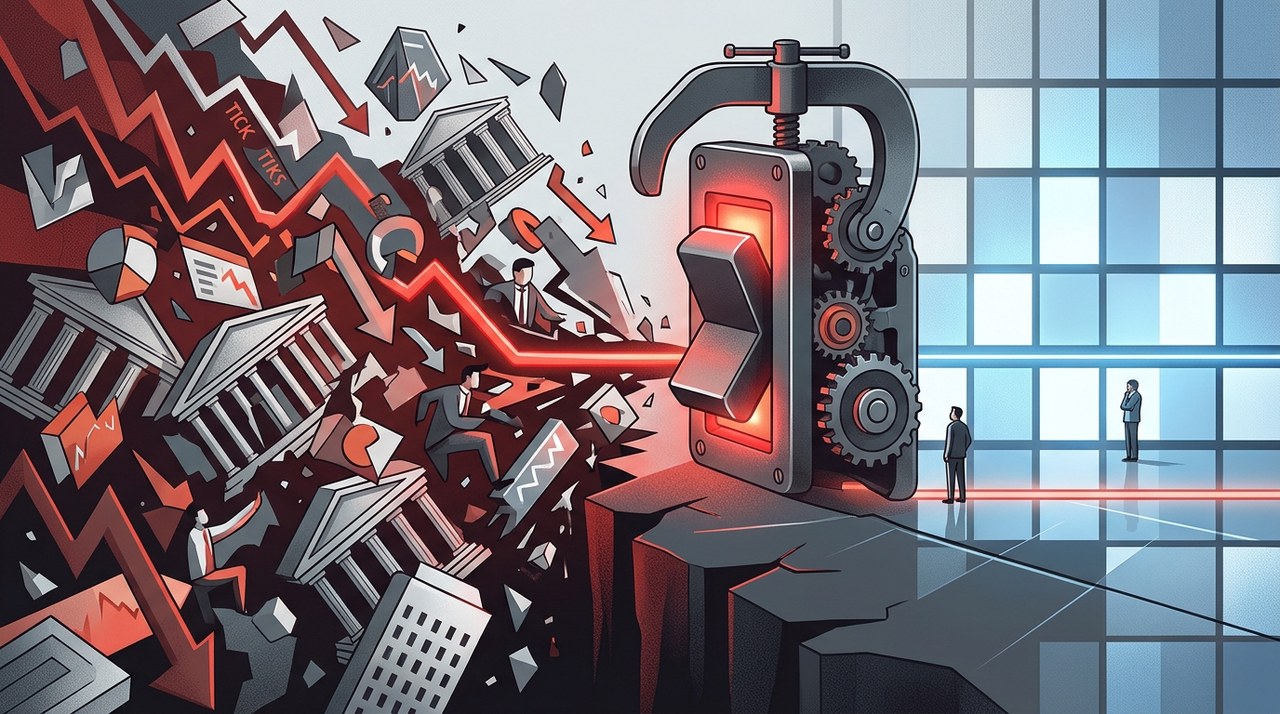
Imagine driving on a busy highway when your car suddenly slams on its emergency brakes. That is very close to what happened on Wall Street this past Thursday.
The S&P 500 index tumbled by as much as 3.8% during a steep selloff driven by technology shares. Had the index fallen just another 3.3%, it would have crossed a critical red line.
Crossing that line triggers an automatic market-wide trading freeze. When this switch is flipped, every buyer and seller in the market gets locked out of trading US stocks for 15 minutes.
Fortunately, the market managed to pull back from the edge before hitting that limit. Still, the close call left many investors wondering how these automatic safety triggers operate.
What Exactly Is a Market Circuit Breaker?
Stock market circuit breakers are automatic safety mechanisms designed to pause trading during extreme market panics.
US financial exchanges created these rules following the infamous Black Monday crash in October 1987, as documented in Securities and Exchange Commission (SEC) filings.
The goal of a trading halt is simple. It gives investors, institutions, and algorithms a mandatory timeout to absorb news and reassess positions during severe price drops.
These price triggers reset every single day. They are calculated based on the previous day's official closing price of the S&P 500 index.
On Wednesday, the S&P 500 closed at 7,688.62. That number set the exact threshold levels for Thursday's trading session.
The Three Threshold Levels Explained
US market rules establish three distinct levels for market-wide circuit breakers:
- Level 1 (7% Drop): A fall to 7,150.41 stops all stock trading across US exchanges for 15 minutes.
- Level 2 (13% Drop): A further decline to 6,689.09 triggers another 15-minute trading halt.
- Level 3 (20% Drop): A fall to 6,150.89 halts trading for the remainder of the business day.
However, there is an important timing rule that investors should keep in mind.
The Level 1 and Level 2 pauses can only be triggered before 3:25 p.m. Eastern Time (ET).
If the S&P 500 drops 7% or 13% after 3:25 p.m. ET, no trading freeze occurs. The market simply continues sliding straight until the 4:00 p.m. ET closing bell.
Why Chip Stocks Sparked Thursday's Selloff
Thursday's market decline did not happen randomly. It originated from sharp losses within the technology sector, specifically semiconductor manufacturers.
Following midterm election results on Tuesday where Democrats secured Congress, market participants expressed concerns regarding potential shifts in corporate spending.
In particular, investors feared reduced capital growth for data centers that purchase artificial intelligence (AI) chips. These AI hardware orders had previously driven significant market gains.
This sudden shift in sentiment triggered heavy selling in hardware stocks. The Philadelphia Semiconductor Index, which tracks key US chip manufacturers, dropped by 10.2% during the session.
Why Only the S&P 500 Controls the Emergency Switch
During the downturn, tech-focused indices like the Nasdaq suffered even larger percentage losses than the broader market.
Yet, even when tech shares plunge, the Nasdaq itself cannot trigger a market-wide trading freeze.
Under US regulatory guidelines, only the S&P 500 index holds the authority to trip the emergency circuit breakers across all exchanges.
Because the S&P 500 tracks 500 large public companies across multiple industries, regulators treat it as the primary indicator of broader market health.
How the Market Recovered Midday
Financial commentators and monitoring accounts tracked the index closely as it neared the 7% limit.
Under US circuit-breaker rules, the following S&P 500 levels would trigger: 7% decline — 7,150.41: 15-minute trading halt... — Walter Bloomberg (@DeItaone)
As selling pressure peaked in the morning, traders kept a watchful eye on the 7,150.41 level.
By midday, buying interest re-emerged to stabilize prices. Data from Trading Economics showed the S&P 500 rebounded to around 7,400.
This recovery left roughly 285 points of cushion above the Level 1 threshold, preventing an official trading halt for the day.
Do Circuit Breakers Calm Markets or Feed Panic?
Economists and market researchers continue to debate whether automatic market halts effectively reduce panic or inadvertently worsen it.
Market-wide circuit breakers last tripped four separate times in March 2020 during the severe financial market turbulence caused by the COVID-19 pandemic.
Some financial academics point to a phenomenon known as the magnet effect.
This theory suggests that as prices get close to a trading halt line, sellers rush to execute orders before they get locked out. That sudden rush can pull prices straight into the trigger level.
...the circuit breakers slowed, but did not completely inhibit downward pressure and the magnet effect is in play. — Laura Kodres, Senior Distinguished Fellow at MIT Golub Center for Finance and Policy
On the other hand, exchange operators argue that pauses provide necessary operational stability.
A 2022 study by the World Federation of Exchanges (WFE) analyzed the March 2020 halts and concluded that price movement stabilized after trading resumed.
...the circuit breakers in the U.S. are designed adequately and serve as an effective safeguarding mechanism. — Nandini Sukumar, CEO of the World Federation of Exchanges
Looking Ahead: What Investors Should Know
Prior to Thursday's market drop, media outlets such as BeInCrypto referenced comments from market analyst Jim Cramer on November 1.
Cramer noted that midterm election developments could extend tech sector volatility across markets like the Nasdaq.
If broader macroeconomic concerns or sector adjustments persist, price fluctuations could affect both traditional equity markets and connected asset classes.
In any volatile market environment, traders should assess fundamental factors rather than reacting impulsively to short-term fluctuations.
Please note that past performance of traditional market indices or digital assets is not an indicator of future results.
Latest blog posts


Amundi Launches Tokenized European Equity Fund on Ethereum
Europe's largest asset manager Amundi has launched a tokenized share class of an equity index fund tracking 600 European companies on Ethereum.
|

 +1
Ethena Price Drops 10% Despite Strong Network Growth
Ethena hit major business milestones in October, but ENA token prices fell over 10% alongside a broader market dip.
|

Leap Launches iOS Beta for Tokenized Stocks on Solana
The team behind Dialect has launched Leap, a beta iPhone app for trading tokenized stocks, ETFs, metals, and crypto on the Solana blockchain.
|