
UniCredit Launches Bitcoin Retail Certificate in Italy
UniCredit Opens BitcoinBTC-4.06% Exposure for Retail Investors in Italy
Major Italian banking institution UniCredit has launched a new financial product designed to give retail investors indirect exposure to Bitcoin.
The bank is issuing Bitcoin-linked investment certificates. These certificates allow everyday clients to participate in crypto market movements without directly holding digital assets.
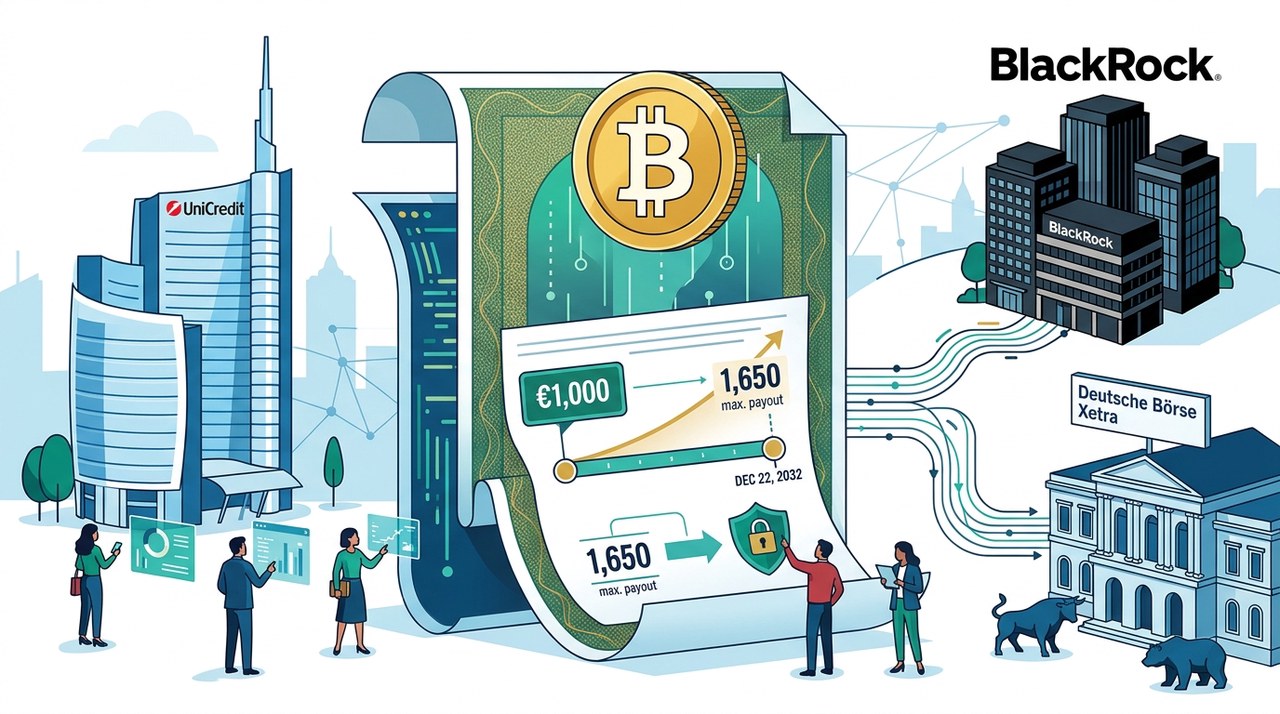
Each certificate carries an issue price of €1,000 and features a six-year term, with a final maturity date set for December 22, 2032.
The product tracks the market performance of BlackRock's iShares Bitcoin Exchange-Traded Product (ETP), which launched on Deutsche Börse's Xetra exchange in March 2025.
How the Certificate Works: Capped Gains and Capital Protection
The structure of this investment note aims to balance market growth potential with downside protection, though specific conditions apply.
Investors who keep their certificates until maturity will receive their initial principal back in full, regardless of how far the underlying asset drops.
However, potential upside gains are strictly capped. The maximum payout per €1,000 certificate is €1,650 at maturity, which limits total potential returns to 65% over the six-year lifespan.
Subscription for the product remains open until December 18. The official starting benchmark price will be based on the ETP closing price on December 21.
UniCredit specified that the certificate is sold exclusively through its internal advisory services to existing bank clients.
Understanding the Fine Print: Protection Timing and Exit Terms
While principal protection is a core feature, investors need to understand how timing affects this guarantee.
UniCredit emphasizes that full capital protection applies only at final maturity on December 22, 2032.
If an investor chooses to sell their note early on the secondary market, the prevailing price will depend on current market conditions.
Consequently, an early sale can result in receiving an amount lower than the original investment.
The product's Key Information Document (KID) states that it targets savers with knowledge or experience in complex financial instruments who cannot tolerate capital loss at maturity.
Fee Structure and Official Performance Scenarios
Structured products come with specific costs and pre-modeled payout possibilities that investors should review carefully.
According to the product's KID, entry costs are set at €250 on a baseline investment of €10,000. Exiting the certificate before maturity incurs an additional €50 fee.
The regulatory document models four possible holding outcomes over the full six-year term for a €10,000 allocation:
- Stress Scenario: Returns the original principal of €10,000 with no gain.
- Unfavorable Scenario: Returns the original principal of €10,000 with no gain.
- Moderate Scenario: Returns the original principal of €10,000 with no gain.
- Favorable Scenario: Returns the maximum capped amount of €13,698.
Under three of the four modeled outcomes, investors recover only their initial capital without earning extra income.
It is important to remember that cryptocurrency markets can be unpredictable. Positive past trends do not guarantee future performance.
Issuer Solvency and Credit Risk Considerations
Besides market price movements, investors are exposed to the financial health of the issuing institution.
Because the certificate represents a debt obligation of UniCredit, repayment relies on the bank's ongoing solvency.
If UniCredit were to encounter severe financial distress or insolvency, certificate holders would rank as unsecured creditors.
Under European banking bail-in rules, unsecured debt instruments can be written down or converted, meaning capital protection relies on issuer stability.
UniCredit's Expanding Crypto-Linked Strategy in Europe
This Italian product launch follows similar offerings introduced by UniCredit across other European divisions.
Chicco Di Stasi, UniCredit's Head of Group Investment Product Solutions, noted that the bank is responding to growing client demand using a model already tested in Germany and Austria.
In March, UniCredit's German subsidiary, HypoVereinsbank, offered retail investors a dollar-denominated capital-protected certificate linked to the iShares Bitcoin Trust ETF, featuring a maximum payout capped at $1,600.
UniCredit's Austrian platform subsequently sold a similar dollar-denominated note between April 20 and May 29.
In Italy, the bank previously tested interest in July 2025 by offering a five-year dollar certificate to professional clients, which included an 85% return cap and a $25,000 minimum investment.
Direct Crypto Trading vs. Structured Exposure
UniCredit maintains a clear distinction between structured financial notes and direct cryptocurrency trading.
While media reports in September indicated that UniCredit was evaluating crypto custody and brokerage options, official bank communications clarify its current position.
The bank's official website states that UniCredit does not promote or facilitate direct investments in cryptocurrencies.
By offering structured certificates tied to regulated ETPs, the bank aims to meet client interest within a traditional banking framework.
Evaluating Structured Notes and Market Risk
Investors considering crypto-linked certificates should carefully assess both upside limits and structural features.
While capital protection offers a safeguard at maturity, capped returns limit upside participation during strong market rallies.
Additionally, holding requirements, entry fees, and issuer credit risks are key factors to consider before investing.
Past performance of digital assets is no guarantee of future returns. Market details and asset pricing can be reviewed on platforms like Bitkub Market.
Latest blog posts

Bitcoin Bottom Analysis: Will This Cycle Avoid Deep Crash?
Recent on-chain data shows Bitcoin testing lower levels, with analysts watching the $53,300 realized price as a potential cycle bottom area.
|
Bitcoin Price Analysis: What Does the $64.5K Rejection Mean?
Bitcoin faced a sharp rejection near $64,500 after recovering from $55,100. Here is what key technical levels and liquidation heatmaps reveal about BTC's current market position.
|


Mog Coin (MOG) Price Forecast: What Lies Ahead?
A friendly breakdown of Mog Coin (MOG), exploring its recent price actions, supply mechanics, and market predictions through 2030.
|