
TSMC Stock Falls 5% Following New US China Chip Rules
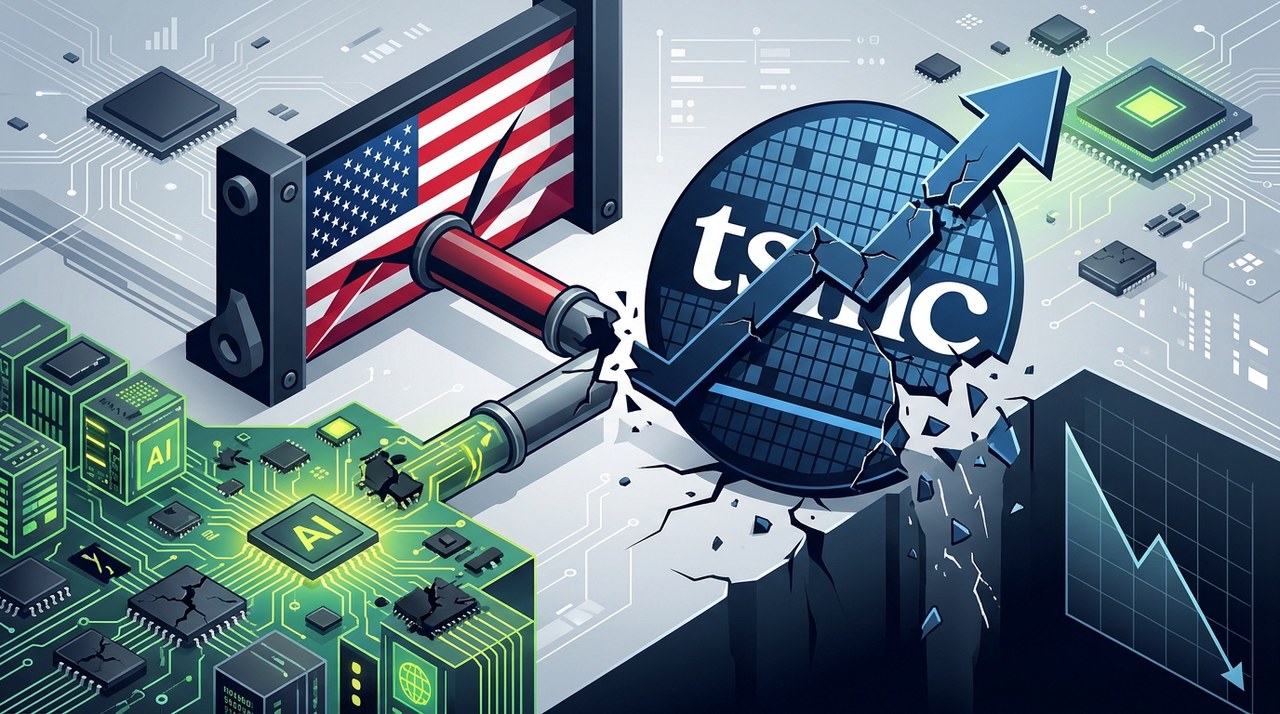
What Caused TSMC Stock to Fall 5%?
Taiwan Semiconductor Manufacturing Company, widely known as TSMC, saw its stock drop about 5% in Taipei trading following the release of new US export restrictions.
The market reaction occurred after reports confirmed that the chip manufacturing giant paused certain advanced chip shipments destined for Chinese clients.
This price movement compares the closing price on Thursday against Monday's session, which was the final trading day before the official announcement of the rule.
While regulatory changes were a primary focus, analysts note that other market catalysts also influenced global technology and semiconductor stocks during the same period.
How Did Competitors and Foundries Fare?
TSMC was not the only major chip manufacturer affected by the regulatory update.
South Korean electronics producer Samsung Electronics also paused deliveries of specific advanced chips to comply with the updated directives.
However, Samsung's shares remained roughly flat over the identical trading sessions, closing Thursday near its Monday levels.
This difference highlights how equity markets reacted differently to each company based on their individual customer exposure and supply chain structure.
Why Chinese Tech Clients Faced Heavy Selling Pressure
Interestingly, the sharpest share declines did not hit the manufacturing foundries themselves. Instead, the downstream technology companies purchasing the microchips bore the brunt of the market sell-off.
E-commerce and technology company Alibaba lost about 8% of its stock value in Hong Kong trading over those same sessions.
Chinese technology group Baidu also saw its stock suffer. Baidu's specialized artificial intelligence unit, Kunlun Chip, relies on Samsung as a manufacturing partner.
Reports from the Financial Times pointed out that Chinese technology enterprises were already operating with constrained hardware inventories before this mandate landed.
The delivery pause effectively removes another crucial source of high-end silicon components for these software and hardware developers.
Understanding the Details of the US Export Rule
The updated policy comes directly from the Bureau of Industry and Security (BIS), which is the export regulatory division under the US Department of Commerce.
The restrictions specifically target advanced logic microprocessors.
Under the new rule, chip designers based or headquartered in China can no longer clear high-performance processors through approved packaging facilities without explicit authorization.
Instead, manufacturing foundries must secure a specific government license before fulfilling and delivering those high-end orders.
Earlier guidelines applied legal tests mainly to the entity selling the chips. This updated directive moves the compliance test directly onto the manufacturing factories.
Breaking Down TSMC's Financial Exposure in Dollars
To evaluate the real risk, it helps to look at TSMC's financial statements.
According to TSMC's third-quarter management report, customers located in China generated 5% of the company's total net revenue.
In dollar terms, that 5% share translates to roughly $2.3 billion for the quarter.
For comparison, China-based customers represented 8% of TSMC's net revenue during the same quarter a year earlier, showing a gradual multi-year shift.
Crucially, the export rule targets only a portion of that $2.3 billion figure, rather than cutting off all Chinese revenue completely.
Potential Business Scenarios and Market Scenarios
The long-term impact on TSMC depends heavily on operational flexibility and regulatory timing.
The vast majority of TSMC's revenue comes from clients located in North America.
Positive Reallocation Scenario: If TSMC successfully shifts its temporarily idled factory capacity to satisfy demand from North American technology clients, the company's final net revenue loss could land well below 5%.
Regulatory Delay Risk: Conversely, if export license approvals stall indefinitely and affected production lines cannot be quickly repurposed, TSMC could experience prolonged revenue friction on those specific manufacturing lines.
Past stock performance and historical revenue figures do not guarantee future corporate or market results.
Why Semiconductor Rules Matter to Market Observers
Think of chip foundries like commercial bakeries with high demand. If one client's custom order gets paused due to new kitchen rules, the business must pivot.
How quickly the bakery can fill those open oven slots with orders from other clients determines its financial balance.
For the digital economy, high-performance logic chips power computing servers, software platforms, and artificial intelligence models.
Investors across equity and technology sectors continue to monitor regulatory changes closely, as chip availability remains a core driver of modern technological growth.
Latest blog posts

US Partners with TRM Labs to Launch Crypto Cybercrime Center
United States law enforcement has teamed up with TRM Labs to launch the Threat Disruption Center, aiming to trace stolen crypto and track scam wallets.


MARA Raises $185M as $1.5B Energy Acquisition Nears End
MARA Holdings priced $185 million in senior debt to complete its $1.5 billion acquisition of Long Ridge Energy.
|
Sweden's H100 Eyes Bitcoin Pool for Share Buyback
Swedish company H100 will vote on December 7 to approve buying back up to 10% of its shares, potentially using its Bitcoin trading pool.
|