


Synergy Relaunches Presale for Quantum-Safe Blockchain
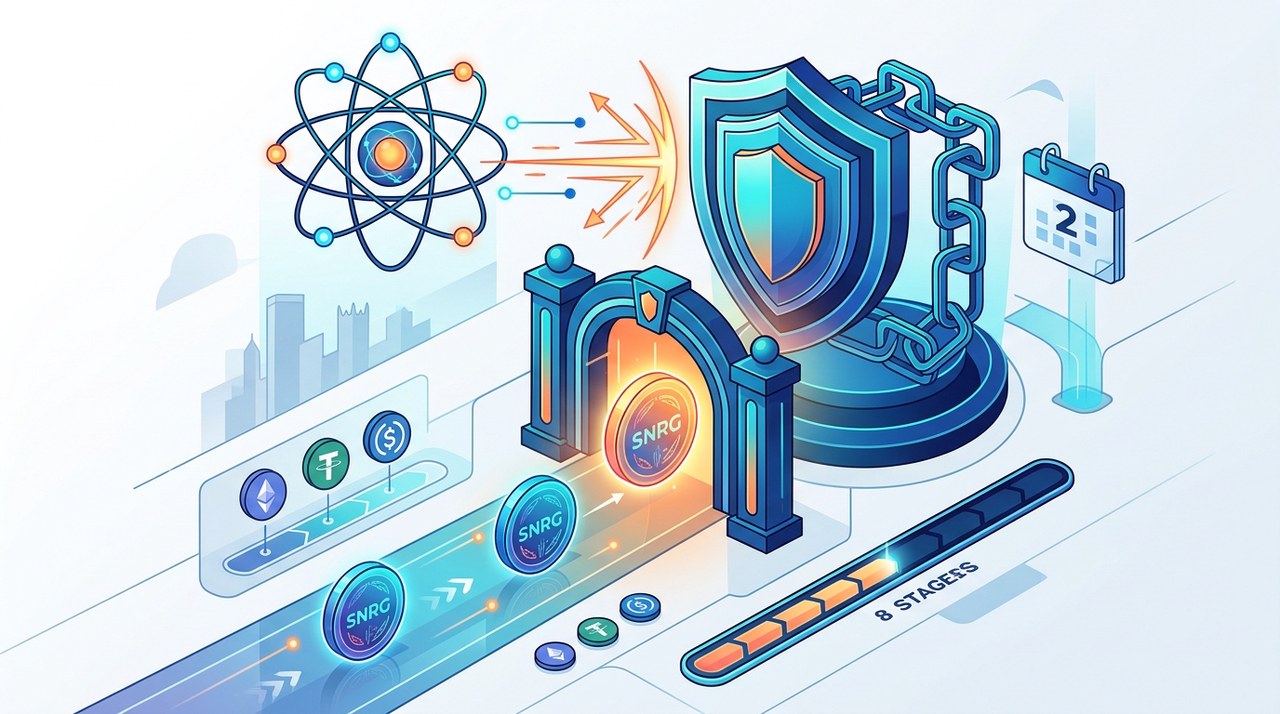
On November 10, 2026, out of Pittsburgh, Pennsylvania, Synergy Network announced a fresh chapter for its project. The team is relaunching the presale for its native coin, SNRG, moving the entire process fully on-chain. Synergy Network is building a next-generation Layer-1 blockchain designed from the ground up to withstand future threats from quantum computing.
This update replaces their older backend payment setup with an automated smart contract on the EthereumETH-2.59% network. By making this switch, transaction management, coin pricing, and stage progression will all happen transparently on the blockchain.
How the Relaunched SNRG Presale Works
The revamped presale structure spans eight distinct stages. Participants can join using popular assets including Ethereum (ETH), TetherUSDT+0.12%, and USD Coin (USDCUSDC+0.03%).
In total, Synergy has set aside 2.24 billion SNRG coins for the entire presale. That amount is divided evenly across the eight phases, meaning exactly 280 million SNRG is available in each stage.
Here is how the pricing schedule moves across the stages:
- Stage 1: Opens at $0.0038 per SNRG.
- Price Increase: The price climbs by $0.006 per SNRG with every new stage.
- Stage 8: Reaches $0.0458 per SNRG in the final stage.
Each stage runs for up to 30 days or until its 280 million coin allotment sells out, whichever comes first. Once a condition is met, the smart contract automatically transitions the presale to the next stage.
While fixed presale tiers outline a planned schedule, potential buyers should remember that crypto assets carry market risk. Presale prices do not guarantee future listing performance, and mainnet token distribution remains subject to technical milestones.
Claim Vouchers, Referrals, and Presale Staking
When someone makes a qualifying purchase during the presale, they do not immediately receive native coins. Instead, the smart contract mints an on-chain Claim Voucher NFT. This NFT serves as verifiable digital proof of the holder's purchased allocation.
When Synergy Network launches its official mainnet, voucher holders will be able to redeem their NFTs for native SNRG coins on a 1:1 basis. Ordinary presale purchases come with no extra lockup or vesting schedules once the mainnet is live. However, the project notes that launching a mainnet and listing coins on exchanges are separate milestones.
The Referral Program
The relaunched presale also includes an automated referral scheme. Once a participant makes their first purchase, they unlock a personal referral link:
- For the Buyer: Using a referral link grants the new buyer an extra 5% SNRG bonus.
- For the Referrer: The person sharing their code receives a 10% SNRG bonus based on the purchase.
- Rule: Self-referrals are strictly blocked by the system.
All referral bonuses are distributed in the form of additional voucher entitlements.
Staking Claim Vouchers for Extra Rewards
Participants can also choose to lock up their Claim Voucher NFTs for set timeframes to earn supplementary rewards:
- 3-Month Duration: Earns a 2% entitlement reward.
- 6-Month Duration: Earns a 4% entitlement reward.
- 9-Month Duration: Earns a 6% entitlement reward.
Rewards are released after successfully completing the full lockup term. While vouchers are staked, the corresponding allocation is mirrored as testnet SNRG on Synergy's public testnet. This allows holders to test network operations. Crucially, testnet coins are strictly for network participation and cannot be redeemed for real mainnet coins.
Participants should note that staking terms require lockups, and yield rates depend on completing the full duration. Digital asset returns are not guaranteed and stay vulnerable to overall market conditions.
Why Is Post-Quantum Security Such a Big Deal?
To understand why Synergy Network is taking this path, it helps to look at standard cybersecurity in crypto. Most active blockchains, including BitcoinBTC-0.85% and Ethereum, rely heavily on elliptic-curve cryptography to secure user accounts and verify transactions.
This encryption works great against today's supercomputers. But quantum computers operate differently. In the future, a powerful quantum computer could theoretically crack elliptic-curve signatures, exposing private keys linked to public addresses and risking user funds.
Upgrading an established network to post-quantum standards after the fact is extremely difficult. It requires altering wallet structures, consensus rules, transaction types, and validator mechanics all at once.
Synergy Network decided to build post-quantum defenses directly into its core architecture from day one rather than trying to patch things up later.
Post-quantum security should not be something a blockchain has to figure out how to implement after the threat becomes unavoidable. It needs to be part of the architecture from the beginning. We designed Synergy around that principle, integrating post-quantum cryptography into the network's foundational security mechanisms rather than treating it as a future upgrade. Our public testnet is already demonstrating that approach, and this presale relaunch represents another step toward bringing that architecture to mainnet.
— Justin Hutzler, Chief Technology Officer of Synergy Network
Inside Synergy's Quantum-Safe Tech Stack
In August 2024, the U.S. National Institute of Standards and Technology (NIST) finalized its first official post-quantum standards, notably FIPS 204, which outlines the Module-Lattice-Based Digital Signature Algorithm (ML-DSA).
Synergy Network has already integrated these standardized algorithms into its live public testnet:
- ML-DSA-65: Used to authenticate network validators.
- ML-DSA-87: Used to sign transactions and handle governance decisions.
Managing these defenses is the Aegis Post-Quantum Engine (APQE). APQE acts as Synergy's cryptographic control center, making sure quantum-resistant signatures work smoothly across consensus and transaction validation while remaining flexible enough for future upgrades.
Because of these implementations, the Quantum Alliance independently designated Synergy Network as Post-Quantum Ready in its official registry for both transaction and consensus safety. Synergy noted that this inclusion occurred without any formal application or payment from their team.
A Multi-Layered Approach: AIVM, Syn Q, and PoSy
Synergy Network is putting effort into standard cybersecurity risks alongside its quantum defenses. The platform brings together several key components:
Artificial Intelligence Virtual Machine (AIVM)
Instead of executing everything in one open space, the AIVM uses isolated compartments to run smart contracts and AI-driven tasks. Keeping applications segregated stops security breaches in one contract from spreading to the rest of the ecosystem.
Syn Q Programming Language
Syn Q is Synergy's native smart contract language. It is tailored specifically to work alongside quantum-resistant cryptographic algorithms.
Proof of Synergy (PoSy) & Hybrid DAG Structure
The network relies on a custom consensus model called Proof of Synergy (PoSy). It blends standard blockchain structures with a Directed Acyclic Graph (DAG) design. This hybrid setup allows parallel transaction processing to boost throughput.
Data from Synergy's public testnet shows an average block creation time of around 1.08 seconds. Anyone can monitor live testnet activity using the project's blockchain explorer, Atlas.
Token Utility and Project Resources
The SNRG coin is designed as the core engine of the ecosystem. It serves three primary functions:
- Paying network gas fees for transactions and smart contracts.
- Staking by validators to help secure consensus.
- Voting on decentralized governance proposals.
For those interested in exploring Synergy Network's technical updates or reading more about their presale structure, official documentation is available through their public channels:
- Presale Portal: synergy-network.io/presale
- Main Website: synergy-network.io
- Project Overview: synergy-network.io/discover-synergy
- Quantum Alliance Registry: quantumalliance.foundation
- Official X (Twitter): [x.com/Synergy Network X](https://x.com/Synergy Network X)
- Media Contact: Zair Khan (Synergy Network)
Past technological benchmarks or testnet speeds do not guarantee future performance on mainnet. Investors should consider project roadmaps and market volatility carefully.
Latest blog posts


Are AI Chip Stocks Cheap Right Now or a Value Trap?
AI chip stocks are at 15-year low valuations. Here is what is driving the market sell-off and key technical price levels to watch.
|

Moody’s Uses Chainlink to Bring Credit Ratings On-Chain
Moody’s is using Chainlink to deliver traditional credit rating data directly across multiple blockchain networks for smart contracts.
|
US CPI Data Triggers $200M Crypto Liquidation Spike
A higher-than-expected US inflation report sparked a quick market reaction, liquidating $200 million in leveraged long bets in just five minutes.
|