

Solana Founder Explains AI, Public Keys, and Crypto's Future
What Is SolanaSOL-0.34%'s Endgame?
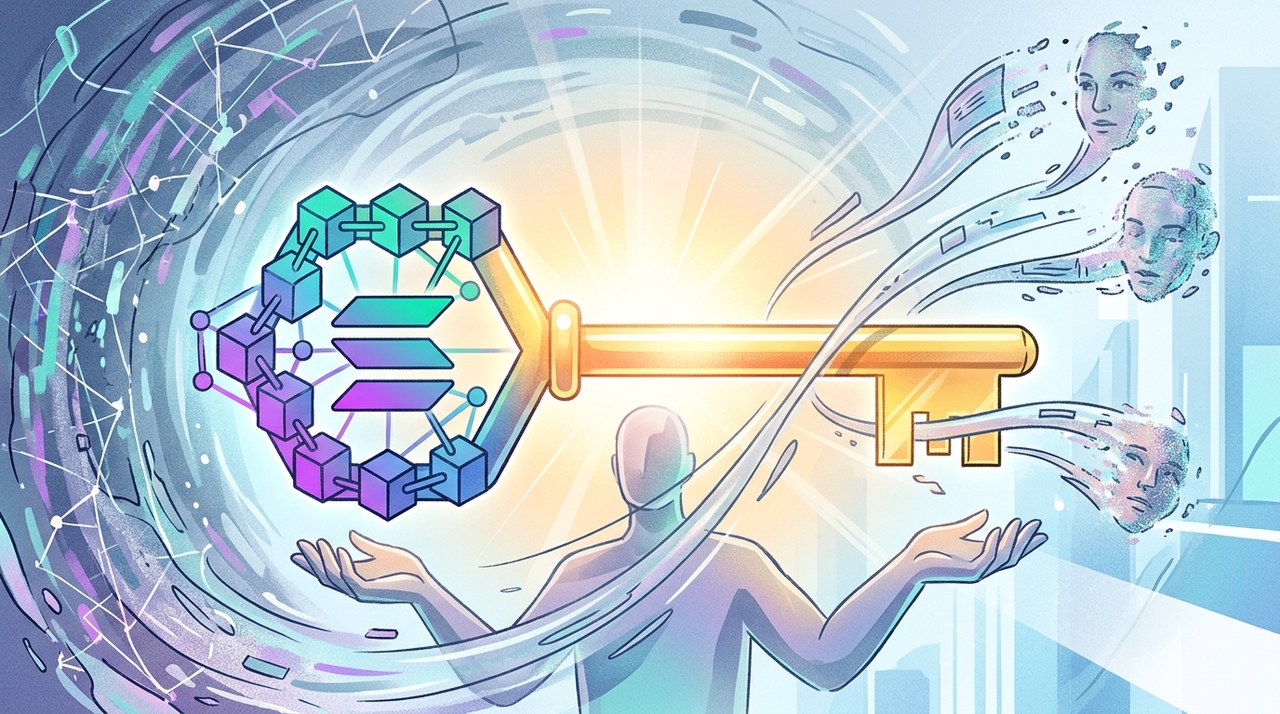
As artificial intelligence continues to transform technology, traditional identity verification systems face unprecedented challenges. Deepfakes and AI tools make online identity verification harder than ever. However, Solana co-founder Anatoly Yakovenko believes crypto offers an elegant, mathematical solution.
During the Breakpoint 2026 conference in London, held from November 15 to 17, Yakovenko shared his core vision for Solana's long-term future. The official Solana X account published a summary of his talk on November 29, 2026. He outlined four major insights regarding where Solana is headed and how blockchain technology fits into an AI-driven economy.
Why AI Cannot Fake Cryptographic Public Keys
Traditional banks and online services rely heavily on personal identity checks. They inspect photo IDs, social security numbers, and facial scans. Yet, modern AI tools are capable of copying human voices, images, and personal data with high accuracy.
Yakovenko noted that public key cryptography operates on a completely different framework. Instead of requiring personal details, crypto systems rely strictly on mathematical pairs of private and public keys.
"We just want to know your public key. And that, AI can't fake," Yakovenko said.
While AI models can generate convincing media or fake credentials, they cannot break the underlying math of public key signatures. This makes public keys a reliable form of digital proof in an automated world.
Yakovenko has previously explored the relationship between AI and cryptography. In a post on X in May, he discussed potential security risks, noting that AI might eventually detect subtle mathematical flaws in post-quantum cryptography signature schemes before human developers spot them.
AI as a Superpower for Writing Smart Contracts
Although AI introduces new verification challenges for traditional identity systems, Yakovenko views AI as a huge asset for software developers building on Solana.
He described AI as a superpower for smart contract development. Because the number of possible coding bugs in a system is finite, automated AI auditing tools can detect and resolve software vulnerabilities far faster than human programmers.
In Yakovenko's view, AI assistance will help push coding bugs in decentralized applications down to zero rapidly.
Building a Global Index Fund on the Blockchain
When discussing the ultimate financial product on-chain, Yakovenko described it as "really boring." In mainstream finance, simple and broad-based exposure is often considered a reliable strategy.
He envisions an on-chain smart contract basket that functions as a global index fund. By bundling productive economic assets into a single tokenized structure, users gain diversified exposure to the global market.
"Here's the perfect asset. It represents the global economy with the least amount of risk," Yakovenko recalled telling his parents.
On November 18, Yakovenko elaborated on this concept, proposing a smart contract basket tracking real-world enterprise assets. He suggested including major companies such as the Magnificent Seven tech giants, private aerospace enterprise SpaceX, and Chinese robotics manufacturer Unitree.
Why Low Network Fees Matter for Institutions
For global financial institutions to conduct business on a public blockchain, transaction costs must remain consistently affordable.
"A great L1 is a cheap L1," Yakovenko stated.
He highlighted that network fees on Solana average around half a basis point, or roughly 0.005%, even during active market cycles. For institutions transferring large volumes, these minimal execution costs make high-frequency operational activity practical.
Is SOL Money? The Friendly Debate
On November 16 at Breakpoint 2026, Yakovenko participated in a main-stage debate with Helius CEO Mert Mumtaz. The session was moderated by Double Zero co-founder Austin Federa and addressed a key topic: Is SOL money?
Yakovenko characterized SOL primarily as a "spam-resistant engine for the global economy," serving as the computational fuel that keeps the network running without congestion.
Mumtaz presented an alternative argument and won the community audience vote. Nevertheless, both founders agreed that SOL remains central to processing global decentralized transactions.
Staying True to Nasdaq Speed and Continuous Upgrades
Reflecting on Solana's inception, Yakovenko recalled including "Nasdaq speed" in his very first presentation deck. While many early observers doubted that a public blockchain could achieve high throughput, the team maintained its technical vision.
"The weird thing is we really never had to pivot," Yakovenko added.
Disagreeing on Protocol Ossification
Solana's focus on active development led Yakovenko to express a different view from EthereumETH-0.55% co-founder Vitalik Buterin regarding protocol ossification. On January 17, Yakovenko posted on X that layer-1 networks must continuously iterate and upgrade to remain functional over time.
Prioritizing Bandwidth and Latency
When asked what users will prioritize a decade from now, Yakovenko pointed to a simple principle: IBRL.
IBRL stands for "Increase Bandwidth, Reduce Latency." In Yakovenko's view, demand for faster response times and higher transaction capacity remains constant across technology cycles.
Understanding Risk in Digital Assets
While automated index funds and cryptographic keys present innovative features, market participants should remain aware of network and financial risks. Cryptocurrency markets experience volatility influenced by macro factors, technical developments, and liquidity conditions.
Past performance of digital assets is not an indicator of future returns. Investors should carefully assess their financial strategy and risk tolerance before buying or trading digital assets. You can review current price action and market metrics for assets like SOL directly on official trading platforms.
Latest blog posts

Craig Wright Explains Bitcoin Halving Math and Miner Fees
Craig Wright argues Bitcoin must double in price every four years unless network transaction fees grow enough to cover miner revenue gaps.
|


XRP Ledger Activity Drops 64%: What It Means for XRP
XRP Ledger payment volume fell 64% in 24 hours to 168 million XRP. Here is a breakdown of network activity, AI trends, and key price levels.
|


Pots Money Exploit Drains $5.71M USDT on BNB Chain
Blockchain security firm PeckShield reported a $5.71 million USDT exploit targeting Pots Money on BNB Chain, causing the IBS token to crash by 100%.
|