

Reserve Rights (RSR) Price Prediction: 2026-2030 Outlook
What Is Reserve RightsRSR+3.58% and How Does It Work?
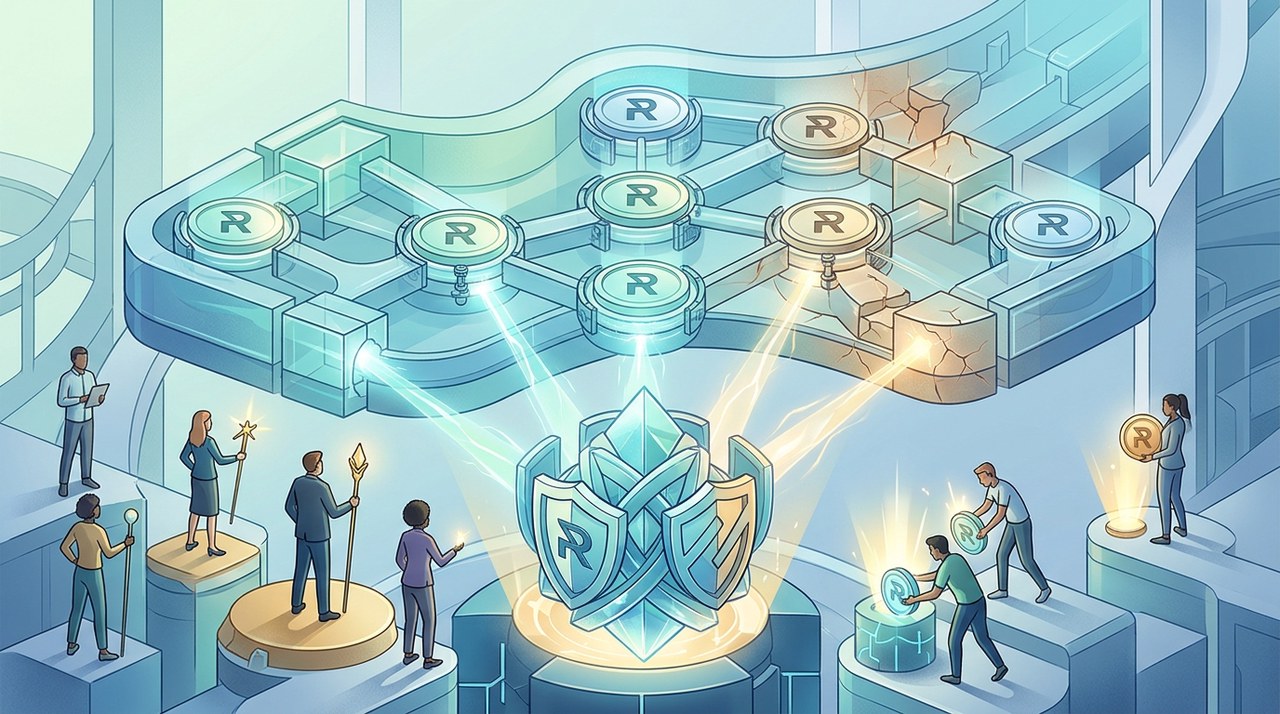
Reserve Rights (RSR) is the governance and backstop token for the Reserve Protocol. You can think of the Reserve Protocol as a launchpad for asset-backed stablecoins, known as RTokens, designed to fight hyperinflation and keep value stable.
While stablecoins like RSV aim to maintain a steady $1.00 peg, RSR acts as a safety cushion. If an underlying asset backing an RToken defaults or fails, RSR tokens are staked and used to cover the loss. In exchange for taking on this risk, RSR holders earn governance rights and staking rewards.
Looking at historical performance, RSR hit an all-time high of $0.1189 on April 16, 2021, and recorded an all-time low of $0.001247 on March 16, 2020.
Past performance of digital assets or past operational results do not guarantee future returns or future operational results. You can view current market prices on bitkub.com/th/market/RSR.
Why Did RSR Drop Recently? Inflation and Market Drivers
Recently, RSR dropped 4.40% to $0.00155 in a 24-hour period. This pull-back was steeper than BitcoinBTC+1.35% and the broader crypto market, largely triggered by macroeconomic developments.
On November 10, the U.S. October Consumer Price Index (CPI) report came in higher than market expectations. Hotter inflation numbers raised concerns that the Federal Reserve might keep interest rates elevated, prompting traders to scale back risk.
- Volume Drop: RSR trading volume fell by 65.75%, signaling quieter market activity.
- Market Sentiment: Social sentiment stayed neutral, showing a slowdown in buying rather than sudden panic selling.
- Short-Term Levels: Holding above $0.00150 could spark a recovery toward $0.00157–$0.00166. However, falling below $0.00150 may push prices lower toward $0.00122.
Major Growth Catalysts for Reserve Rights Heading into 2026
The Reserve ecosystem is making several operational updates focused on supply management and network growth:
- 30 Billion Token Burn: The treasury is permanently removing 30 billion RSR tokens, cutting maximum supply by nearly 30% to address dilution concerns.
- veRSR Staking Model: Under the vote-escrowed model, holders lock tokens for governance rewards, which lowers active market supply.
- Strategic Super Reserve (SSR) Fund: This fund helps developers build and launch new stablecoins and RTokens across the ecosystem.
Out of a total supply of 100 billion tokens, circulating supply currently ranges between 53.5 billion and 60 billion RSR (with approximately 58.88 billion active). While supply reductions can reduce selling pressure, price outcomes still depend heavily on market conditions.
Technical Analysis: Key Support and Resistance Levels
RSR remains in a long-term downtrend, but chart patterns indicate an extended accumulation phase near its lows around $0.00155.
The key floor sits at $0.000998 support. If buyers defend this level, RSR could test resistance in the $0.0020–$0.0022 range. A sustained breakout above $0.0020–$0.0022 with high volume could lead toward $0.003151, with a long-term technical target around $0.005838. Conversely, losing $0.000998 support could invalidate the setup and risk further downside.
Reserve Rights (RSR) Price Forecast (2026 – 2030)
Future price movements depend on adoption rates, token utility, and broader macroeconomic factors. Below are potential price scenarios for 2026 through 2030 based on different market conditions.
Reserve Rights Price Forecast for 2026
In 2026, supply burns and veRSR staking could tighten circulating token availability. If crypto market conditions remain favorable, RSR could see improved valuation range.
- Potential Low: $0.00099 (if interest rates stay high and market momentum cools)
- Average Price: $0.0031 (under neutral market growth and steady staking adoption)
- Potential High: $0.0058 to $0.00581 (if token burns significantly reduce liquid supply during a bull cycle)
Reserve Rights Price Forecast for 2027
By 2027, expansion across Layer 2 networks like Base and Arbitrum, alongside frozen token unlocks, could strengthen utility.
- Potential Low: $0.0028 (if Layer 2 adoption lags behind expectations)
- Average Price: $0.0063 (assuming steady cross-chain expansion)
- Potential High: $0.0118 (if demand for decentralized stablecoin backing surges)
Reserve Rights Price Forecast for 2028
During 2028, tokenization of Real-World Assets (RWA) and multi-chain RToken deployments could enhance protocol TVL.
- Potential Low: $0.0045 (if real-world asset regulations slow down integration)
- Average Price: $0.0082 (with moderate growth in asset tokenization)
- Potential High: $0.0164 (if institutional players adopt RTokens for treasury operations)
Reserve Rights Price Forecast for 2029
In 2029, growing adoption of inflation-resistant stablecoins in developing markets could increase RSR demand.
- Potential Low: $0.0074 (if competing stablecoin designs dominate market share)
- Average Price: $0.0170 (under steady global demand for inflation-hedged assets)
- Potential High: $0.0372 (if RTokens gain dominant traction in inflation-hit regions)
Reserve Rights Price Forecast for 2030
By 2030, widespread stablecoin reliance could position RSR as an established backstop safety layer.
- Potential Low: $0.0173 (if network usage stabilizes at baseline levels)
- Average Price: $0.0338 (with sustained protocol revenue and governance participation)
- Potential High: $0.0580 to $0.08614 (under a strong bull scenario with maximum stablecoin adoption)
Comparing Third-Party Market Predictions
Analyst platforms use varying algorithmic models to project price trends. Here is how independent firms forecast average RSR prices:
- Wallet Investor: Takes a conservative stance, projecting $0.000102 in 2026, $0.0009 in 2027, and $0.0022 by 2030.
- PricePrediction.net: Forecasts steady growth, estimating $0.0029 in 2026, $0.0045 in 2027, and $0.0205 by 2030.
- Digital Coin Price: Projects a moderate trend with $0.00135 in 2026, $0.00264 in 2027, and $0.0135 by 2030.
Frequently Asked Questions (FAQs)
- Will Reserve Rights go up?: RSR has growth factors like token burns and protocol expansion, but digital assets carry risks. Prices can rise or fall based on market trends and adoption.
- How many Reserve Rights tokens exist?: RSR has a total supply of 100 billion tokens, with around 58.88 billion currently in circulating supply.
- How high could RSR go by 2026?: Under bullish conditions, RSR could target $0.0058 by 2026. However, if market weakness continues, prices could test support near $0.00099.
- Where can I buy Reserve Rights?: RSR trades on major cryptocurrency exchanges including Binance, KuCoin, Uphold, and Huobi Global (HTX).
Latest blog posts


Jupiter (JUP) Bounces 11%: Can It Clear Resistance?
Jupiter (JUP) posted an 11% rebound to $0.25 after market selling pressure eased, but key technical resistance levels lie directly ahead.
|

Mike McGlone Warns of Potential Bitcoin Macro Unwind
Bloomberg Intelligence analyst Mike McGlone warns of macro liquidity risks, while Arthur Hayes and market data point to changing institutional sentiment.
|


Ethena Nears $7.5B Threshold as USDe Expands to Stellar
Ethena expands its USDe stablecoin across Avalanche and Stellar while approaching a key $7.5 billion supply milestone that could trigger ENA token buybacks.
|