


NUVA Launches HOME Token for Access to U.S. Mortgages
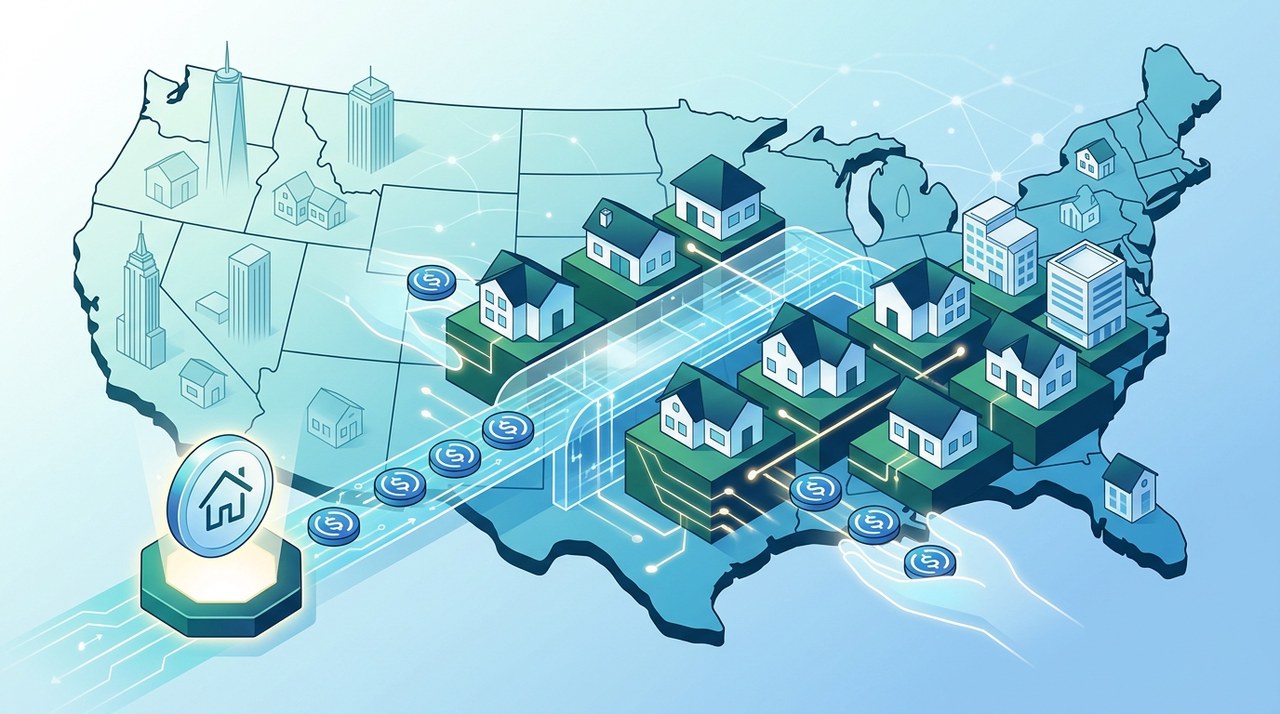
Unlocking U.S. Home Loans for Global Investors
Imagine being able to back U.S. home loans with as little as a single digital dollar. For decades, the multi-trillion-dollar U.S. mortgage market was largely reserved for large financial institutions, Wall Street banks, and wealthy accredited investors. If you were a retail investor living outside the United States, gaining direct exposure to these income-generating home equity loans was virtually impossible.
That traditional landscape is now evolving through real-world asset (RWA) tokenization. A new marketplace called NUVA, created through a strategic partnership between Animoca Brands and Nuva Labs, has officially launched a product known as the HOME token.
The HOME token allows eligible non-U.S. investors to gain financial exposure to a managed pool of U.S. home equity lines of credit (HELOCs). The entry barrier is remarkably low, allowing participants to start with just 1 USDCUSDC-0.09%. While this opens up novel investment channels, understanding how the product is structured—and the credit risks involved—is essential before participating.
What Exactly Is the HOME Token and How Does It Work?
At its core, HOME is an ERC-20 token built on the EthereumETH+2.30% blockchain. It operates similarly to a tokenized investment vault. When you purchase or hold HOME tokens, you do not directly own individual physical houses or specific mortgage legal documents. Instead, your tokens represent fractional economic exposure to a basket of home equity loans stored inside a managed vault.
The project targets an annual return of 7%, which is recalculated and reset on a monthly basis. The market price of the HOME token reflects the vault's Net Asset Value (NAV), which fluctuates according to interest collected from home borrowers and the overall health of the loan portfolio.
It is crucial to highlight that the 7% annual yield is an estimated target rather than a guaranteed payout. Actual returns depend heavily on variable interest rates, borrower repayment patterns, housing market conditions, and vault liquidity. Your capital remains exposed to risk at all times.
Demystifying U.S. HELOCs: A $460 Billion Asset Class
To understand why NUVA is tapping into this sector, it helps to examine what a HELOC actually is. A Home Equity Line of Credit (HELOC) allows homeowners to borrow money against the equity value they have accumulated in their residential property over time.
You can think of a HELOC as a revolving line of credit—much like a credit card—secured directly by the borrower's house. Homeowners can draw money as needed during a designated timeframe, typically paying variable interest rates benchmarked against national interest rate policy.
According to official Federal Reserve Economic Data, total U.S. HELOC balances expanded to $460 billion in the second quarter. Furthermore, reports from the Federal Reserve Bank of New York highlight that HELOC balances grew by $13 billion in that quarter alone, marking 17 consecutive quarters of growth. NUVA aims to channel this expanding market into decentralized finance (DeFi).
Bridging Wall Street Private Credit and Decentralized Finance
Bringing real-world credit onto the blockchain is an emerging trend across crypto. Platforms like Maple FinanceSYRUP+0.00% have created onchain lending pools for corporate entities, Centrifuge brings structured private credit onchain, and Figure Technology Solutions already issues HELOCs on its proprietary Provenance blockchain.
What sets NUVA's HOME token apart is how it packages this credit exposure for individual retail users. Instead of requiring investors to buy whole loans or commit six-figure sums into standard private credit funds, HOME converts these loans into an accessible ERC-20 token starting at 1 USDC.
“Traditional securitization was built primarily for institutional investors,” explained Anthony Moro, Chief Executive Officer of Nuva Labs. “For individual investors, those structures can be difficult to access.”
Moro, who previously spent 22 years as a senior executive at BNY Mellon, emphasized that HOME isn't trying to manufacture artificial demand for residential mortgages. Instead, it makes an existing asset class available through digital rail networks.
“HOME is not trying to create demand for residential credit from scratch,” Moro noted. “It is taking an asset class that already has substantial institutional demand and making that exposure available through a more accessible onchain structure.”
Underwriting Standards: Who Are the Underlying Borrowers?
When assessing credit products, borrower quality is paramount. The initial loan assets inside the HOME vault are originated through Figure Technology Solutions. Figure's loan marketplace processed $4.3 billion in loan volume during the second quarter alone, including $2.8 billion traded via its Figure Connect platform.
To maintain credit quality, NUVA enforces strict criteria for all loans admitted into the vault pool:
- High Average FICO Score: The average borrower credit score across the vault must be at least 735, reflecting strong financial reliability.
- Combined Loan-to-Value (CLTV): Total debt pledged against the property is capped at 69% of the home's appraised value, creating a solid equity cushion.
- Debt-to-Income (DTI) Limit: Borrowers cannot exceed a 40% debt-to-income ratio, ensuring adequate monthly cash flow to cover payments.
- Geographic Limits: Exposure to California real estate is capped at 30%, while any other individual U.S. state is limited to 15% to prevent localized real estate risk.
In future phases, NUVA plans to explore additional real estate debt categories, such as debt-service coverage ratio (DSCR) loans and residential-transition loans (RTLs).
Risk Buffers, Liquidity, and Redemption Terms
Investing in mortgage loans involves real-world financial risks, including borrower defaults, property price drops, and liquidity delays. NUVA has integrated specific risk-management layers into the vault structure, though these measures do not completely eliminate potential losses.
Here is how liquidity and loss protections are arranged within the HOME vault:
- First-Loss Equity Buffer: Approximately 5% of the vault's capital is allocated to a first-loss equity segment. If defaults or forced sales occur, this buffer absorbs losses first before normal HOME holders suffer any price reduction.
- 5% Liquidity Reserve: A dedicated 5% liquid reserve is maintained in cash or highly liquid assets to facilitate standard redemptions.
- Two-Day Redemption Window: While the vault has no enforced lockup periods, processing withdrawal requests typically requires around two U.S. business days.
- Secondary Sales for Large Redemptions: For larger withdrawals exceeding liquid reserves, underlying loans may need to be sold over-the-counter or through Figure Connect.
Investors should keep in mind that liquidity delays can occur if market conditions deteriorate rapidly or if redemption volume spikes beyond reserve levels.
Onchain Transparency vs. Traditional Reporting
In traditional private credit funds, investors usually rely on static quarterly financial reports sent weeks after a quarter ends. NUVA aims to modernize this process through real-time onchain data visibility.
By publishing loan-level health metrics directly on public blockchain networks, token holders can review collateral ratios, delinquency figures, and borrower credit profiles at any time.
Who Is Eligible to Invest? Geographic Restrictions
Because cross-border credit regulations vary, the HOME token is strictly reserved for eligible non-U.S. investors.
Residents and entities based in the United States, United Kingdom, Hong Kong, Mainland China, the British Virgin Islands, and sanctioned jurisdictions are excluded from participating. NUVA enforces these rules using automated wallet screening and IP address blocking.
The Broader Landscape: RWA Adoption Across Industry Giants
The launch of the HOME token comes as traditional financial institutions deepen their involvement in digital assets and tokenized real-world assets.
For example, banking giant Standard Chartered recently expanded its institutional crypto and RWA custody services into Singapore. Meanwhile, technology titan Samsung integrated USDC stablecoin features for over 82 million Galaxy device users to streamline global payments.
At the same time, crypto markets remain dynamic, with BitcoinBTC+1.80% ETF flows experiencing periodic volatility alongside shifting macroeconomic rate policies. This evolving environment highlights growing interest in asset-backed digital tokens that bridge traditional yield sources with decentralized access.
Key Takeaways and Risk Summary
NUVA's HOME token offers an innovative bridge connecting international investors with U.S. residential property credit. By setting a low entry threshold of 1 USDC, it makes an institutional asset class accessible onchain.
However, potential participants should carefully evaluate the following factors:
- Target Returns Are Variable: The 7% annual yield target resets monthly and depends on loan performance and economic factors.
- Credit and Liquidity Risks: Capital remains exposed to real estate defaults, macroeconomic shifts, and potential withdrawal settlement delays.
- Regulatory Compliance: Participation is restricted strictly to non-U.S. residents in compliant jurisdictions.
Past performance of digital assets or financial products does not guarantee future results. Investors should evaluate their financial objectives and risk tolerance carefully before investing in tokenized credit pools. To view real-time market data and crypto asset prices, visit Bitkub Market.
Latest blog posts



Bitcoin Hits $55,000 Low as 4-Year Cycle Theory Comes into Focus
Bitcoin touched $55,081 in November 2026 before recovering above $60,000, leading market analysts to examine historical four-year cycle patterns.
|

3 XRP Ledger Features Race for 2026 Activation
Three key XRP Ledger amendments—Lending Protocol V1_1, Confidential Transfers, and Single Asset Vault—are seeking final validator votes before the end of 2026.
|


Google's Quantum Chip Beats Classical Limits in Impossible Game
Google's latest quantum chip has achieved a historic milestone by outperforming classical supercomputers in a non-local quantum game once deemed mathematically impossible for standard binary hardware.
|