

MERGE Madrid 2026 Wraps Up with Shift to Crypto Supervision
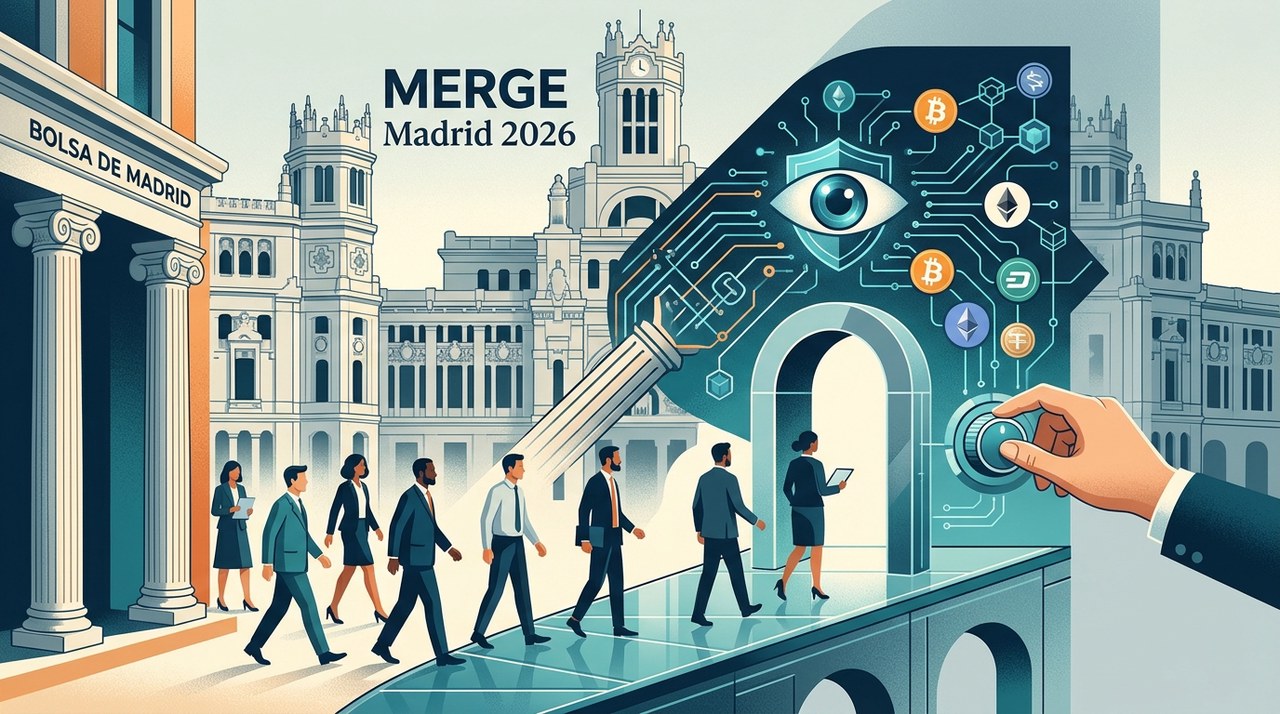
MERGE Madrid 2026 officially wrapped up at the Palacio de Cibeles on November 11, 2026. Over three days, the event brought together key leaders from traditional finance, blockchain, venture capital, and regulatory authorities.
The conference serves as a main institutional platform for Web3 and digital assets across Southern Europe and Latin America. Its primary goal is to help traditional financial institutions and digital asset companies work together smoothly.
The event kicked off on Tuesday with an Institutional Summit at the Bolsa de Madrid. It then transitioned into main conference sessions covering regulation, investment opportunities, and practical blockchain applications.
European Regulators Shift Focus from Licensing to Supervision
On the final day, regulatory oversight took center stage. Officials from across Europe discussed how the Markets in Crypto-Assets (MiCA) regulation needs to evolve moving forward.
Desislava Petrova, Senior Supervision Officer at the European Banking Authority (EBA), outlined the immediate priorities for European authorities during a panel comparing MiCA to the United States' GENIUS Act.
In terms of priorities, we're shifting from authorization to supervision.
Petrova emphasized that as crypto businesses expand across European borders, regulators must exchange supervisory data more efficiently.
Regulators from Spain (CNMV), Portugal (CMVM), Italy (Consob), and Luxembourg (CSSF) shared similar perspectives during a joint session.
Irene Tagliamonte, Head of the Regulatory Impact Analysis Office at Consob, pointed out that national authorities need a common supervisory language, standardized reporting, and tighter cooperation.
Meanwhile, Natasha Deloge, Head of the Innovation Division at Luxembourg's CSSF, stressed the need for quick actions against unlicensed entities targeting European consumers. Panelists also noted that legal variations between countries continue to create friction for cross-border settlement of tokenized securities.
Tokenization Grows, But Technical and Demand Challenges Remain
The afternoon sessions centered on investment trends and tokenized real-world assets (RWAs). Victor Sáez from Kraken shared update metrics regarding xStocks, the firm's tokenized equity products.
Sáez revealed that xStocks has grown past $1 billion in assets under management (AUM). Interestingly, over 60% of trading activity happens outside normal traditional market hours, reflecting strong global demand for 24/7 equity access.
However, Sáez clarified that simply tokenizing an asset does not automatically generate investor interest.
If the underlying asset has no demand, demand is not going to show up because you tokenize it.
He emphasized that strong distribution channels, underlying market demand, and sufficient liquidity remain critical for success.
Matt Ward, Executive Director for Europe at Hashgraph, highlighted interoperability as another major operational barrier.
The buyers are there, but they are just on a different chain, the wrong currency, their collateral is locked up somewhere else.
Ward noted that establishing reliable cross-chain connectivity is essential for building healthy secondary markets. Investors should keep in mind that tokenized assets carry inherent market risks, liquidity constraints, and regulatory dependencies.
Institutional Adoption and Venture Capital in Web3
Several major financial institutions took part in the investment discussions, including BNP Paribas Securities Services, Hamilton Lane, Allfunds Blockchain, and TetherUSDT+0.75%.
BNP Paribas outlined its progress in launching custody and administrative services for tokenized funds across Luxembourg, France, and Italy. Hamilton Lane shared its perspective on opening up private market investments to a broader investor base.
In addition, Hadron by Tether sponsored a dedicated Tokenization Track. The track focused on tokenized money market funds, digital debt securities, and the back-end architecture required for trade execution and settlement.
Another afternoon session explored venture capital trends in Web3, discussing fundraising strategies, valuations, and current market hurdles for early-stage founders.
Spotlight on Emerging Startups and Real-World Utility
Early-stage companies were featured prominently on the final day through a startup showcase supported by the Madrid City Council. Selected startups presented functional applications of blockchain technology:
- Micelio Data: Presented verified data infrastructure designed for tracking textile supply chains.
- Tsamurai: Showcased a Web3 platform intended for fan-funded creative projects.
- Wemsys: Highlighted specialized tools for blockchain security, analytics, and regulatory compliance.
The agenda also included the ISBE in Pitch showcase. Connected to the Spain Blockchain Services Infrastructure (Infraestructura de Servicios Blockchain de España) and supported by the Comunidad de Madrid, the initiative gave tech founders direct access to potential partners and investors.
Blockchain Beyond Finance: Fan Engagement in Sports
Beyond financial markets, MERGE Madrid explored how Web3 tools are impacting consumer-facing sectors like sports and entertainment.
A specialized session featuring sports blockchain provider ChilizCHZ-0.60% and Spanish football club CD Leganés explored the future of fan engagement.
Iván Maroto, Chief Business Officer at CD Leganés, detailed how the club linked digital tokens directly to physical sections of their stadium pitch. Token holders can receive specific rewards when match events take place within their designated pitch zone.
It's more what we are doing with the token than the token itself.
Maroto stressed that sports organizations must prioritize meaningful utility over token speculation.
Julian La Picque, CFO of Chiliz, added that the platform plans to expand beyond standard utility tokens into products tied to club equity and stadium financing models.
Summary of MERGE Madrid 2026
The conclusion of MERGE Madrid 2026 capped off three days of dialogue between regulators, banks, asset managers, and blockchain startups.
With recurring institutional events in Madrid, Buenos Aires, and São Paulo, MERGE continues to serve as an international bridge connecting traditional finance with decentralized technology across Europe and Latin America.
Latest blog posts


Stock ETF Buyers Pounce on Dip as Bitcoin Funds Bleed $1.6B
US spot Bitcoin ETFs saw $1.6 billion in net outflows in November, while traditional stock funds attracted billions from investors buying price dips.
|


Sui Cancels Suiball Hardware Wallet Over Security Risks
The Sui Foundation canceled the Suiball hardware wallet before launch to protect users from potential supply chain security risks.
|
SEC Enforcement Actions Drop 24% as Crypto Stays in Focus
The U.S. SEC filed 348 enforcement actions in fiscal 2026, down 24% from the prior year while keeping crypto cases in the spotlight.
|