Louisiana AG Slams CFTC Chair Over Prediction Market Lawsuit
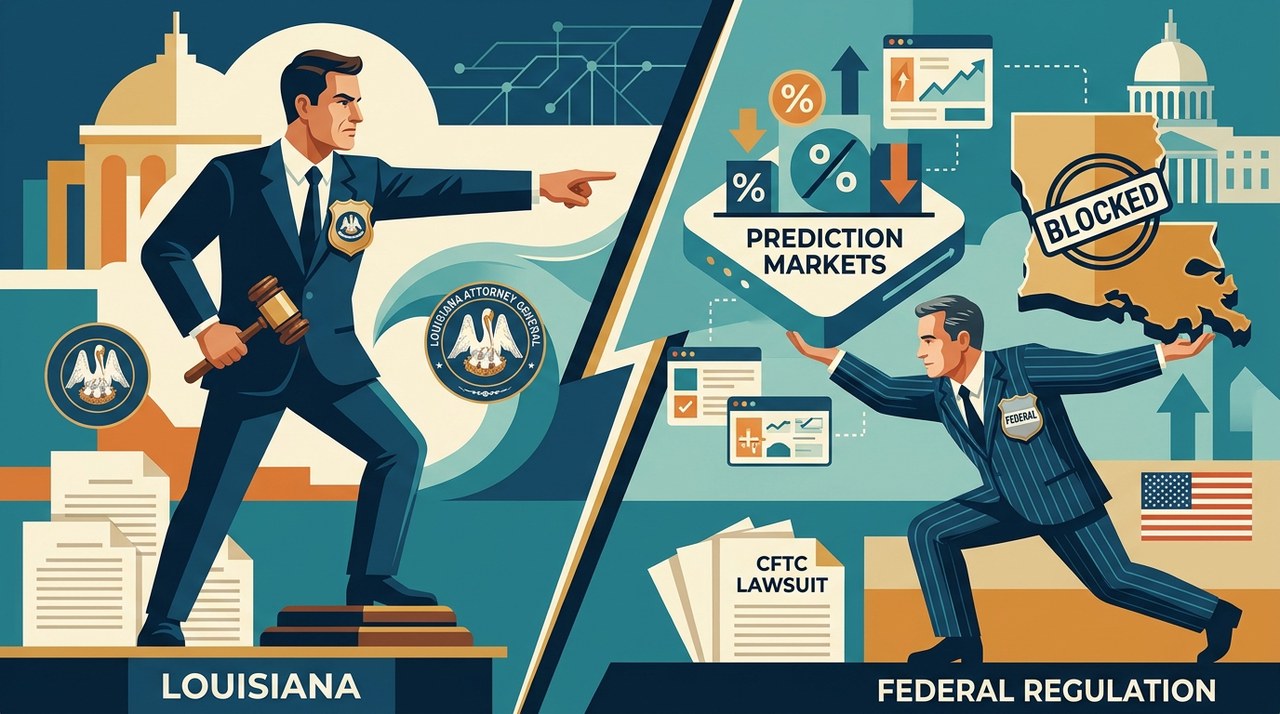
The Federal Legal Battle Over Prediction Markets
A fresh conflict has erupted between federal regulators and state authorities over the future of online prediction markets in the United States.
On Friday, the Commodity Futures Trading Commission (CFTC) officially sued the state of Louisiana. The federal agency is asking the court to block an order issued by a Louisiana state judge.
That local judge's order previously banned 31 different prediction market platforms from operating within Louisiana. Prominent names on that list include Kalshi and the crypto-based platform Polymarket.
Louisiana Attorney General Reacts Strongly
The CFTC's legal action drew an immediate and sharp response from local officials in Louisiana.
Following the agency's court filing, Louisiana's Attorney General publicly criticized the CFTC leadership, describing the agency's approach in harsh terms.
The Louisiana AG called the CFTC chair an 'obsequious standard bearer' for prediction markets.
In everyday terms, the state prosecutor is asserting that the federal regulator is bending over backward to champion private prediction platforms over state judicial decisions.
What Are Prediction Markets and Why Is There a Dispute?
Prediction markets allow users to trade contracts based on the outcomes of real-world events. These events can range from political elections and interest rate decisions to sporting outcomes and entertainment awards.
Platforms like Polymarket, which utilizes blockchain technology for event trading, and Kalshi have seen significant interest recently. However, their rapid growth has sparked a complex regulatory debate.
Federal Authority vs. State Regulations
The debate centers around jurisdiction and legal classification. The CFTC views prediction markets as financial derivatives, arguing that federal law gives the agency exclusive authority over these markets.
Conversely, many state authorities view event-based prediction trading as a form of online gambling or sports betting. Because states retain authority over gaming regulations, local officials argue they have the right to restrict or prohibit such activities.
Looking Ahead: What This Case Means
This lawsuit could establish a significant precedent for how prediction markets and crypto-linked event platforms are regulated in the United States.
If federal courts side with the CFTC, federal preemption could limit individual state bans. If Louisiana prevails, more state regulators might move to restrict these platforms locally.
As the legal landscape continues to evolve, market participants should stay informed about ongoing regulatory decisions, keeping in mind that digital asset markets and novel trading platforms involve regulatory uncertainty and risk.
Latest blog posts



Unocoin Reports $200K Crypto Loss After Key Breach
Indian exchange Unocoin confirmed a $200,000 crypto loss from hot wallets after backup keys were compromised, pledging full user reimbursement.
|
JPMorgan Boosts Strategy Stake 36% and Holds $540M in Bitcoin ETF
JPMorgan Chase increased its holdings in Strategy by 36% in Q3 while holding over half a billion dollars in BlackRock's spot Bitcoin ETF, according to SEC filings.
|

Hoskinson Responds to ADA Holders Over Price Concerns
Cardano founder Charles Hoskinson recently addressed frustrated investors during a livestream, stating he never promised token price gains. The discussion comes as ADA trades significantly below its historical high.
|