
JPMorgan and Hyundai Card Test AI Agents for Banking
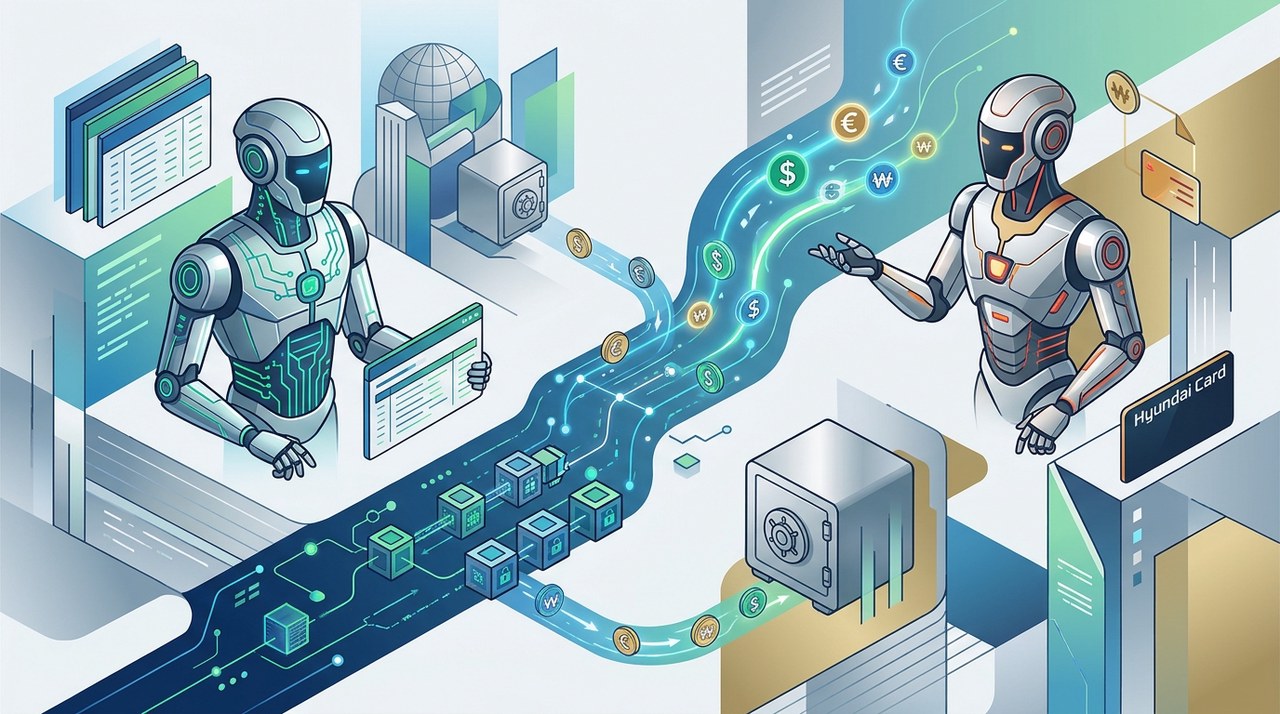
JPMorgan and Hyundai Card Put AI Agents to the Test
Imagine having a digital assistant that monitors corporate bank accounts and handles currency trades automatically when funds drop too low. That is the concept JPMorgan and Hyundai Card recently tested.
On November 18, Hyundai Card confirmed it ran a proof-of-concept trial on JPMorgan's Kinexys blockchain platform. The test used software bots to simulate foreign exchange transfers between overseas subsidiaries without a human typing the commands.
However, this was strictly an exploratory simulation. No real money moved during the exercise, and human-defined safety rules controlled every step.
How the Automated FX Transfer Process Worked
To understand the experiment, picture two automated assistants communicating securely behind the scenes to balance corporate accounts.
Here is the exact step-by-step workflow demonstrated during the pilot:
- Monitoring balances: The trial began when an overseas subsidiary's account balance dropped below a preset limit.
- Comparing market rates: Hyundai Card's AI agent checked the account and searched across multiple banks for foreign exchange quotes.
- Issuing instructions: The Hyundai bot instructed a JPMorgan Kinexys agent to convert the currency and bridge the shortfall.
- Verifying credentials: Before releasing funds, the Kinexys agent checked the sender's identity and authority level.
- Processing or escalating: Valid requests cleared automatically, while out-of-scope orders were rejected or flagged for human staff approval.
Hyundai Card defined the operational boundaries, while JPMorgan developed the verification controls. Neither institution disclosed transaction volumes, expected cost savings, or a target commercial release date.
Clarifying the Hypothetical $5 Million Limit
During discussions surrounding the test, Wee Kee Toh, head of Kinexys Insights at JPMorgan, mentioned a $5 million transfer threshold.
Company representatives later clarified that the $5 million figure was only a hypothetical example to illustrate rule boundaries, not an active ceiling used in the trial.
Because the trial remained simulated, it is still unclear how AI agents will handle sharp market volatility. Advanced multi-agent negotiations are not scheduled for testing until the first half of 2027.
Comparing the Kinexys Trial to Earlier Stablecoin Pilots
This experiment follows another blockchain test Hyundai Card conducted earlier in the year.
In July, Hyundai Card ran a live transfer of $20,000 using TetherUSDT+0.41% on the Avalanche blockchain between Hyundai Motor's U.S. and Mexican subsidiaries. That test moved real funds and settled in about seven minutes.
In contrast, the November Kinexys trial only evaluated treasury logic and authorization rules on a permissioned ledger, without settling live commercial assets.
While financial institutions continue testing automated workflow tools, corporate transactions remain anchored by human oversight and governance.
Hyundai Card also noted potential plans for future in-vehicle payment systems with JPMorgan. Still, fully autonomous corporate banking remains an emerging concept that requires further testing.
Past performance of blockchain trial projects or digital assets does not guarantee future results or commercial adoption.
Latest blog posts


Bitcoin's 200-Week Average Reaches New $68,000 Level
Blockstream CEO Adam Back highlighted that Bitcoin's 200-week moving average reached $68,000, even as short-term market prices trade slightly lower.
|

Ripple CTO Warns XRP Community Over Off-Topic X Replies
Ripple CTO David Schwartz announced he will block accounts posting XRP promotions in unrelated discussions on X to curb social media spam.
|


Fresh Crypto Wallets Move $3 Million in UNI and PEPE
Two newly created crypto wallets withdrew nearly $3 million in UNI and PEPE from major exchanges in five hours, raising questions about whale accumulation.
|