
Inside Ethereum's Roadmap: Glamsterdam, Hegotá, and Beyond
How EthereumETH+1.04% Upgrades: Rollups and Hard Forks
Upgrading Ethereum is a bit like servicing an airplane while it is in mid-flight. Instead of releasing one giant overhaul called Ethereum 2.0, developers update the network through regular events called hard forks.
These coordinated upgrades happen roughly twice a year when research and testing are ready. The main focus has been scaling the network using layer-2 networks.
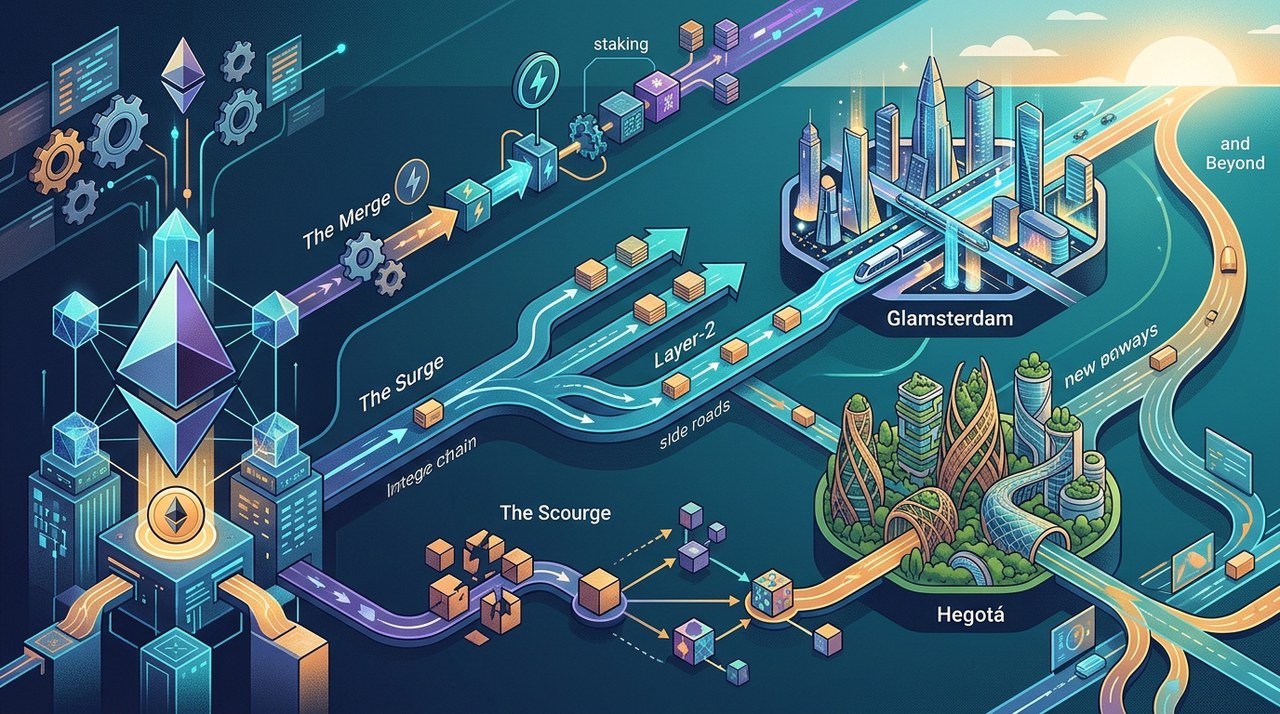
Think of layer-2 networks like side roads that handle traffic off the main highway. They process transactions on separate chains and send the combined results back to Ethereum. This approach uses rollups to bundle hundreds of transactions into a single batch, making activity much cheaper and faster for everyone.
The Master Plan: Vitalik's Six Roadmap Phases
In July 2022, Ethereum co-founder Vitalik Buterin outlined six key phases for the network's ongoing development. These phases are broad goals that move forward in parallel:
- The Merge: Transitioned the network from mining to staking, cutting energy use by 99.95%.
- The Surge: Focuses on scaling so rollups can handle far more transactions at lower costs.
- The Scourge: Aims to lower the influence of intermediaries and tackle Maximal Extractable Value (MEV).
- The Verge: Works toward a stateless design so validator nodes do not need to store all network data.
- The Purge: Cleans up old historical data to keep hardware requirements light.
- The Splurge: Covers smaller user experience tweaks and long-term improvements.
A Timeline of Recent Upgrades
Ethereum has already completed several major milestones on its roadmap:
- September 2022 (The Merge): Replaced proof-of-work with proof-of-stake. This cut energy use drastically, though it did not directly lower transaction fees.
- April 2023 (Shanghai/Shapella): Allowed validators to withdraw their staked ETH for the first time.
- March 2024 (Dencun): Introduced proto-danksharding (EIP-4844) with temporary blob storage. This dramatically dropped layer-2 transaction costs.
- May 2025 (Pectra): Combined the Prague and Electra upgrades. It added smart account capabilities (EIP-7702) and raised validator stake limits from 32 ETH to 2,048 ETH.
- December 2025 (Fusaka): Brought Peer Data Availability Sampling (Peer DAS), allowing validators to verify data samples without downloading entire blocks.
Glamsterdam: The Next Big Upgrade in Testing
The next planned upgrade is named Glamsterdam. The name combines Amsterdam (the execution layer update) and Gloas (the consensus layer update). Its main objective is scaling Ethereum's base layer directly.
Key Features in Glamsterdam
- Enshrined Proposer-Builder Separation (ePBS / EIP-7732): Builds the separation between block proposers and block builders right into the protocol. It extends data propagation time from 2 seconds to 9 seconds, allowing much larger blocks.
- Block-level Access Lists (BALs / EIP-7928): Gives nodes a map of transaction data ahead of time so they can process independent actions in parallel.
- Gas and Storage Repricing: Adjusts database growth to around 120 GiB per year. Under EIP-8037, creating a new account will cost more gas, while standard ETH transfers could become up to 71% cheaper.
- Contract Enhancements: Raises the maximum contract size from 24 KiB to 64 KiB and allows developers to deploy contracts to identical addresses across multiple chains.
Glamsterdam entered testing on the Sepolia testnet in October 2026. A planned fork on the Hoodi testnet was postponed to December 15, 2026, after security firm ChainSecurity raised concerns about smart contract safeguards. Node operators will need to update their client software when it launches, but everyday ETH holders do not need to take any action.
Looking Ahead to 2027: Hegotá
Following Glamsterdam, developers plan to release Hegotá, combining Bogotá and Heze. Mainnet activation is targeted for the second quarter of 2027.
Features Under Consideration for Hegotá
- Fork-choice Enforced Inclusion Lists (FOCIL / EIP-7805): Uses validator committees to force builders to include pending transactions, preventing censorship.
- Frame Transactions (EIP-8141): Lets accounts define their own transaction validation rules. This brings social recovery, spending limits, multi-signature controls, and quantum-resistant signatures directly into the network.
The full scope of Hegotá remains under active debate. In late 2026, some developers suggested dropping FOCIL to focus more resources on quantum computer defenses. Note that past performance of digital assets is not indicative of future performance.
Latest blog posts
Ethereum ICO Turnaround: $100 to $555K as Wall Street Sells
Early Ethereum buyers enjoyed massive historical gains, but recent months show Wall Street funds pulling billions from spot ETH ETFs.
|

Stellar RWA Hits $4.3B as DEX Volume Drops 22%
Stellar's tokenized real-world asset market has reached $4.3 billion, even as trading volumes on decentralized exchanges take a temporary dip.
|


XRPL Native Lending Upgrade Nears Activation Vote
The XRP Ledger needs just one more validator vote to launch a two-week activation countdown for native borrowing and lending features.
|