

Greece Approves 10% Crypto Tax and 15% DeFi Levy
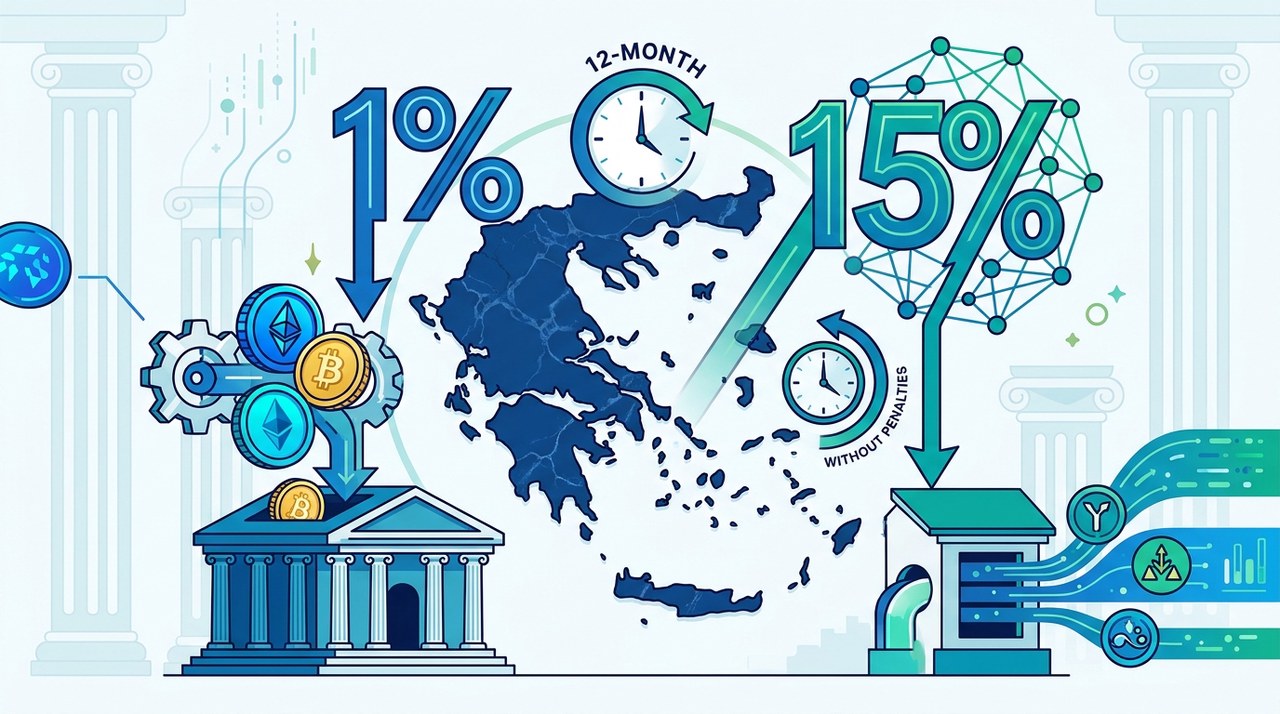
Greece Sets Clear Tax Rules for Digital Assets
Greece is taking a major step toward regulating digital assets within its borders. The Greek government has formally approved new tax rates aimed at cryptocurrency gains and income generated from Decentralized Finance (DeFi) platforms.
Under the new policy, capital gains from cryptocurrency investments will be taxed at a flat rate of 10%. At the same time, earnings derived from DeFi activities will face a 15% levy.
To help investors adapt to the new rules, authorities are providing a 12-month window for declaring past gains without incurring late-filing penalties. However, key questions still surround the tax treatment of crypto-to-crypto swaps.
Breaking Down the 10% Capital Gains Tax
Capital gains taxes generally apply to the profit realized when selling an asset for a higher price than its original purchase price.
Under the newly approved system, Greek investors who sell their crypto assets for cash will pay a 10% tax on the net profit.
For example, if an investor purchases digital tokens for $2,000 and later sells them for $3,000, the taxable capital gain is $1,000. Under the 10% tax rate, the tax liability on that trade would be $100.
This clear structure gives retail investors a predictable framework for calculating annual profits when converting cryptocurrencies back into fiat currency.
Understanding the 15% Levy on DeFi Income
Decentralized Finance (DeFi) protocols allow users to generate yields through activities like staking, lending, and providing liquidity.
The Greek framework sets a separate 15% levy on income derived from DeFi. This differentiates passive yield generation from simple asset sales.
Tax authorities treat earnings from staking or lending similar to traditional financial interest payments. Because it is categorized as ongoing income rather than capital appreciation, it carries the higher 15% rate.
Active DeFi participants will need to track incoming rewards and calculate their value at the time of receipt to report this income accurately.
A 12-Month Grace Period for Past Gains
Recognizing that crypto tax compliance has historically been ambiguous, the Greek government is offering a temporary amnesty window.
Investors will have 12 months to declare past crypto gains without facing standard late-filing penalties.
This grace period gives crypto holders an opportunity to review past transactions, calculate previously unrecorded profits, and report them to tax authorities without fear of financial punishment for late submission.
Tax experts expect this incentive to encourage voluntary disclosure and help bring historical crypto holdings into compliance with local tax laws.
Unresolved Questions: Crypto-to-Crypto Swaps
While the framework establishes clear rates for cash sales and DeFi income, certain technical areas remain uncertain.
Questions remain over how crypto-to-crypto swaps will be taxed. It is still unclear whether exchanging one token directly for another triggers an immediate taxable capital gain.
In some countries, swapping BitcoinBTC-4.82% for EthereumETH-6.79% is treated as a taxable sale followed by a purchase. In other jurisdictions, tax is deferred until assets are sold back into fiat currency.
Until official guidance clarifies this detail, traders who frequently swap between different digital tokens will face ongoing accounting challenges.
The Broader Context of European Regulation
Greece's new tax measures align with a wider effort across Europe to increase oversight of digital asset markets.
European Union directives, including MiCA (Markets in Crypto-Assets) and DAC8 reporting rules, are pushing member states to implement standardized monitoring for digital wealth.
By establishing precise tax rates for capital gains and DeFi earnings, Greece is building the legal foundation needed to integrate digital assets into its national economy.
Key Steps for Investors Moving Forward
As the new regulations take effect, investors operating in Greece can take practical steps to ensure proper reporting:
- Maintain thorough records of all transaction histories, cost bases, and sale prices.
- Distinguish clearly between simple capital gains and passive DeFi income rewards.
- Take advantage of the 12-month grace period to report historical gains penalty-free.
- Monitor upcoming updates regarding the specific tax treatment of token-to-token swaps.
As tax agencies worldwide refine their approach to digital finance, clear documentation remains the most effective tool for crypto investors to remain compliant.
Latest blog posts


Democrats Target Data Centers: Impact on Bitcoin Miners
Political pushback against AI data centers in Texas and across the US creates new hurdles for Bitcoin miners shifting to AI hosting.
|
Bitcoin and Ether ETFs See $530M Outflows as Rally Pauses
US spot Bitcoin and Ether ETFs recorded $530 million in combined daily outflows on Thursday as Bitcoin dropped below $76,000 alongside a stock market pullback.
|

Hyperliquid Seeks US Approval for Perpetual Futures
Hyperliquid Strategies spent $785 million on tokens this quarter while pursuing US regulatory registration to launch perpetual futures trading.
|