

Europol Warns Quantum Threat Targets Crypto Keys Not Chains
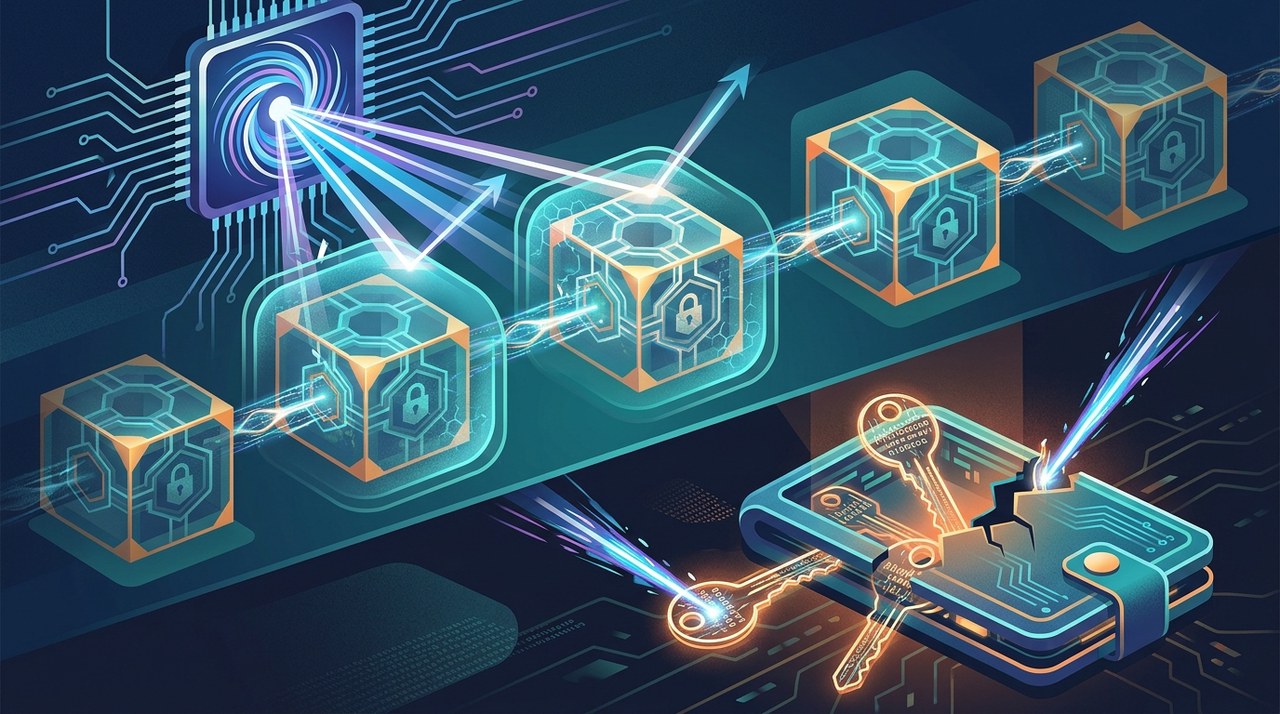
Many people fear that a powerful quantum computer will one day crack BitcoinBTC-1.10%'s code and destroy the entire crypto market. However, European law enforcement agency Europol has released a report that shifts the focus of this narrative.
The report, titled Quantum Computing and Cryptocurrencies from Europol's European Cybercrime Centre, explains that quantum machines do not threaten the underlying blockchain structure. Instead, the real risk lies in exposed private keys inside individual crypto wallets.
Why Your Blockchain Is Safer Than You Think
Sci-fi movies often depict quantum supercomputers snapping security systems in half instantly. Europol clarifies that blockchain networks are much sturdier against quantum power than many realize.
Bitcoin uses a Proof-of-Work system that relies heavily on cryptographic hash functions. Similarly, Proof-of-Stake networks like EthereumETH-1.26% use hash functions to connect blocks and maintain an accurate ledger.
An attacker using Grover's algorithm could theoretically speed up searches against these hashes. Even so, breaking a standard 256-bit hash still demands about 2^128 quantum operations. That keeps the core blockchain ledger firmly secured against quantum attacks.
In both PoW and PoS systems, hash functions are largely quantum-safe. The primary quantum risk lies in public-key cryptography used by wallets, not the blockchain itself.
The Real Danger: Exposed Public Keys
While the core network remains safe, individual wallet security faces a major challenge. Cryptocurrency ownership depends on a mathematical link between a public key and a private key.
With standard computers, calculating a private key from a public key is practically impossible. But a quantum computer running Shor's algorithm changes that math entirely. It allows an attacker to derive private keys from public information.
Whenever you make certain transactions, your public key becomes visible on the public ledger. Europol warns that once a public key is exposed, you cannot undo that exposure.
Exposed Externally Owned Accounts (EOAs) cannot be secured retroactively. They must be abandoned in favor of quantum-resistant alternatives.
The Massive 76-Day Bitcoin Moving Job
The solution to quantum decryption already exists in the form of post-quantum cryptography. For instance, the National Institute of Standards and Technology (NIST) has published post-quantum standards that developers can adopt.
The real problem is the sheer scale of migrating millions of users across a decentralized global network. Moving everything requires enormous time and block space.
Europol highlights research showing that migrating all Unspent Transaction Outputs (UTXOs) on Bitcoin would take at least 76 days of continuous network capacity if no other transactions were processed.
Shutting down the network completely for 76 days is impossible. A more realistic plan would dedicate 25% of every Bitcoin block to migration, stretching the entire upgrade process across 300 days.
Because crypto operates without a central authority, this massive effort requires synchronized action across the ecosystem:
- Core developers writing and testing quantum-safe protocols
- Miners and node operators updating their node software
- Wallet providers and crypto exchanges upgrading user interfaces
- Individual holders transferring funds to new quantum-safe wallet addresses
Preparing Before the Clock Runs Out
Europol is not predicting the death of digital assets. Instead, the agency encourages proactive upgrades to guarantee long-term survival before practical quantum computers arrive.
Some emerging projects are already building with quantum security in mind. For example, quantum-focused blockchain Quantus recently enabled trading for its QTC token via Near Intents, demonstrating how developers are experimenting with early solutions.
As technical solutions develop, investors should evaluate both technological upgrades and market conditions carefully. Past performance of digital assets is no guarantee of future returns.
Europol's warning serves as a clear call to action. Upgrading global networks takes time, and starting early is the best way to keep user funds secure for decades to come.
Latest blog posts


Tron, Tether, and Chainalysis Launch Crime Task Force
Tron, Tether, and Chainalysis have launched the Digital Crime Task Force to combat AI-powered crypto crime and illicit activities.
|
Tron and Tether Partner with Chainalysis to Stop Crime
Tron and Tether have partnered with Chainalysis to track illicit USDT activity and assist law enforcement following the dissolution of the T3 crime unit.
|

Tether, Tron, and Chainalysis Form New Anti-Crime Alliance
Tether, Tron, and Chainalysis launched the Digital Crime Task Force to catch illicit USDT transactions before stolen funds can disappear.
|