
EU Seeks $55 Billion Fund for AI and Quantum Computing
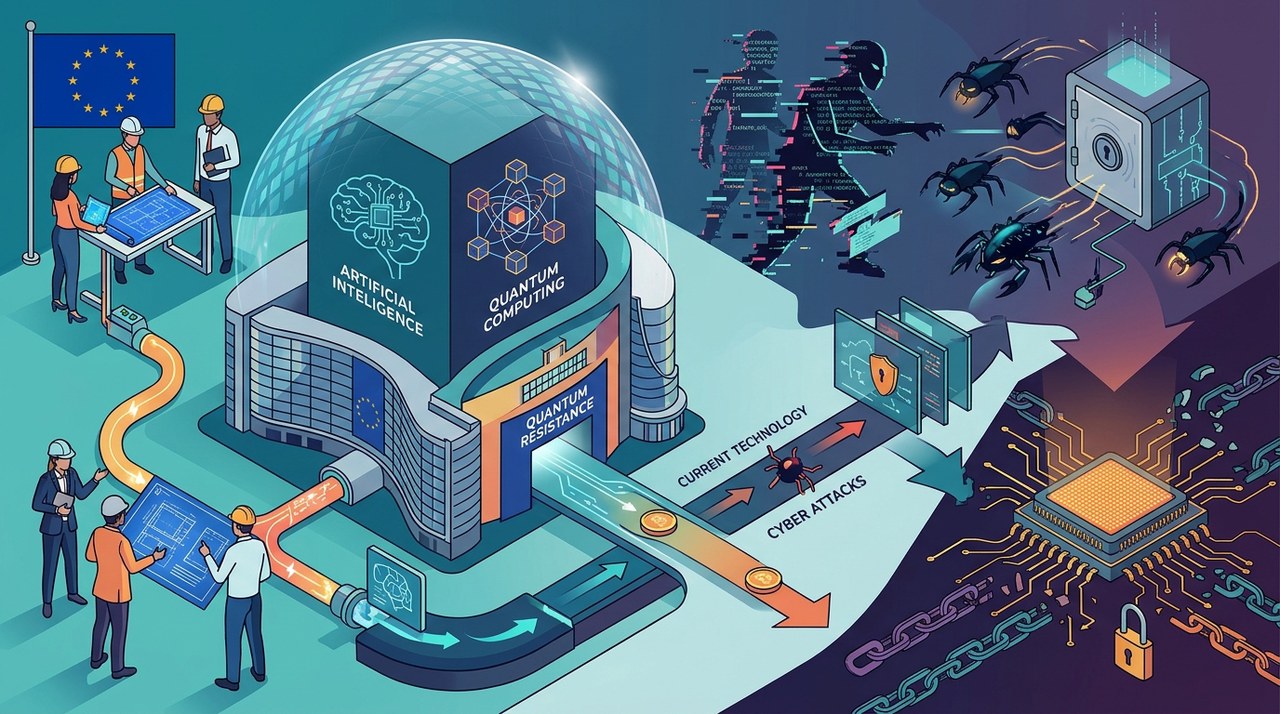
EU Explores Massive $55 Billion Tech Investment
The European Union is reportedly working on plans to establish a technology fund worth up to $55 billion. This ambitious initiative aims to advance developments in artificial intelligence and quantum computing.
European policymakers want to ensure the region stays competitive globally. They also recognize that advanced technologies present new challenges for digital infrastructure and cybersecurity.
How Attackers Currently Use AI Against Crypto Exchanges
CyberCYBER-16.59% threats are no longer just static code exploits. Malicious actors already leverage artificial intelligence to target cryptocurrency platforms and user accounts.
AI tools enable attackers to scan smart contracts for vulnerabilities at remarkable speeds. These automated systems can also craft highly convincing phishing messages to trick users into revealing private security credentials.
Hackers already use AI to target crypto exchanges, while future quantum computers could break the cryptography that protects users' funds.
The Future Challenge: Quantum Computing and Encryption
While artificial intelligence poses an active threat today, quantum computing represents a significant long-term structural challenge for digital security.
Blockchain networks rely heavily on public-key cryptography to protect wallets and verify transactions. Standard computers would need millions of years to break these cryptographic mathematical locks.
In contrast, mature quantum computers utilize principles of quantum mechanics. Once fully realized, these machines could theoretically solve complex mathematical equations rapidly, putting traditional wallet encryption at risk.
Understanding the Security Landscape
To visualize the difference between standard computing and quantum capabilities, consider how combination locks work:
- Traditional Computers: Try lock combinations one by one in sequence, taking vast amounts of time.
- Quantum Computers: Process complex mathematical probabilities simultaneously, dramatically cutting down decryption times.
- AI Threat Vectors: Automate modern phishing and vulnerability discovery, speeding up existing cyber attack cycles.
How Blockchain Developers Plan to Adapt
The crypto developer community is fully aware of these emerging technical hurdles. Researchers are actively designing quantum-resistant cryptographic algorithms to upgrade existing blockchain structures.
Major networks intend to deploy quantum-proof security measures well before high-powered quantum machines become commercially widespread.
Key Takeaways for Digital Asset Users
The EU's proposed $55 billion funding highlights the urgent need for robust tech infrastructure. As digital threat models change, public institutions and private developers must continually upgrade security safeguards.
For individual crypto holders, maintaining best practices remain essential. Utilizing hardware security, enabling multi-factor authentication, and keeping software up to date help protect personal funds against present-day automated AI attacks.
Latest blog posts



Bitcoin Drops Below $60,000 as Altcoins Face Selling Pressure
Bitcoin has dipped below $60,000 while HYPE and SOL pull back, as analysts point to stock market pressure and upcoming U.S. inflation data.
|

Kalshi Traders See 24% Chance XRP Could Drop to $0.80
Prediction market traders on Kalshi estimate a 24% probability of XRP falling to $0.80 before November ends as the token sits near $0.92.
|
OpenVault Raises $2 Million Seed Round at $20M Valuation
OpenVault completes a $2 million seed funding round led by HorizonArc Ventures at a $20 million valuation to expand its AI structured finance platform.
|