
Early Dogecoin Blocks Once Paid Up to 1 Million DOGE
Dogecoin's Wild Beginnings in 2013
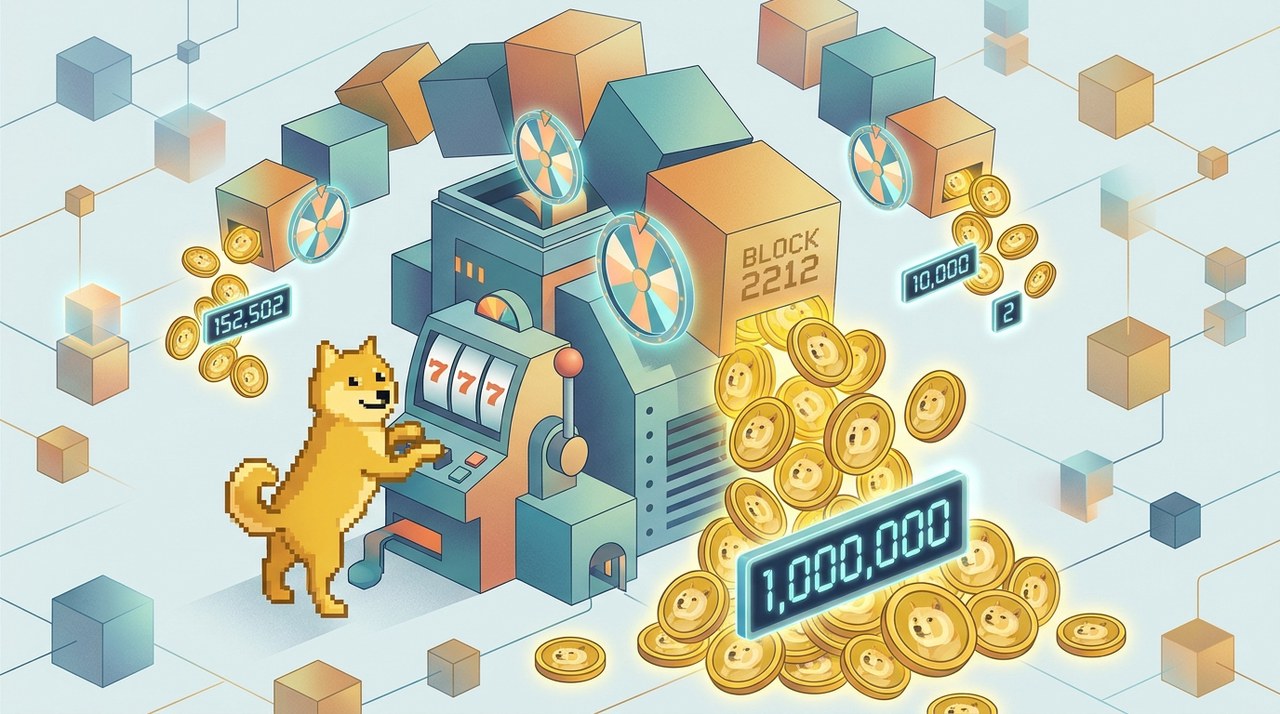
When Dogecoin officially launched on December 8, 2013, it did not follow the standard block reward model used by most cryptocurrencies today. Instead of giving miners a fixed amount for every verified block, the network used a randomized payout mechanism.
For the first 100 days of the network, every block mined felt like a lottery draw. Two different miners working under the exact same network conditions could end up receiving completely different compensation.
How the Random Block Payouts Worked
From block 0 to block 100,000, Dogecoin's algorithm randomly generated rewards ranging from as little as 1 or 2 DOGEDOGE-0.29% all the way up to 1,000,000 DOGE per block.
Dogecoin community member 'nformant' recently brought renewed attention to this early era, highlighting how unpredictable early mining earnings really were.
The Curious Incident at Block 2212
Because the reward system was so novel, it produced some intriguing historical anomalies on the blockchain. One notable event occurred at block 2212.
At block 2212, the network generated a block reward of 152,502 DOGE. However, due to how the miner claimed the payout, they only received 10,000 DOGE.
"For 100 days, every Dogecoin block was a lottery ticket worth 2 to 1,000,000 DOGE. One miner won 152,502 and only claimed 10,000. The rest - never created," 'nformant' shared.
Because the remaining 142,502 DOGE were never claimed by the miner, those tokens were permanently lost and never created on the blockchain.
Replaying the Dogecoin Lottery
To help crypto enthusiasts explore this historic period, 'nformant' created an interactive simulation tool called the 'Dogecoin Lottery Replay'.
The simulation allows anyone to input any block number from block 1 through block 144,999 to see what the calculated reward was for that block.
Because payouts were determined mathematically using the previous block's hash, anyone can re-calculate and verify these historical drawings today.
The simulation shows that the final randomized lottery payout occurred at block 144,999, which awarded a reward of 384,843 DOGE.
The Timeline of Dogecoin Reward Changes
The randomized system was eventually phased out step by step to bring predictability to Dogecoin's token supply.
- December 8, 2013: Launch of Dogecoin with random block rewards up to 1,000,000 DOGE.
- February 14, 2014 (Block 100,000): The maximum randomized block reward was reduced to 500,000 DOGE.
- March 17, 2014 (Block 145,000): Random payouts ended completely, shifting to a fixed reward of 250,000 DOGE per block.
- Block 600,000 Onward: The fixed reward eventually dropped to 10,000 DOGE per block, establishing the ongoing reward structure used today.
Understanding Crypto Mining Evolution
Looking back at Dogecoin's initial lottery model reminds us of how much experimentation occurred in early cryptocurrency design.
While Dogecoin now operates on a steady, fixed issuance schedule, its early randomized rewards remain one of the most distinctive chapters in meme coin history.
Past performance of digital assets or historical network reward distributions do not indicate future returns or performance. Digital assets involve significant market risks and high price volatility.
Latest blog posts



Bitcoin Price Faces December Test as Analysts Eye Bottom
Bitcoin traded near $59,200 in late November 2026 amid record spot ETF outflows and interest rate concerns, leaving analysts divided on whether December will bring a market bottom.
|

Justin Sun Calls for Delisting of Trump-Linked WLFI Token
TRON founder Justin Sun has urged crypto exchanges to delist World Liberty Financial (WLFI), requesting deposit restrictions and full disclosure of funds.
|
Understanding Low Sentiment Around Bitcoin in Bear Markets
Market sentiment around Bitcoin has dropped to historic lows, leading digital asset veterans to question its core value proposition.
|