
Did AI Break Bitcoin Security? The Viral Rumor Explained
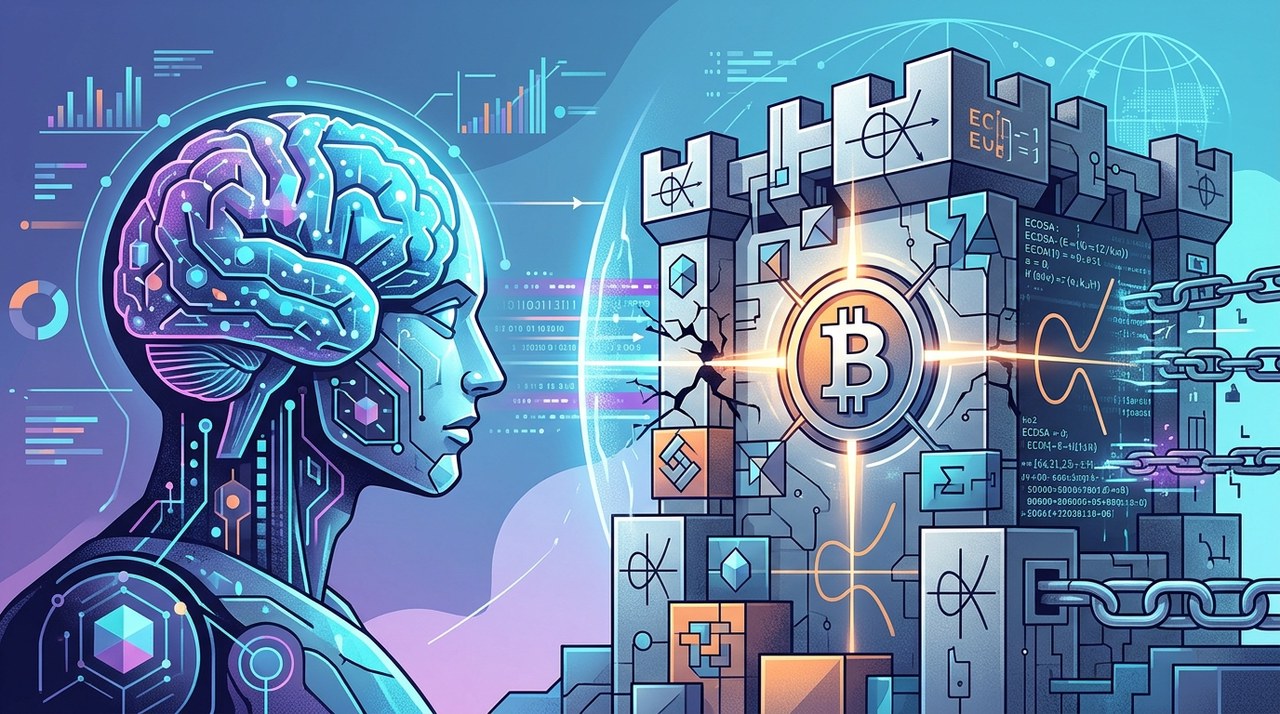
The Scary Headline That Shocked the Crypto World
Imagine waking up to news that artificial intelligence cracked BitcoinBTC-0.54%'s security code.
That exact fear swept across social media recently, causing sudden worry among investors.
People began sharing rumors that an AI lab broke the encryption behind major digital assets.
Fortunately, there is no need to panic.
Galaxy Digital head of research Alex Thorn tracked down where this wild story started.
He discovered that nobody actually broke Bitcoin's security system.
Instead, the entire story was just a massive game of internet telephone.
Understanding the Basics: How Bitcoin Protects Your Funds
To understand the rumor, let us look at how Bitcoin protects user accounts.
Bitcoin uses a math system called ECDSA, or Elliptic Curve Digital Signature Algorithm.
Think of ECDSA as a unique digital signature for every transaction.
It proves you own your coins without revealing your private password.
Computer systems also rely on standard tools like RSA encryption and advanced mathematics.
If an AI ever cracked these systems, global cybersecurity would face serious trouble.
However, nobody has publicly demonstrated the ability to fake a Bitcoin signature.
No private keys were stolen, and RSA encryption remains completely safe.
Tracing the Rumor: How the Story Started
Alex Thorn scanned days of posts on platform X to find the origin.
The earliest post he found was published on November 15, 2026.
An X user named ibr (@stillibr) posted a theory explaining falling crypto prices.
The user claimed to hear rumors that an advanced AI lab cracked ECDSA.
Yet, the post offered zero evidence of any breakthrough or actual coin sales.
How Social Media Fueled the Fire
Over the following days, other online users added their own theories.
On November 20, quantum error correction researcher Anthony Leverrier (@letonyo) raised a question.
He wondered if AI company Anthropic found an attack on Ring-LWE.
Ring-LWE is a complex math problem related to advanced lattice-based cryptography.
On November 21, user psychosomatica (@xenoimpulse) shared another rumor.
They claimed a friend heard from AI lab insiders about a math breakthrough.
The rumor claimed a fast polynomial-time factoring algorithm was close to release.
The Rumor Peak: Wild Theories Spread Quickly
By November 24, online chatter hit an all-time high.
AI writer Andrew Curran (@Andrew_Curran_) mentioned hearing several breakthrough rumors.
He admitted he had been hesitant to post about them earlier.
Later that day, account @imjustnewatai claimed an AI lab privately proved P=NP.
In computer science, proving P=NP would mean hard problems are easy to solve.
That same morning, blog reader Giorgio Camerani shared a similar idea.
He posted it as his personal theory on a science blog.
None of these posts named any real witnesses to the alleged proof.
What Scientist Scott Aaronson Actually Said
Computer scientist Scott Aaronson soon found himself in the middle of the storm.
Before he even commented, one viral post had gathered 2.6 million views.
On November 24, Aaronson answered a blog reader's question about factoring math.
He mentioned hearing rumors and expecting interesting news in cryptography.
However, he cautioned that stories often change as people retell them.
When the speculation exploded, Aaronson edited his original comment.
He crossed it out and told readers not to use it as proof.
He asked people not to claim AI found a factoring algorithm.
Setting the Record Straight
To clear up confusion, Aaronson published a mock interview blog post.
He explained he heard details about an upcoming theoretical result in research.
He stressed that this result poses no immediate danger to current security.
While he heard more shocking stories, he confirmed those were purely unproven speculation.
He suggested researchers might simply be getting closer to proving P != NP.
Proving P != NP actually reassures us that current encryption remains strong.
Mainstream News and AI Company Responses
By November 28, 2026, mainstream outlet The Guardian covered the rising rumor.
Aaronson told the newspaper he takes reports of math discoveries seriously.
However, The Guardian highlighted that no AI company announced an encryption breakthrough.
The publication reached out to top AI developers Anthropic and OpenAI for comments.
Neither company reported breaking any digital signature standards.
What This Means for Everyday Crypto Users
This event shows how quickly unverified social media posts can trigger market fear.
Always check primary sources before reacting to drastic claims online.
As of today, Bitcoin's underlying technology remains secure and operational.
Past performance of digital assets does not guarantee future results.
You can follow real-time market data directly at bitkub.com.
Latest blog posts

Bitcoin ETF Outflows Reach $5.39B as Market Risks Shift
U.S. spot Bitcoin ETFs recorded $5.39 billion in November outflows while an early Ethereum investor moved 45,000 ETH.
|

Will XRP Price Stabilize Above $1 Before the End of 2026?
XRP is attempting to recover after falling to a two-year low near $0.86 in November 2026. Here is an overview of key levels, ETF flows, and market trends.
|
Bitcoin Held at a Loss Tops 2022 Bear Market Levels
More than half of Bitcoin's total circulating supply is currently sitting at an unrealized paper loss, exceeding levels recorded during the peak of the 2022 bear market.
|