


Crypto Law Update: SEC FAQs, Canton Coin, and CFTC Rules
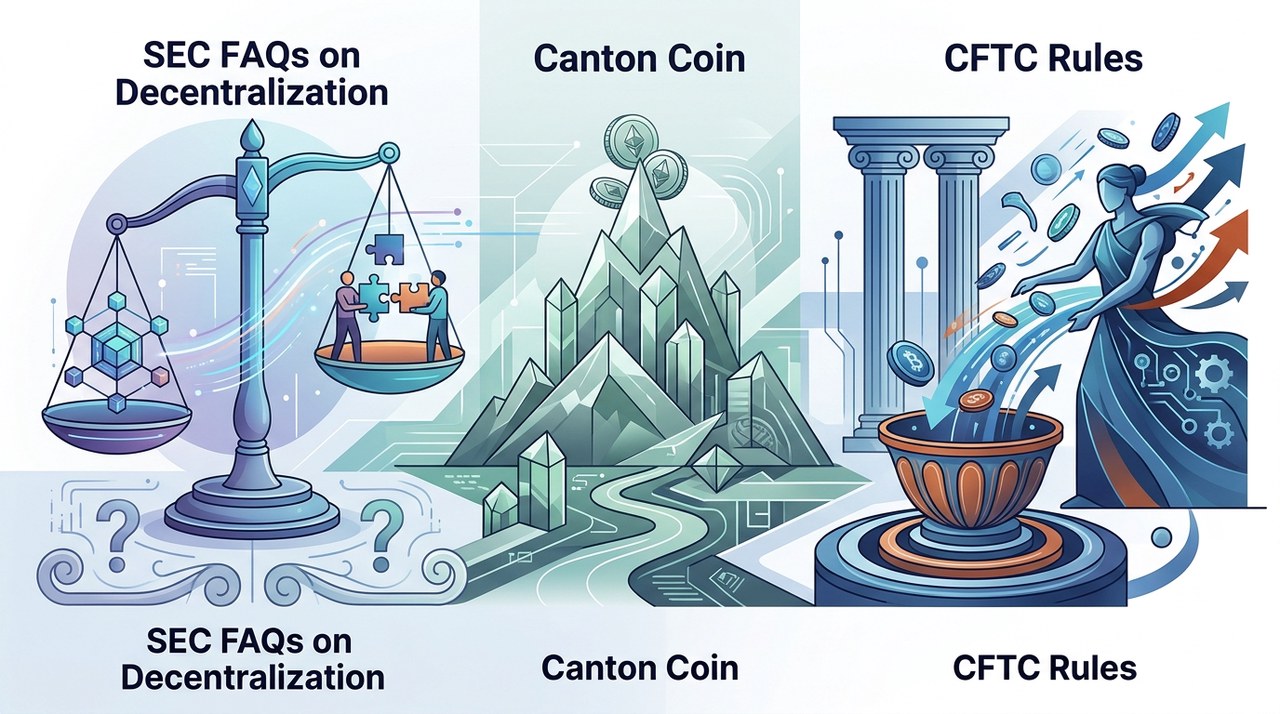
Welcome to this week's crypto law roundup! Navigating digital asset regulations can feel overwhelming. That is why we break down complex legal updates into clear, easy-to-understand insights.
Before we jump into the legal details, let's look at market context. During these announcements, Bitcoin (BTCBTC-0.49%) traded near $74,634 (+0.03%) and EthereumETH-1.10% (ETH) hovered around $2,116 (-0.46%). Remember, past performance of digital assets is not an indicator of future results.
SEC Clarifies Rules on Decentralization and Governance
On November 2, 2026, the SEC's Division of Corporation Finance updated its crypto-asset FAQ page. The regulators added three new questions to help project founders understand how the agency evaluates decentralized networks.
The staff explained that participants in a broad governance system are generally not treated as a single central party. This applies as long as participants are independent and have no formal or informal agreements to act together.
However, the SEC detailed specific signs of central control. A project might still have a central party if one entity holds unilateral authority to:
- Restrict user or validator access
- Select network validators
- Change voting processes or alter code
- Reverse blockchain transactions
- Revoke access to the platform
The SEC emphasized that token utility is separate from network decentralization. A token can have clear utility within an ecosystem, but regulators still examine who holds actual operational, voting, and economic control. Simply calling a project a DAO is not enough.
SEC Staff Issues No-Action Letter for Canton Coin
On November 3, 2026, SEC staff issued a no-action response regarding Canton Coin. The staff confirmed they would not recommend enforcement action over the token's minting and distribution.
The SEC viewed Canton Coin as a digital commodity based on two main factors:
- The token's value comes from programmatic network activity and market supply and demand, not central managerial effort.
- The Canton NetworkCC+4.96% operates without a central party controlling operations.
Under this framework, Canton Coin can be minted programmatically by Super Validators, Validators, and application providers without registration under Section 5 of the Securities Act or Section 12(g) of the Exchange Act.
However, the SEC stressed that this position is strictly fact-specific. It does not mean every utility or governance token is exempt from securities laws. Projects must provide clear evidence that code and market dynamics drive value rather than promises of profit from management.
CFTC Orders Exchanges to Remove State-Level Barriers
On November 5, 2026, the Commodity Futures Trading Commission (CFTC) issued new guidance for Designated Contract Markets (DCMs). The CFTC stated that federally regulated exchanges cannot block access to eligible U.S. residents simply because of the state they live in.
Exchanges have 30 days to remove state-based geographic restrictions or explain why compliance is not feasible. This guidance also applies to restrictions implemented through third-party intermediaries.
This policy builds on a recent dispute where the CFTC challenged Utah's attempt to apply local gambling laws to federal event contracts. Now, the CFTC is establishing a nationwide access standard under Core Principle 2 and Regulation 38.151.
This directive directly impacts prediction markets and crypto derivative platforms. Exchanges must review their geofencing rules, account terms, and onboarding controls to ensure fair access.
OFAC Sanctions Eight Canadian Crypto Businesses Over Iran Links
On November 6, 2026, the U.S. Treasury's Office of Foreign Assets Control (OFAC) sanctioned eight Canada-based money services businesses (MSBs) under Executive Order 13902.
Treasury alleged that these businesses converted Iranian rials into digital assets and processed transfers with sanctioned Iranian entities. Some transactions were linked to the Islamic Revolutionary Guard Corps (IRGC), terror groups, and sanctioned drug trafficker Ryan Wedding.
This action was coordinated with FinCEN, Canada's FINTRAC, and the U.S. DEA. The sanctions block all U.S. property associated with these businesses and prohibit U.S. persons from transacting with them.
This enforcement action highlights why crypto platforms must look beyond simple customer name checks. Effective compliance requires wallet screening, counterparty risk analysis, and transaction monitoring.
Former FBI Agent Pleads Guilty to $2.47 Million Crypto Theft
On November 5, 2026, former FBI agent Patrick Steven Yaroch pleaded guilty to wire fraud and money laundering.
According to Justice Department court documents, Yaroch abused his access to internal FBI systems to make around 100 unauthorized transfers. These transfers involved credentials from 35 active investigations, including at least one official FBI operational wallet, netting approximately $2.47 million.
He then moved and laundered the stolen digital assets to hide their origin. Sentencing is scheduled for March 4, 2027.
This case underscores the vital importance of robust custody controls. Organizations handling recovered digital assets must implement multi-party authorization, strict access controls, and regular internal audits to protect private keys from insider threats.
Key Takeaways for Crypto Businesses
These legal actions show that regulators are prioritizing operational realities over surface labels. Whether evaluating token decentralization, exchange access, sanctions compliance, or internal custody security, clear documentation and strong risk controls remain vital for long-term compliance.
Latest blog posts

Bitcoin Holders Split as Retail Leaves and Smart Money Buys
Bitcoin market data reveals a clear split as small retail wallets decline while mid-tier holders accumulate despite ongoing spot ETF outflows.
|
BitGo Revenue Drops 51% in Q3 as Net Income Clims
BitGo recorded a 51% revenue drop in Q3 due to quiet trading and low-margin stablecoin activity, but treasury gains lifted overall net income.

BlackRock Bitcoin ETF Sees $1.66B Outflows in 7 Days
US spot Bitcoin ETFs recorded $201 million in net outflows on Monday, with BlackRock's IBIT extending its withdrawal streak to seven trading sessions totaling $1.66 billion.
|