

Crypto Donors Spent Record $471M on 2026 US Midterms
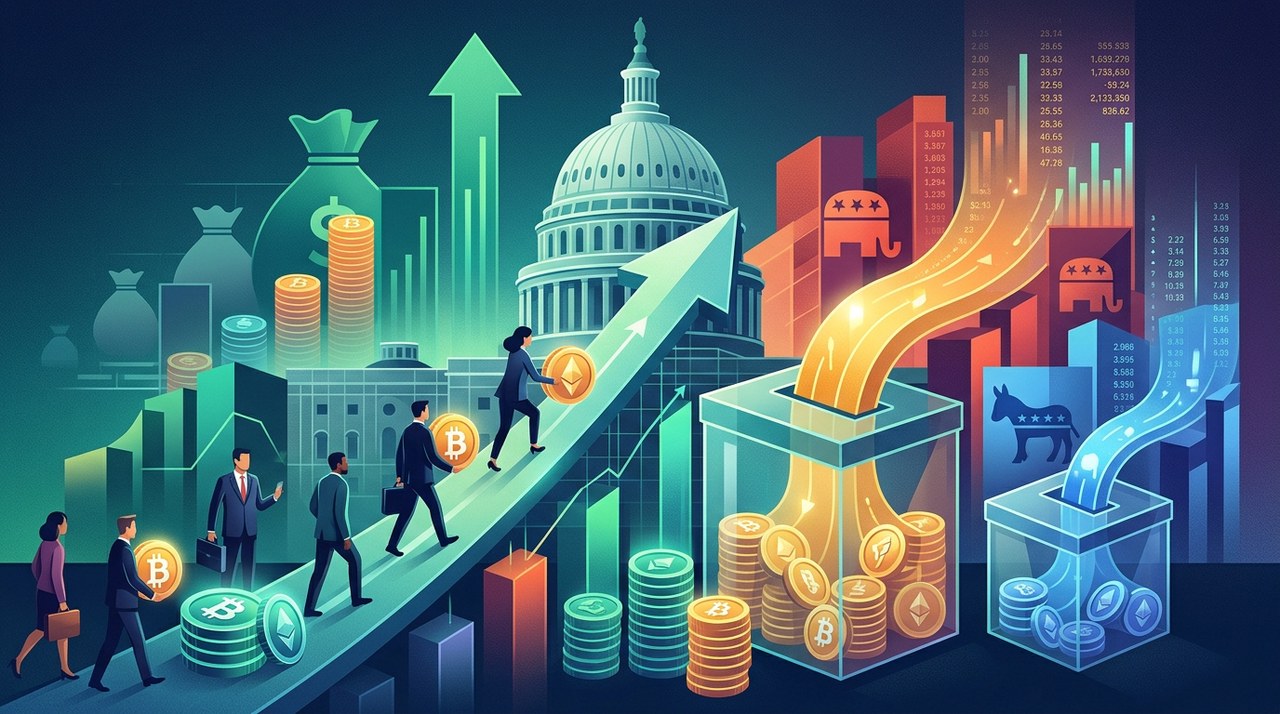
A Record-Breaking Election Season for the Crypto Industry
The cryptocurrency industry went all-in on the 2026 U.S. midterm elections. According to a detailed report by James Delmore, a blockchain and market analyst for Breadcrumbs, crypto-linked companies and executives contributed a massive $471 million to federal political campaigns.
That figure is nearly double the $250 million the industry spent during the 2024 election cycle. The massive influx of cash shows just how serious crypto companies are about shaping policies in Washington.
The research drew on official Federal Election Commission (FEC) records up to November 6, 2026. It highlights where the money came from, which political parties benefited most, and whether these massive investments paid off at the ballot box.
Where Did the Political Money Go?
Republican candidates received the vast majority of financial support from the crypto sector. Out of the total $471 million contributed, $302 million (65%) went toward Republican-aligned candidates and committees.
Democratic-aligned candidates and committees received $96 million (21%) of the total funds. The remaining portion was spread across bipartisan groups and non-affiliated committees.
Over $250 Million Flowed to Mainstream Political Committees
Instead of keeping all their money inside crypto-specific organizations, industry donors directed more than $250 million straight to major non-crypto Political Action Committees (PACs) and party committees.
- MAGA, Inc.: $94 million to support Trump-endorsed Republicans.
- Leading the Future: $50 million to a Super PAC focused on artificial intelligence.
- Lone Star Rising: $18 million supporting Democrat James Talarico for Texas Senate.
- HMP (House Majority PAC): $17 million supporting Democrats in House races.
- Congressional Leadership Fund: $15 million aligned with House Republican leadership.
- Senate Leadership Fund: $8 million aligned with Senate Republican leadership.
- V-PAC: Victors, Not Victims: $6 million supporting Vivek Ramaswamy for Ohio governor.
- Invest in Tomorrow Coalition: $6 million supporting Democratic clean energy candidates.
Inside the $163 Million Crypto Super PAC War Chest
Beyond general political committees, the industry relied heavily on specialized crypto PACs. The primary industry group, Fairshake, raised substantial funds and directed them to affiliated committees like Protect Progress and Defend American Jobs.
Together, these dedicated digital asset PACs spent roughly $163 million during the 2026 cycle. About 82% of that total supported Republicans or opposed Democrats, while 18% supported Democrats or opposed Republicans.
- Defend American Jobs (Republican): $102 million spent.
- Protect Progress (Democrat): $29 million spent.
- Fairshake (Bipartisan): $18.4 million spent.
- Digital Freedom Fund (Republican): $8.3 million spent.
- Fellowship (Mostly Republican): $4.8 million spent.
- First Principles Digital (Republican): $900,000 spent.
- Jump PAC (Bipartisan): $0 reported spending.
High Win Rates but Costly Losses in Senate Battles
On paper, candidates backed by crypto super PACs enjoyed impressive electoral success. Out of 90 candidates supported, 73 won their congressional races, while 14 lost and 3 remained uncertified at the time of publication. That represents a win rate of over 80%.
However, looking at the financial efficiency paints a different picture. More than half of the total $163 million spent by crypto PACs—specifically $88 million—went toward losing efforts.
Here is how spending unfolded across major Senate contests:
- Ohio Senate: $64 million spent to back Jon Husted and oppose anti-crypto incumbent Sherrod Brown (Candidate Lost).
- Nebraska Senate: $14 million spent to back winner Pete Ricketts against Dan Osborn (Candidate Won).
- Alabama Senate: $13 million spent to support winner Barry Moore (Candidate Won).
- Illinois Primary: $10 million spent opposing Juliana Stratton (Candidate Lost).
- Kentucky Senate: $8 million spent supporting winner Andy Barr (Candidate Won).
In Ohio alone, crypto PACs poured $64 million—representing 39% of their entire spending—into a single losing campaign.
Who Built the $471 Million Fund?
Both prominent digital asset companies and wealthy individual executives financed the $471 million political push. The top five corporate and investment entities accounted for $288 million, or 61% of all donations.
Top Corporate and Investment Donors
- Andreessen Horowitz (a16z): $117 million
- Coinbase: $61 million
- RippleXRP-2.57%: $50 million
- Crypto.com: $39 million
- Winklevoss Capital Fund: $21 million
Top Individual Donors
- Reid Hoffman: $28 million
- Cameron Winklevoss: $18 million
- Tyler Winklevoss: $18 million
- Chris Larsen: $17 million
- Ross Stevens: $6 million
When categorizing by donor industry alignment, pure digital asset firms and individuals provided the bulk of the funding:
- Crypto-native entities: $276 million
- Crypto-native individuals: $82 million
- Crypto-affiliated entities: $70 million
- Crypto-affiliated individuals: $43 million
- Total: $471 million
How Donors Backed Specific Political Parties
Political preferences varied significantly among key figures and firms in the blockchain space.
Largest Donors Supporting Republicans
- Foris Dax (Crypto.com): $38 million
- Winklevoss Capital Fund: $21 million
- Tyler Winklevoss: $17 million
- Cameron Winklevoss: $17 million
- Andreessen Horowitz (a16z): $10.6 million
- Cantor Fitzgerald: $10 million
- Ross Stevens: $6.3 million
- Blockchain.com: $5 million
- SolanaSOL-2.46% Institute: $3.6 million
- Bijan Tehrani: $3 million
- Matt Huang: $2.6 million
Largest Donors Supporting Democrats
- Reid Hoffman: $28 million
- Chris Larsen: $16.7 million
- Ron Conway: $7.5 million
- Michael Novogratz: $1.9 million
- Brian Armstrong: $494,000
What This Means for Crypto Legislation
With hundreds of millions invested, the cryptocurrency sector has clearly established itself as one of the largest corporate spending groups in American politics. The primary goal behind these massive donations remains securing clear, predictable regulatory frameworks for digital assets in the United States.
While crypto-backed candidates won the majority of their races, lawmakers and industry observers continue to debate whether spending on high-profile losses in states like Ohio will impact future legislative momentum.
Latest blog posts



 +2
David Schwartz Reveals Selling 23 Million XRP and Most BTC
Former Ripple CTO David Schwartz disclosed reducing his XRP holdings by over 88%, alongside selling most of his Bitcoin and Ethereum due to low risk tolerance.
|

Ripple Ex-CTO David Schwartz Discloses Crypto Holdings
Ripple CTO Emeritus David Schwartz revealed significant reductions in his XRP, Bitcoin, and Ethereum holdings over time.
|

Tron Inc Reports 22% Boost in Q3 Net Income
Tron Inc posted a $14.9 million net income for Q3 2026, marking a 22% year-over-year increase driven by growing staking revenue.
|