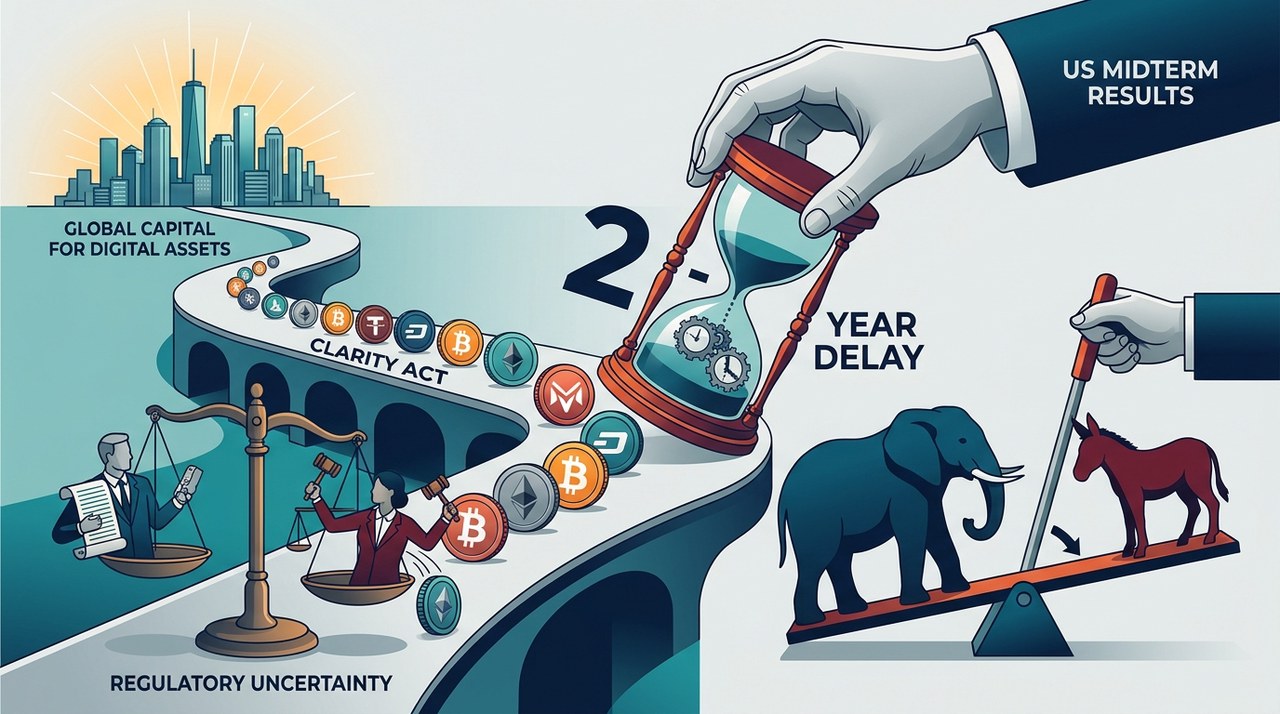
CLARITY Act Facing 2-Year Delay After US Midterm Results
Political Shifts and the Future of US Crypto Rules
Imagine setting up a business, but the ground rules keep changing every time new leadership takes over. That is exactly what the cryptocurrency industry is experiencing right now in the United States.
Following recent US midterm election results, where the Democratic Party took control of both chambers of Congress, key crypto legislation known as the CLARITY Act could be delayed for at least two years.
Popular market analyst Ash Crypto highlighted this growing challenge in a November 5 post on X. He noted that the new political reality dramatically complicates plans made by President Donald Trump to transform the United States into the global capital for digital assets.
Understanding the CLARITY Act and Why It Matters
To understand why a two-year delay is significant, it helps to look at what the CLARITY Act actually aims to achieve.
Currently, crypto companies operating in the US face a confusing regulatory landscape. Two different government agencies—the Securities and Exchange Commission (SEC) and the Commodity Futures Trading Commission (CFTC)—frequently overlap and compete over who gets to regulate digital tokens.
The CLARITY Act was introduced to clear up this confusion by establishing clear, nationwide federal rules for digital assets.
While government regulatory agencies like the SEC and CFTC can issue guidance or alter specific administrative rules on their own, formal legislation passed by Congress provides a far more durable framework. A statutory law remains stable across different presidential administrations, giving long-term certainty to investors and technology developers.
How Midterm Numbers Change the Voting Math
Passing major laws through the US Senate requires careful political math. In most cases, lawmakers need 60 votes to overcome procedural filibusters before a bill can even reach a final vote.
Back in September, the Senate held a key vote on the CLARITY Act. During that procedural session, Democrats unanimously voted against advancing the bill, denying Republicans the 60 votes needed to move it forward.
The latest midterm elections have made that legislative math even more challenging for crypto proponents:
- Democrats flipped seven seats in the midterm elections.
- This shift brought their total in the House of Representatives to 54 seats.
- Republicans now face an uphill battle to pass major pro-crypto bills without bipartisan support.
Republicans will now need Democratic support to pass major pro-crypto legislation, and given the party's current stance, analyst Ash Crypto noted that securing those votes will be difficult.
SEC Oversight vs CFTC Authority
One of the fundamental disagreements between the two political parties centers on which agency should hold primary authority over digital assets.
Many Web3 developers and crypto firms prefer oversight from the CFTC, which traditionally manages commodities like wheat, oil, and gold. Proponents argue the CFTC offers a regulatory approach better tailored to open-source software and decentralized networks.
Conversely, several leading Democratic lawmakers favor granting broader authority to the SEC. According to market analysts, Democratic proposals could introduce stricter oversight on digital assets and centralized exchanges.
Reports indicate that plans are in motion to expand the SEC's authority over crypto markets while simultaneously restricting the regulatory scope of the CFTC. For industry participants, this shift could mean higher compliance hurdles and increased regulatory scrutiny.
Impact on Institutional Adoption and Domestic Builders
Uncertainty in federal regulations rarely bodes well for big financial institutions. Traditional banks, asset managers, and large funds usually wait for clear legal frameworks before deploying substantial capital.
Ash Crypto warned that this legislative pause could temporarily cool institutional adoption. While institutional interest in digital assets has expanded significantly over recent years, investors must keep in mind that crypto markets remain highly volatile and subject to fast-changing macroeconomic and political conditions.
In addition to institutional hesitation, there is a growing concern that software engineers and startups may leave the United States altogether.
That doesn't mean crypto adoption will stop, but it could push many crypto builders offshore.
If American developers fear sudden regulatory enforcement actions without clear compliance guidelines, many may choose to relocate their projects to crypto-friendly jurisdictions across Europe, Asia, or the Middle East.
Bipartisan Hope: Not All Lawmakers Have Given Up
Despite the political gridlock, the door to crypto legislation is not entirely shut. It is worth remembering that the September Senate vote was simply a procedural question about whether to advance the bill toward a final vote, not a rejection of the bill becoming law.
Shortly after that procedural setback, a group of seven Democratic lawmakers issued a joint statement emphasizing that they remain committed to finding workable solutions.
Key figures involved in these discussions include:
- Senator Kirsten Gillibrand
- Senator Cory Booker
- Senator Ruben Gallego
- Senator Raphael Warnock of Georgia
These lawmakers noted that they have spent two years working on comprehensive legislation to establish safe, sensible guidelines for the sector. Their ongoing involvement suggests that negotiations will continue, even if reaching a final compromise takes longer than the industry originally hoped.
The Return of Prominent Crypto Critics
Another factor keeping the crypto industry on alert is the return of outspoken political critics to key positions in Washington, most notably Ohio Senator Sherrod Brown.
During his previous time as chair of the Senate Banking Committee, Senator Brown maintained a strict anti-crypto stance. His past public comments included:
- Suggesting that cryptocurrencies should be completely banned.
- Describing digital assets as a hotbed for Ponzi schemes with poor consumer protections.
- Framing crypto as a national security threat used by foreign cybercriminals, drug traffickers, and terror financiers.
Recognizing his influential role, crypto-focused political action committees (PACs) spent heavily to defeat him. In 2024, crypto PACs poured more than $40 million into campaigns targeting his seat. In the recent midterm cycle, that political spending rose to $64 million.
Despite this record-breaking campaign funding, the political effort did not yield the outcome crypto advocates sought. Senator Brown's return ensures that skeptical voices will remain prominent during upcoming legislative hearings.
Is Crypto Too Big to Be Stopped?
Even with potential political delays and the prospect of tougher regulatory conditions in the US, many market observers remain confident in the broader trajectory of the crypto asset class.
Over the last decade, blockchain technology has evolved from an experimental concept into a global financial sector backed by institutional products, public companies, and millions of daily users worldwide.
Several industry analysts argue that digital asset technology has become too big and geographically diverse to be halted by political shifts in any single country. While policy friction in Washington may slow down US-based legislation, global development continues uninterrupted.
As always, readers should remember that digital assets remain speculative instruments. Regulatory decisions, economic shifts, and technological changes can heavily impact asset valuations, and past growth or adoption patterns do not guarantee future performance.
Latest blog posts


Could GTA VI Signal Bitcoin's Next Big Market Move?
Traders are comparing GTA VI to past market patterns, while whale moves and AI IPOs shape Bitcoin's current trend.
|

Ripple CEO Sees Potential Crypto Recovery Post-Anthropic IPO
Ripple CEO Brad Garlinghouse suggests recent market weakness stems from capital shifting into Anthropic's IPO, comparing it to previous market patterns.
|


1inch Taps Hyperliquid to Offer Perpetual Futures Trading
1inch has integrated Hyperliquid's perpetual futures, allowing users to trade crypto, equity, commodity, and FX derivatives directly within its app.
|