Caterpillar Stock Drops 44% Despite Record $78B Backlog
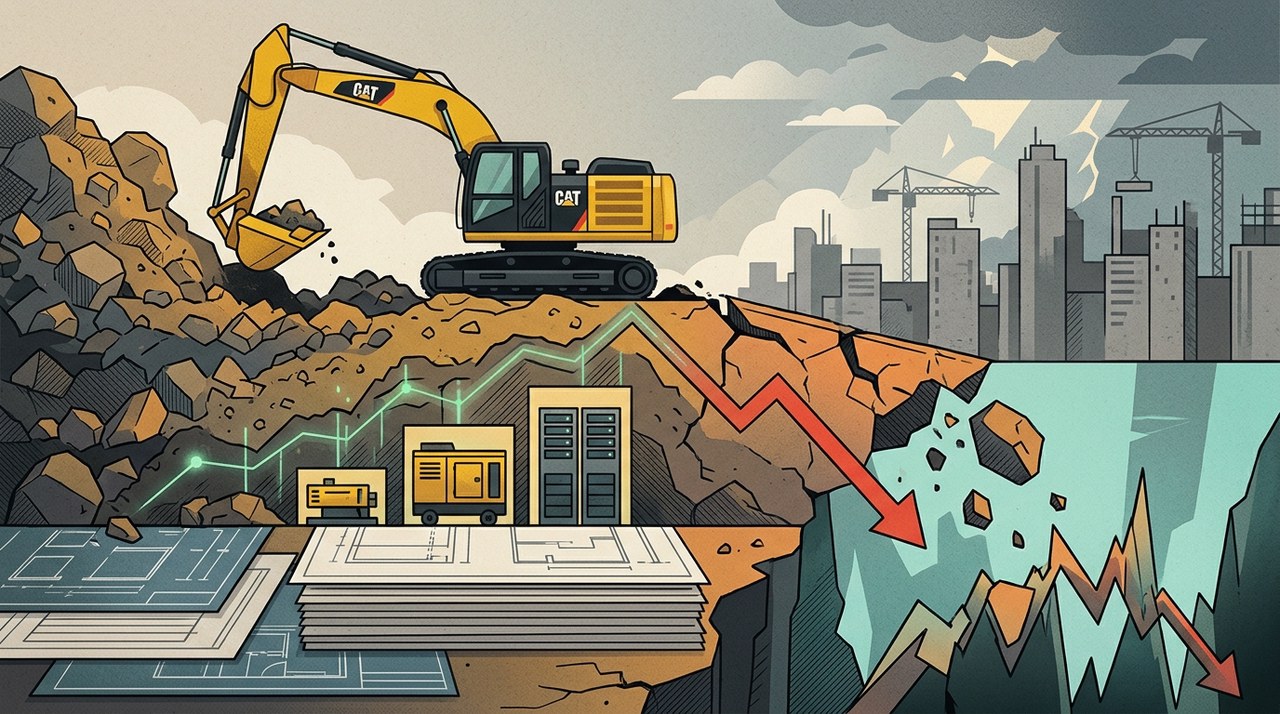
The Puzzle Behind Caterpillar's Stock Drop
Caterpillar is best known for its heavy construction equipment, but it has quietly become a key provider of power systems for artificial intelligence data centers. The company supplies large-scale gas generators that keep high-powered AI servers up and running.
Despite playing a critical role in the ongoing AI expansion, Caterpillar's stock has taken a significant hit in recent months. Since June 30, the company has lost roughly $214 billion in market capitalization.
On November 13, Caterpillar shares closed at $600.20. That price marks a decline of nearly 44% from its previous peak level.
What makes this downturn surprising to many market observers is that Caterpillar's order backlog actually reached a record $78 billion. An order backlog represents confirmed purchases that customers have booked but the company has not yet delivered.
This contrast leaves investors asking an important question: Is the stock market anticipating a future economic slowdown that current order numbers do not yet show?
Strong Financial Results Missed Market Expectations
Looking strictly at third-quarter financial figures, Caterpillar experienced solid top-line growth. Total revenue and sales rose 17% year-over-year to hit $20.7 billion.
Demand was particularly strong in the power generation division. Power generation sales jumped 75% compared to the same period last year, driven primarily by demand from expanding data centers.
Even with those positive metrics, Caterpillar's stock dropped 9.3% on October 29, the day it announced earnings.
Traders had anticipated an upgraded full-year financial outlook. When Caterpillar issued a more conservative sales expectation for the fourth quarter, investors responded by selling shares.
Local Opposition and Community Restrictions
Changing public sentiment and local political decisions have added extra headwind for companies building out AI infrastructure.
Data tracked by Ballotpedia showed that local voters approved limits on new data center developments in 40 out of 41 ballot measures during recent elections.
Local communities frequently voice concern over the large amounts of electricity and cooling water data centers consume, as well as the strain placed on regional electrical grids.
These local restrictions triggered pullbacks across several related equipment makers. For example, Vertiv, which manufactures specialized power and cooling systems, saw its stock fall 13% immediately following the election results.
A global analysis by the Financial Times indicates that manufacturing, power utility, and mining firms have collectively lost about $4.2 trillion in market valuation since June. That broad decline raises questions about whether pending equipment orders across the sector will remain intact.
Are Order Backlogs Always Reliable Indicators?
To understand why stock prices might decline despite large order books, it helps to look at how purchasing behavior works during periods of rapid supply expansion.
Paul Kedrosky, a venture capitalist and fellow at MIT, pointed out to the Financial Times that order backlogs are often trailing indicators rather than guaranteed future revenue.
During equipment shortages, corporate buyers often place double or triple orders with multiple suppliers just to ensure they receive equipment on time. Once hardware supply catches up, excess orders can be canceled rapidly.
Historical Parallel: The 2001 Telecom Fiber Bust
Financial history offers an example of how quickly order backlogs can change. During the telecom boom of the late 1990s, demand for fiber-optic cables grew rapidly.
In the second quarter of 2001, major customers of Corning’s photonics unit began canceling orders they had previously placed.
By September 2001, major telecommunications carriers delayed additional fiber purchases altogether, according to company regulatory filings.
Corning recorded a $5.5 billion net loss for that year and reduced its workforce by 12,000 employees. Its stock price, which traded above $100 in 2000, fell to $16 by June 2001.
The Bull Case for Ongoing Demand
Not all market analysts believe the current AI buildout will follow the path of the dot-com era telecom decline.
Alex Cordovil, an analyst at Dell'Oro Group, told the Financial Times that current record backlogs lock in supplier revenue growth through 2027.
In addition, Goldman Sachs CEO David Solomon defended the development of domestic data centers. He cautioned that placing severe local restrictions on domestic infrastructure could shift AI computing capacity overseas.
Other major equipment providers are experiencing similar trends. Siemens reported a 60% increase in its data center order backlog, while Eaton saw its order volume double year-over-year.
What to Watch Going Forward
Upcoming quarterly earnings announcements across the sector will offer clearer insights into order trends. These reports will show whether enterprise customers continue placing new orders or if cancellation rates begin to increase.
When assessing technology sector trends, it is helpful to weigh long-term growth arguments against potential short-term operational and market risks.
Please note that past performance of companies or financial markets is not a guarantee of future results.
Latest blog posts


Wall Street Giant Holds $440M in XRP, But Price Drops Below $1: Here's Why
Franklin Templeton revealed a $440 million XRP stash in a recent SEC filing. However, broader market conditions pushed XRP's price below $1.
|
Bitcoin and the Anthropic IPO: Can History Repeat Itself?
Bitcoin's price pullback ahead of Anthropic's IPO resembles the lead-up to SpaceX's listing, but key liquidity drivers differ this time.
|
Bitcoin and US Dollar Split Paths at Key Technical Mark
The US Dollar Index climbed above its 200-week moving average, while Bitcoin fell below its own long-term trendline amid rising rate hike expectations.
|