
Bitcoin Short-Term Holders Transfer 47,000 BTC at a Loss
Bitcoin Drops Below Key Short-Term Cost Level
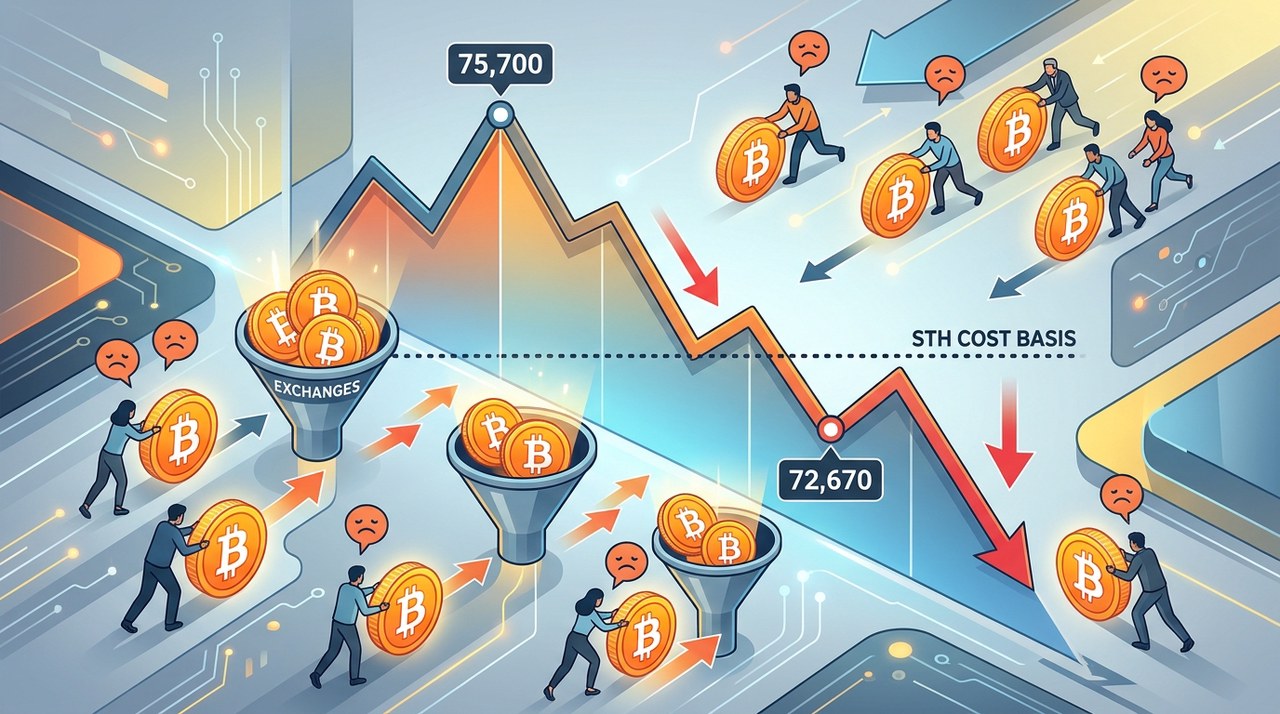
Bitcoin recently experienced a notable market pull-back, dipping to an 11-week low of $72,670. According to analytics platform CryptoQuant, this drop pushed the price below the average purchase price of short-term investors, which stood around $75,700.
When prices fell beneath this cost threshold, market data revealed that short-term holders moved roughly 47,000 BTCBTC+0.03% onto crypto exchanges while trading at a loss. Understanding these movements offers valuable insight into current market sentiment and short-term trader psychology.
What Is a Short-Term Holder Cost Basis?
In crypto analytics, market participants are often split into two main groups: long-term holders and short-term holders. A short-term holder (STH) is generally defined as an address holding Bitcoin for less than 155 days.
The realized price or cost basis for short-term holders represents the average price at which these recent buyers acquired their coins. In this instance, that benchmark was approximately $75,700.
- Above the Cost Basis: When Bitcoin stays above $75,700, recent buyers are generally in profit and feel confident.
- Below the Cost Basis: When Bitcoin drops to $72,670, recent buyers face unrealized losses, which can trigger emotional selling.
Why Transfer 47,000 BTC to Exchanges?
When investors move their cryptocurrency from private wallets to centralized exchanges, it usually indicates an intention to sell, trade, or use those assets as margin collateral.
The transfer of 47,000 BTC directly to exchange wallets at a loss signals classic capitulation among newer market entrants. When loss aversion kicks in, traders often choose to realize a smaller loss immediately rather than risk holding through further downward volatility.
Short-term holders tend to react more strongly to quick market shifts. When market prices fall below their entry points, exchange inflows often increase as traders attempt to manage their risk.
On-Chain Data Insights from CryptoQuant
CryptoQuant uses public blockchain data to track wallet movements and exchange reserves in real time. Their data highlights how transparent public blockchains are when monitoring large-scale investor activity.
While short-term holders have actively transferred coins during this dip, long-term holders typically demonstrate different behavior. Long-term investors often hold through cyclical price fluctuations, acting as a stabilizing force over extended periods.
Navigating Market Volatility Wisely
Large exchange inflows can create temporary sell pressure, which may keep prices volatile in the near term. However, crypto markets are highly dynamic, and sentiment can adjust rapidly based on macroeconomic conditions, institutional interest, and broader demand.
Investors evaluating market conditions should remain aware of inherent price volatility and avoid making hasty decisions based solely on short-term price movements.
Past performance of digital assets is not an indication of future performance. You can monitor live market activity directly on the Bitkub BTC Market.
Latest blog posts


XRP Community Targeted by 11.5 Million Scam Posts
A massive wave of fake airdrop posts on X has targeted XRP users over the past month as real-world asset activity grows on the XRP Ledger.
|
India ED Probes Hashpay Over Alleged Fake Crypto Scam Scheme
India's Enforcement Directorate is investigating crypto platform Hashpay over allegations of promising 1% daily returns through fake tokens.

Healthcare Beats Tech by Record Margin as Market Shifts
Healthcare stocks have taken a 35.6 point lead over tech stocks, marking the widest performance gap between the sectors in 25 years.