
Bitcoin Mining Profits Sink as Network Hashrate Hits 1 ZH/s
BitcoinBTC+1.84% Hashrate Bounces Back to 1 ZH/s
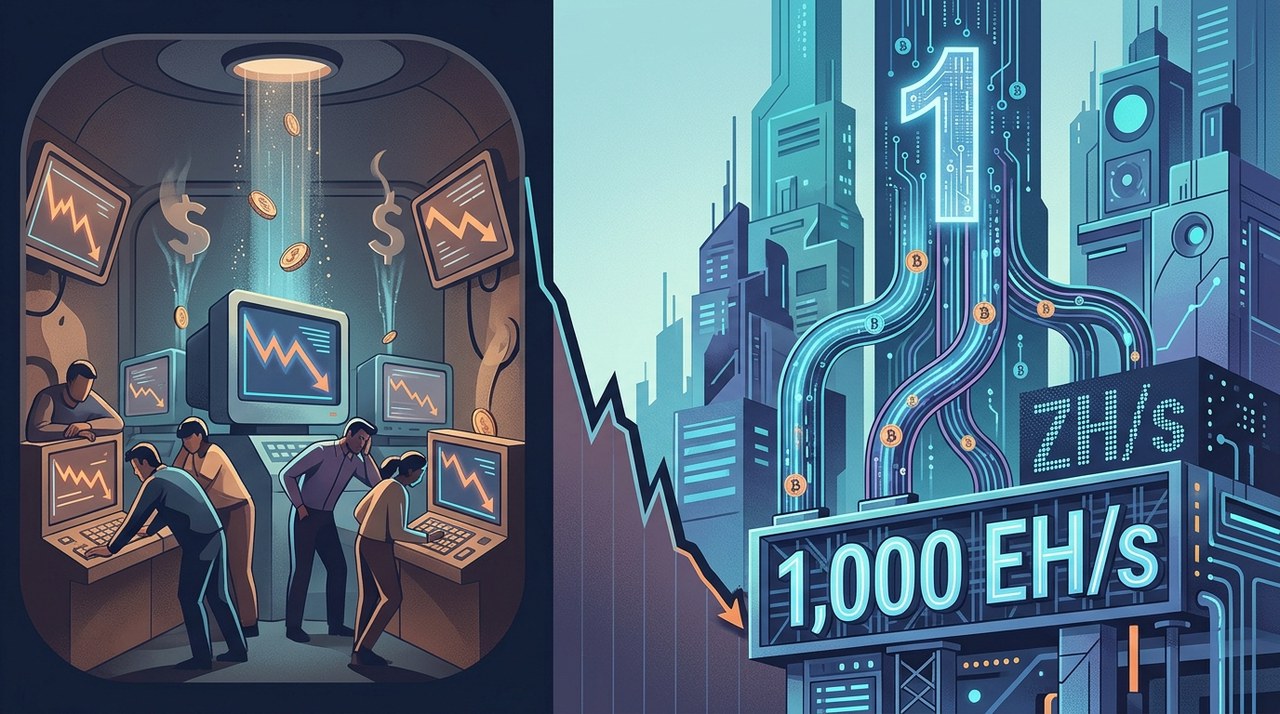
Bitcoin miners are navigating one of the most challenging economic environments in recent history. Even though Bitcoin's total computational power has bounced back above 1 zettahash per second (ZH/s), daily income for operators continues to drop.
Just recently, the network lost roughly 100 exahash per second (EH/s) as Bitcoin's price slipped down to $55,081 on Bitstamp. That price level represents a low not seen since early September 2024. However, the network has since recovered its total computing power, pushing back past the 1,000 EH/s threshold.
While having a strong network sounds like great news, the underlying financial math tells a much tougher story for the companies keeping the blockchain running.
Mining Revenue Hits Lows as Hashprice Slips
To understand why miners are hurting, it helps to look at a key industry metric called hashprice. Hashprice measures how much revenue a miner can expect to make from a specific amount of computing power each day.
On November 21, 2026, the daily hashprice dropped to just $26.16 per petahash per second (PH/s). This comes after hovering slightly under the $28 per PH/s mark, marking some of the lowest revenue levels in recent history.
At the same time, transaction fees have provided almost no financial relief. Historically, high network traffic generates fees that supplement the fixed block reward. Today, annual transaction fee revenue is on track for its lowest levels since at least 2011.
Over a recent 24-hour window, fees made up just 0.64% of total block rewards. That is well below 1% of total miner earnings. Because fees are so low, miners rely almost entirely on the market price of Bitcoin to cover their daily operational costs.
Trading Below the Cost of Production
Industry observer and crypto entrepreneur Kyle Chassé shared his thoughts on the situation with his 283,900 followers on X. He pointed out that Bitcoin is currently trading near or below what it costs many facility operators to produce.
To explain the dilemma, Chassé compared crypto mining to traditional resource extraction:
Think of a gold mine where every ounce sells for less than it cost to dig. Miners in that spot have two options. Switch machines off, or sell coins to pay the bills. Hashrate is still sitting near record highs. Nobody has switched off yet.
Chassé concluded his analysis with a question that highlights the industry's current tension: So who blinks first, the miners or the price?
Top ASIC Hardware Earns Barely Pennies
To see how thin these margins really are, we can look at the daily earnings of today's most powerful SHA-256 mining rigs. Assuming an electricity rate of $0.10 per kilowatt-hour (kWh), even brand-new hydro-cooled equipment struggles to generate meaningful profit.
Here is a quick look at estimated daily profits for top-tier mining hardware under current conditions:
- Bitmain Antminer S23 Hydro 3U (1.16 PH/s): Generates an estimated daily profit of only $6.29.
- Bitdeer Sealminer A4 Ultra Hydro (886 TH/s): Earns around $4.92 per day in net profit.
- Bitmain Antminer S23 XP Hyd (600 TH/s): Brings in roughly $4.12 per day.
For machines operating between 318 TH/s and 865 TH/s, the numbers look even tighter. Estimated daily profits for these rigs range from just $0.58 up to $3.66.
Keep in mind that these estimates only account for direct electricity costs. They do not factor in facility maintenance, staff wages, cooling overhead, or equipment financing. When facilities invest thousands of dollars per unit, making just a few dollars a day makes recovering capital very slow.
Network Difficulty Adjustments Add Fresh Pressure
How did computing power get back to 1.06483 ZH/s after dipping to around 912 EH/s on November 14? A big reason was the network's previous difficulty adjustment, which lowered mining difficulty by 9.13%.
That difficulty reduction gave operators temporary relief by making it easier to solve blocks. However, that boost may prove short-lived.
Bitcoin's automated system adjusts mining difficulty roughly every two weeks to keep block discovery time close to 10 minutes. Right now, miners are solving blocks in an average of 9 minutes and 10 seconds. Because blocks are being discovered faster than normal, the next adjustment scheduled around November 27, 2026, is projected to increase difficulty by about 8.99%.
If this difficulty hike goes through, miners will need even more computational power to earn the same amount of Bitcoin, placing extra pressure on already stretched profit margins.
Sustaining Operations in a Tough Market
The fact that total hashrate remains above 1 ZH/s shows that miners are determined to stay online. However, maintaining high computing output while revenue sits near record lows creates significant long-term operational strain.
To keep machines running, many mining companies are drawing down existing cash reserves, relying on previously raised capital, or selling off stored Bitcoin holdings. As treasury reserves decrease, companies have fewer financial buffers if market conditions remain tough.
Market conditions in digital assets can change quickly due to energy prices, regulatory developments, and broader macroeconomic factors. Operators will need careful risk management as the network prepares for its upcoming difficulty change.
Past returns of digital assets or past performance do not guarantee future returns or performance.
Latest blog posts

Wall Street Bull Says Stock Market Selloff Is Overreaction
The S&P 500 dropped into correction territory, but market analyst Ed Yardeni believes strong economic fundamentals will prevent a full bear market.



AI Uncovers Bitcoin Core Bug That Could Freeze Network Nodes
Bitcoin Core developers have patched a medium-severity vulnerability discovered by AI security tools that allowed bad actors to temporarily freeze node processing.
|
 +2
3 Altcoins Defy the Market Crash as Bitcoin Hits Two-Year Low
Bitcoin fell near $55,000 amidst market liquidations, but Pieverse, Venice Token, and Pearl managed to record notable weekly gains.
|